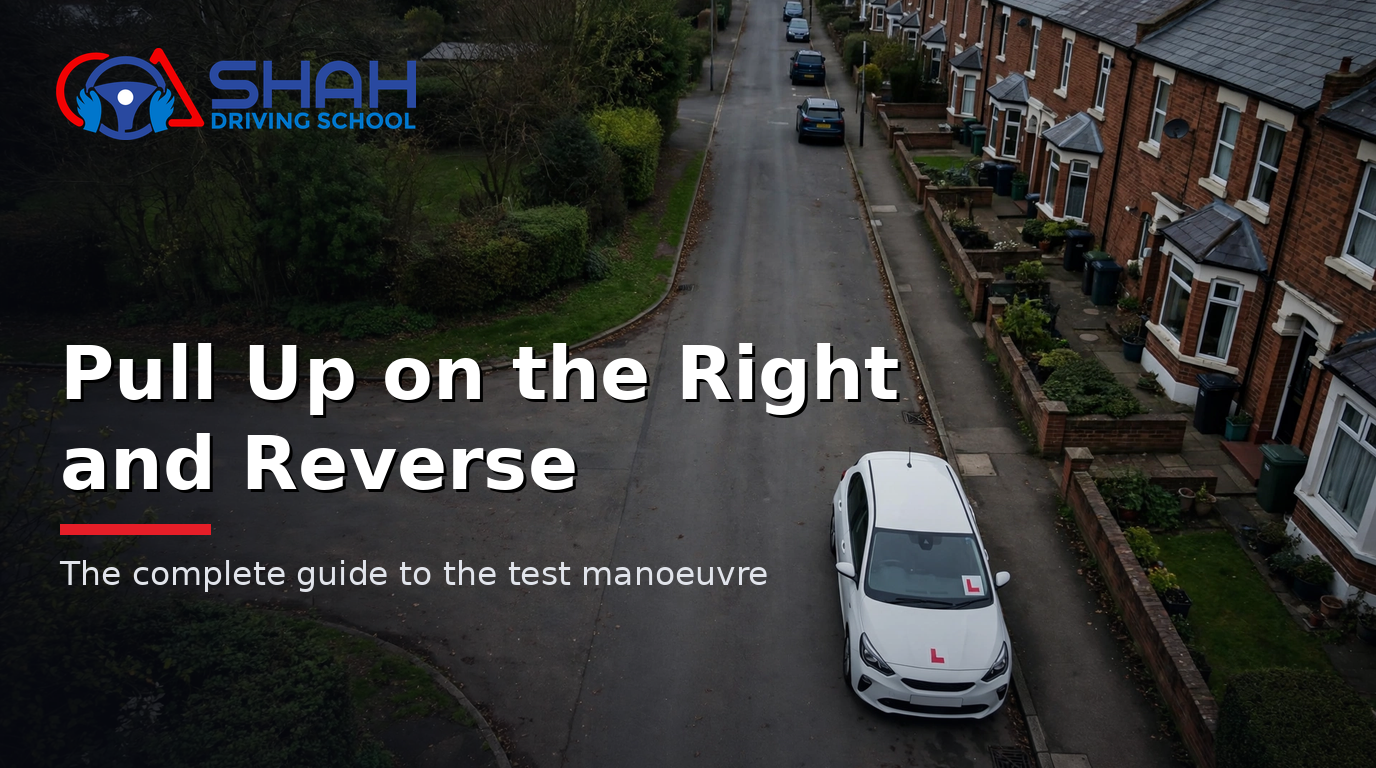

“Pull up on the right-hand side of the road.” When the examiner says those words, many learners freeze. Park on the wrong side? Facing the traffic? It feels like breaking every rule you have learned.
Pull up on the right and reverse is a set test manoeuvre, added to the UK driving test in December 2017. It has three clear parts: pull up on the right, reverse back about two car lengths, then rejoin the traffic. This guide breaks each part into simple steps. Our Bolton instructors practise it on quiet residential streets until it becomes routine.
The examiner is not testing strange parking. They are testing whether you can manage a car safely while it is temporarily on the “wrong” side of the road. That means three skills:
The official GOV.UK guide to the driving test lists this manoeuvre among those you could be asked to perform. The examiner chooses a suitable road — normally a quiet, straight residential street — and asks you to pull up on the right where it is safe. You pick the exact spot.
Your choice of spot decides how easy everything else becomes. Look for a clear, straight stretch with good views in both directions.
Avoid stopping:
A sensible spot also has room behind you. You will reverse about two car lengths, roughly eight to ten metres. Make sure that space is empty and stays legal. Choosing well is a skill examiners notice, just like choosing a good bay in forward bay parking.
The common fault here is rushing the crossing. Signal, check, pause, then move. That small pause proves you have genuinely judged the oncoming traffic.
The examiner will now ask you to reverse back for about two car lengths. Nobody measures with a tape. They want a sensible distance, in a straight line, close to the kerb.
Our instructors drill this slow, straight reverse during manual driving lessons because it also strengthens your general reversing control.
Rejoining is the part examiners watch most closely. You are moving off from the right side, facing the direction traffic comes from. Your view and your risks are different from a normal move-off.
The most common serious mistake in this whole manoeuvre is pulling away without a proper blind spot check. Turn your head. Examiners watch for that head movement, exactly as they do in an emergency stop recovery or any normal move-off.
Every fix is about routine, not talent. Practise the sequence until your checks happen automatically. The same discipline improved your hill start — slow, ordered steps beat rushed talent.
Rarely. In everyday driving, parking on the left is almost always safer and simpler. The Highway Code even requires you not to park at night facing against the traffic flow, unless you are in a recognised parking space.
So why does the test include it? Because life sometimes puts you on the right side briefly: turning around, avoiding an obstruction, or using a space on a one-way street. The DVSA wants proof that you can handle those moments with observation and control. Learn it for the test, respect it for life.
Examiners favour quiet residential roads with light traffic. Around Bolton, routes from the test centre pass plenty of wide, straight residential streets in areas like Great Lever and Halliwell. Your instructor will know the likely spots and practise them with you.
Practise at quiet times while learning. Never practise alone as a learner; a qualified supervisor must sit beside you. Short, regular practice on two or three streets builds the routine fast.
Both play a part. The examiner chooses the road and gives the instruction. You choose the exact stopping place, and that choice is part of what is being assessed.
Roughly eight to ten metres — about twice the length of a typical family car. Examiners judge a sensible distance, not a precise measurement.
No. It is one of the set manoeuvres, like reverse bay parking. Refusing or avoiding it would count against you. Good preparation removes the fear entirely.
Pause and let it pass if needed, keeping your car straight and controlled. Then re-check all around before continuing. The examiner wants safe decisions, not a non-stop performance.
During the day it is not automatically illegal, but it is discouraged because you face oncoming traffic. At night, the Highway Code says you must not park facing against the traffic flow unless in a recognised parking space. On your test, you perform this manoeuvre at the examiner’s request on a suitable road.
More questions? Read our frequently asked questions page.
Pull up on the right and reverse is the manoeuvre most learners avoid — which is exactly why it catches them out. Three parts, one calm routine: choose well, reverse straight, rejoin carefully.
Shah Driving School teaches manual and automatic lessons across Bolton, Horwich, Atherton and Farnworth. Our DVSA-approved instructors give every manoeuvre equal practice time, including this one. Book your lessons today, or explore our intensive driving courses if your test is near. Let’s make the “scary” manoeuvre your easiest one.
WhatsApp us