
Six names, one job: get people across the road safely. But the types of pedestrian crossings in the UK do not all work the same way. Some have lights, some do not. Some let cyclists ride across, some do not. One has a flashing amber phase that no other crossing uses, and one is built for horses.
Learn the visual giveaway for each crossing, and the driver rule follows. This guide covers all five formal types: zebra, pelican, puffin, toucan and pegasus. It also covers the newer parallel crossing, with the Highway Code rule for each.
|
Crossing |
Traffic lights? |
Push button? |
Cyclists? |
Horses? |
|---|---|---|---|---|
|
Zebra |
No |
No |
Should dismount |
No |
|
Pelican |
Yes |
Yes |
No |
No |
|
Puffin |
Yes |
Yes |
No |
No |
|
Toucan |
Yes |
Yes |
Ride across |
No |
|
Pegasus |
Yes |
Yes |
Yes |
Yes |
|
Parallel |
No |
No |
Ride across |
No |
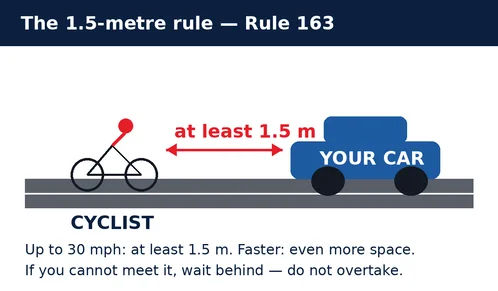
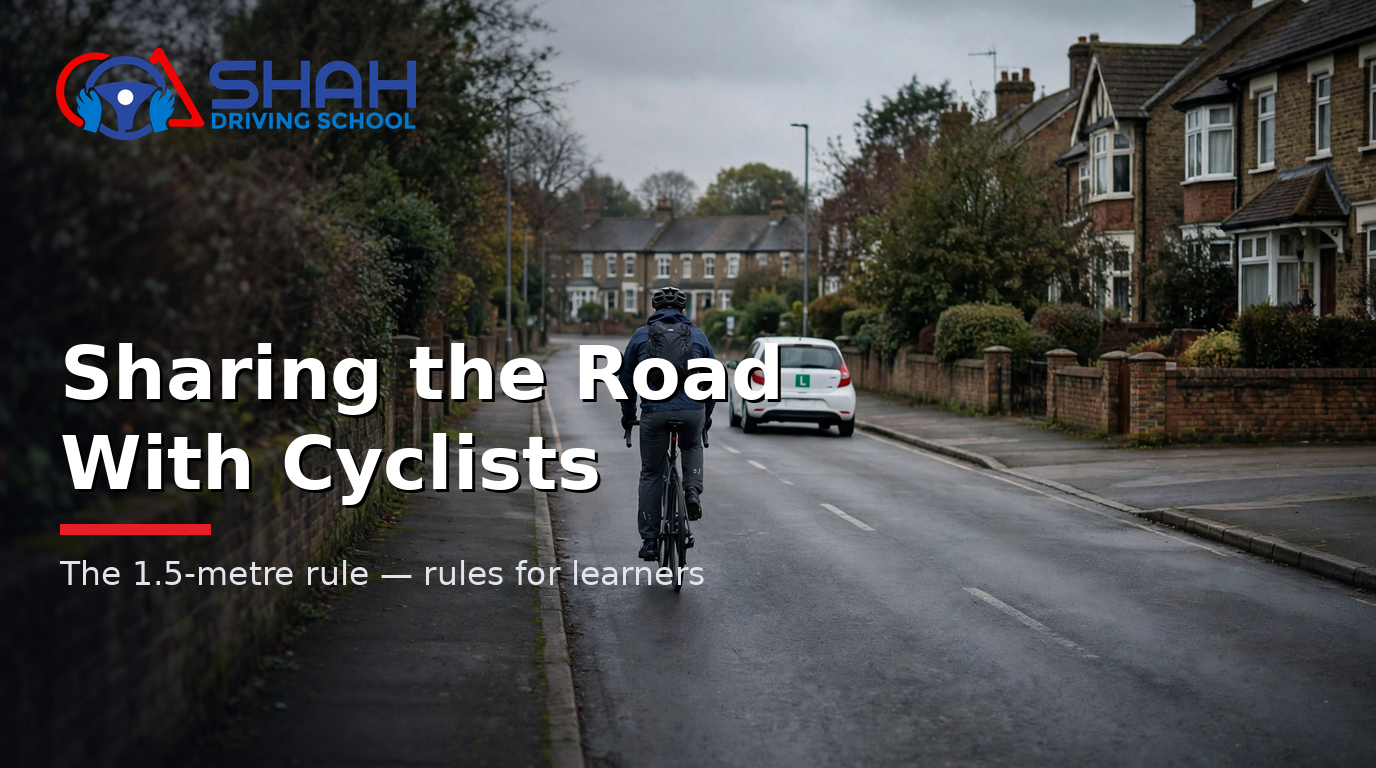
At least 1.5 metres up to 30 mph — more at higher speeds. If you cannot meet it, wait behind.
The zebra is the oldest and most recognisable crossing in the UK. How to spot it: black-and-white stripes across the road, flashing amber Belisha beacons on black-and-white poles at either side, and zig-zag lines on the approach. No traffic lights, no push button.
The driver rule comes from Rule 195, and it has two levels:
Allow more time for stopping on wet or icy roads — our stopping distances guide has the full figures. Do not wave, flash your lights or use your horn to invite pedestrians across, because it could be dangerous if another vehicle is approaching. Be patient, and do not sound your horn or rev your engine — it can be intimidating.
Two more zebra rules matter. A zebra crossing with a central island is two separate crossings, so you give way to each half separately. And Rule 191 says you must not park on a crossing or in the area covered by the zig-zag lines. You also must not overtake the vehicle nearest the crossing — whether it is moving, or has stopped to give way to pedestrians.
The pelican is the original light-controlled crossing. The name comes from PEdestrian LIght CONtrolled. It was introduced in Britain in 1969 and was the first pedestrian-operated traffic light crossing in the UK. How to spot it: traffic lights for drivers, a push button on each side, and the red and green man signals on the far side of the road.
The driver rule is in Rule 196. You MUST stop when the red light shows. After red comes a flashing amber — the pelican is the only crossing with this phase. When the amber light is flashing, you MUST give way to any pedestrians on the crossing. If the amber light is flashing and there are no pedestrians on the crossing, you may proceed with caution.
One detail catches learners out. A pelican crossing that goes straight across the road is one crossing, even when there is a central island. Rule 197 says you MUST wait for pedestrians crossing from the other side of the island. That is the opposite of the zebra rule, where an island splits the crossing in two.
Pelicans run on a fixed timer rather than sensors, so the crossing time cannot adjust to slower walkers. Many have been replaced by puffin crossings. Puffins are now the preferred type for new road schemes, but pelicans are still common, so you must still recognise them.
The puffin is the pelican’s smarter replacement. The name stands for Pedestrian User-Friendly INtelligent crossing. How to spot it: like a pelican, it has traffic lights and a push button — but the pedestrian signal is on the near side of the road, on the same side as the waiting pedestrian, instead of across the road.
The big difference is sensors. Puffin crossings use kerbside sensors to detect people waiting to cross, and on-crossing sensors to detect people still on the crossing. If someone is crossing slowly, the sensors hold the red light for drivers for longer. If a pedestrian presses the button and walks away, the sensors cancel the request so traffic is not held up for no reason.
The driver rule is in Rule 199. Toucan, puffin and equestrian crossings are similar to pelican crossings. But there is no flashing amber phase — the light sequence for traffic is the same as at traffic lights. Stop on red, go on green, and give way to anyone still crossing after the signal changes (Rule 198).
The toucan is named for a pun: “two can” cross — pedestrians and cyclists together. How to spot it: it looks like a pelican or puffin from a distance. But it has an additional signal for bikes — a green bike symbol alongside the green man. It is also wider, at around 4 metres, compared with around 2 metres for a pelican or puffin.
The key difference is for cyclists. Unlike zebra, pelican and puffin crossings, cyclists can legally ride across a toucan crossing without dismounting. Pedestrians and cyclists share the crossing area, and both wait for the green signal. As a driver, be aware that cyclists may cross at a higher speed than pedestrians — check both sides before you move off.
Toucan crossings are usually found where cycle routes meet roads, on the outskirts of parks and alongside cycle lanes. The driver rule is the same as for puffins: Rule 199, no flashing amber phase, stop on red. Our sharing the road with cyclists guide explains the wider rules for driving near cyclists.
The pegasus — called an equestrian crossing in the Highway Code — is the least common type on UK roads. It is like a toucan crossing, but built for horse riders as well as pedestrians and cyclists. How to spot it: a higher-placed control button that a rider can press without dismounting, alongside a normal-height panel for pedestrians, and usually fences or barriers nearby. Pegasus crossings are wider than pedestrian-only crossings, to keep vehicles further from horses.
Like puffin crossings, pegasus crossings can detect movement on the road and hold the signal longer, so horses and riders get enough time to cross. The driver rule is Rule 199 again: no flashing amber phase, the same light sequence as traffic lights, and never enter the crossing if you cannot clear it completely. You will most often find pegasus crossings near parks and bridleways.
The parallel crossing is the newest type. It looks like a zebra crossing, but with a cycle route alongside the black-and-white stripes — pedestrians on the stripes, cyclists on the cycle lane beside them. There are no traffic lights and no push button.
The driver rule is the same as for a zebra, extended to cyclists. Rule 195 says to look out for pedestrians or cyclists waiting to cross, and to slow down or stop. Give way to those waiting. You MUST give way when a pedestrian or cyclist has moved onto the crossing. The same warnings apply: do not wave, flash or sound your horn to invite anyone across, and be patient. A parallel crossing with a central island is two separate crossings, just like a zebra.
Not a crossing type as such, but every learner meets one: the lollipop person. A school crossing patrol officer steps into the road with a “Stop for children” sign, usually near a school at drop-off and pick-up times. Rule 210 says you MUST stop when the patrol shows the sign. It is a criminal offence not to stop, and the RAC notes it can mean a £1,000 fine, three penalty points or even disqualification. Wait until all pedestrians are safely across and back on the pavement before you move off.
Crossings are a regular test topic, and the faults are almost always the same:
The habit that passes the test is simple: slow early, look both ways, and wait until the crossing is fully clear. If you are a new driver, read our first solo drive tips — crossings are one of the everyday situations that guide helps you handle.
Toucan crossings and parallel crossings. On a zebra, pelican or puffin crossing, cyclists should dismount. Pegasus crossings can also be used by cyclists, alongside horse riders and pedestrians.
Three things. The pedestrian lights are on the far side at a pelican and the near side at a puffin. The pelican has a flashing amber phase for drivers and the puffin does not. And the puffin uses sensors to extend the red light for slow crossers, while the pelican runs on a fixed timer.
You should give way to pedestrians waiting to cross, and you must give way once they have moved onto the crossing. In practice, slow down and be ready to stop for anyone waiting — it is what examiners expect.
No. You must not overtake the moving vehicle nearest the crossing, or the vehicle nearest the crossing that has stopped to give way to pedestrians (Rule 191).
A zebra-style crossing with a cycle route alongside the stripes. Pedestrians use the stripes, cyclists ride across on the cycle lane, and drivers give way to both — the same rules as a zebra, under Rule 195.
More questions? Read our frequently asked questions page.
Zebra, pelican, puffin, toucan, pegasus, parallel — six names, but only two ideas to remember. At crossings without lights, you give way. At crossings with lights, you stop on red and wait for the crossing to clear. Learn the visual giveaway for each, and you will never have to guess.
If you are learning to drive in Bolton or Atherton, we will take you through every crossing type on real roads. Zebra crossings near schools, signal-controlled crossings in the town centre, and the routes to the Bolton test centre on Weston Street. Book manual driving lessons with Shah Driving School. Call us on 0749 0662 777, or visit our contact page to book your first lesson. The crossing is not a delay. It is the whole point of the road.
Highway Code rules: Using the road, Rules 159 to 203 (GOV.UK) — Rules 191–199; Road users requiring extra care, Rules 204 to 225 (GOV.UK) — Rule 210. Crossing types and features: RAC — Road crossings explained.y
WhatsApp us