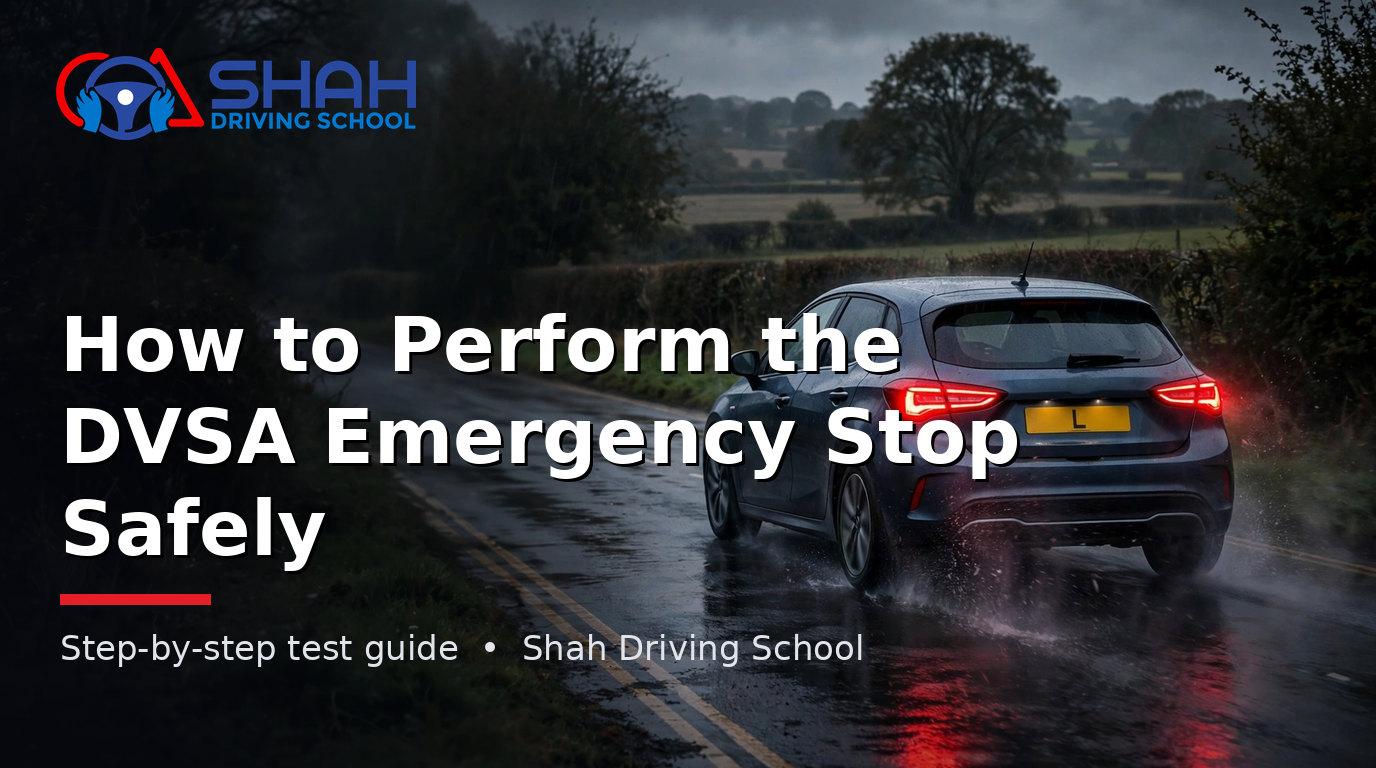
Few moments in a driving test raise the heart rate like the words “emergency stop.” One second you are driving normally, the next the examiner raises a hand and says “Stop” — and you need to bring the car to a halt quickly, smoothly and under complete control. Learning how to perform the DVSA emergency stop safely is not just about passing your test; it is one of the most valuable real-world skills you will ever learn as a driver.
In this guide, the instructors at Shah Driving School walk you through exactly what the examiner expects, the step-by-step technique, the mistakes that cost learners marks, and how to practise until the whole thing feels natural.
What Is the DVSA Emergency Stop?
The emergency stop is a controlled manoeuvre that simulates a real-life hazard — a child running into the road, a car pulling out suddenly, or an animal appearing from nowhere. The examiner wants to see that you can stop the car as quickly as possible while keeping full control of it.
It is worth knowing that you will not necessarily be asked to do one. Under current DVSA examiner guidance, the emergency stop is carried out on roughly one in seven tests, chosen at random. It can happen at any point during the test where road and traffic conditions are suitable — so the best approach is to be ready for it from the moment you pull away from the test centre.
When Will the Examiner Ask You to Do an Emergency Stop?
Here is exactly how it unfolds on the day, based on official DVSA examiner guidance:
- The examiner will first ask you to pull up on the left in a safe place.
- While the car is stationary, they will explain that shortly they will ask you to carry out an emergency stop.
- They will demonstrate the signal: they raise their right hand to face level and say “Stop!” at the same time.
- You will then be asked to drive on normally.
- Before giving the signal, the examiner will look behind to check it is safe — but you must wait for the actual signal and not stop early just because you see them check their mirror.
- When you hear “Stop!” and see the raised hand, you brake immediately.
That mirror check by the examiner is your only warning. Stay alert, keep a safe speed, and keep your feet in a ready position once you know the exercise is coming.
How to Perform the DVSA Emergency Stop Safely: Step by Step
Step 1: React to the Signal — Don’t Hesitate
The moment you hear “Stop!” and see the raised hand, start braking. A delayed reaction adds precious metres to your stopping distance. This is a reaction exercise as much as a braking one, so commit to the stop decisively. DVSA examiner guidance: official test wording, including the emergency stop
Step 2: Brake Firmly and Progressively
Press the brake pedal firmly and progressively — hard enough to stop quickly, but avoid stamping on it so violently that the wheels lock. Most modern training cars are fitted with ABS (anti-lock braking system), which prevents the wheels from locking and lets you keep steering while braking hard. If you feel the brake pedal pulsing under your foot, that is the ABS working — keep your foot planted and do not lift off.
Step 3: Press the Clutch Down Just Before You Stop
Just after you begin braking, press the clutch pedal fully down. This stops the engine from stalling and means you are ready to move off again promptly. Timing matters here: clutch down too early and you lose engine braking; too late and the car may stall. Your instructor will help you find the sweet spot for the car you are learning in — it varies slightly from car to car.
Step 4: Keep Both Hands on the Wheel and Steer Straight
Keep both hands firmly on the steering wheel and the car travelling in a straight line. Do not yank the wheel or try to swerve. The examiner is watching for control, and a straight, stable stop is exactly what control looks like. If the car begins to skid, ease off the brake slightly, steer gently in the direction of the skid, and reapply the brake once you have grip again.
Step 5: Secure the Car — Handbrake On, Neutral Selected
Once the car has completely stopped, apply the handbrake straight away and select neutral. This shows the examiner the manoeuvre is finished and keeps the car secure. Take a breath — the hard part is over.
Step 6: Observe All Around, Then Move Off Safely
Before moving off, carry out full observations — mirrors and blind spots — exactly as you would for any other move-off. When the road is clear, select first gear, signal if anyone would benefit, release the handbrake and drive on calmly. Rushing this final step is a common way to pick up a fault after an otherwise perfect stop.
Common Mistakes That Cost Learners Marks
Even confident learners slip up on the emergency stop. Watch out for these:
- Checking mirrors before braking. In normal driving, mirror checks come first — but in a genuine emergency, braking comes first. The examiner has already checked behind; your job is to stop.
- Pressing the clutch too early. This disconnects the engine and lengthens your stopping distance. Brake first, then clutch.
- Locking the wheels. Stamping the brake in a non-ABS car causes a skid. Firm, progressive pressure is the skill being tested.
- Releasing the brake too soon. Keep braking until the car has fully stopped, then secure it.
- Forgetting observations before moving off. The manoeuvre is not finished until you have rejoined traffic safely.
- Panicking after a stall. If you do stall, it is not the end of the world — restart the engine calmly once stopped and carry on. Staying composed impresses examiners.
Emergency Stop in a Manual vs an Automatic Car
The technique is nearly identical, with one simplification in an automatic: there is no clutch pedal to worry about, so you just brake firmly and keep the car in Drive with your foot on the brake once stopped. Many learners find the emergency stop easier in an automatic for exactly this reason.
If you are still deciding which to learn in, our manual driving lessons give you full licence flexibility, while automatic driving lessons let you focus purely on road skills without gear changes. Both are taught in dual-controlled cars by DVSA-approved instructors across Bolton and Atherton.
How to Practise the Emergency Stop Before Your Test
Reading about the technique is only half the job — your body needs to rehearse it until it is automatic:
- Practise with your instructor first. Your instructor will start you at low speeds on a quiet road and build up gradually. Never practise emergency stops on your own or on public roads without proper supervision.
- Rehearse in different conditions. Wet roads dramatically increase stopping distances. If you get the chance to practise in light rain with your instructor, take it.
- Narrate it to yourself. Talking through “signal — brake — clutch — secure — observe — move off” cements the sequence in your memory.
- Book a mock test. A mock test under test conditions is the best way to experience the surprise element. Ask your instructor about focused intensive driving courses if your test date is approaching.
- Revise the theory. Stopping distances and ABS questions appear in the theory test too — our driving theory test preparation can help.
Learners at Shah Driving School practise the emergency stop as a standard part of their syllabus, so by test day it feels like just another exercise.
FAQs: DVSA Emergency Stop
Will I definitely be asked to do an emergency stop on my test?
No. It is carried out on roughly one in seven tests, chosen at random. But you should prepare as if it will happen, because you will not know in advance.
What exactly does the examiner do?
They pull you over, explain the exercise, demonstrate the signal (raised right hand plus the word “Stop!”), check behind for safety, then give the signal while you are driving normally.
Should I check my mirrors before braking?
No — not for this exercise. The examiner checks behind before giving the signal. Your priority is to stop as quickly and safely as possible.
What if I stall the car?
Stay calm. Apply the handbrake, restart the engine once stopped, and continue. A stall alone is not an automatic fail — panicking or rolling back is what causes problems.
Does the emergency stop count as a manoeuvre?
It is recorded separately from the reversing manoeuvres. The examiner assesses your control, reaction and observations throughout.
Have more questions? See our frequently asked questions page or get in touch.
Ready to Feel Confident Behind the Wheel?
The emergency stop is one of those skills that feels daunting until you have done it a few times — then it becomes second nature. With structured, patient tuition from DVSA-approved instructors, you will master it along with every other part of the test syllabus.
Shah Driving School offers manual and automatic lessons, intensive courses and test preparation across Bolton, Atherton, Horwich, Farnworth, Lostock and surrounding areas. Book your driving lessons today, or explore our driving lessons in Bolton to find the right course for you. Let’s get you test-ready — safely.