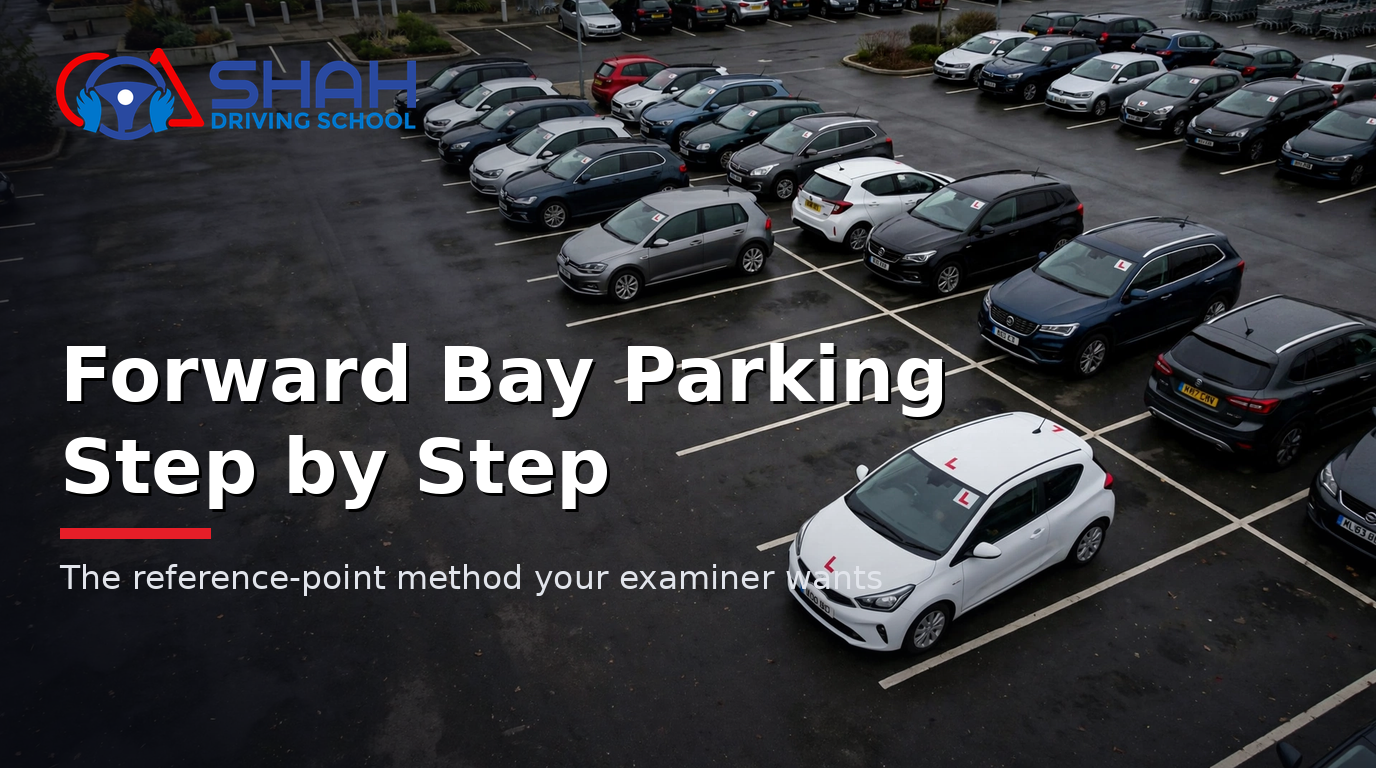
You are driving through a busy car park. The examiner says: “Drive forward into a convenient bay.” Your heart speeds up. Which bay? When do you turn? How do you finish straight?
Forward bay parking looks simple, and it honestly is, once you own a method. This guide gives you that method step by step: choosing the bay, the reference point, the full-lock turn, and the careful reverse out. Our Bolton instructors teach it exactly like this, in real car parks, until it feels boring. Boring is good. Boring passes tests.
Forward Bay Parking on Your Driving Test
Bay parking is one of the manoeuvres your examiner can choose on the day. The official GOV.UK guide to the test confirms the examiner will ask for one reversing manoeuvre during your drive. For bay parking, the examiner decides which version you get:
- Forward bay park: drive forward into a bay, then reverse out.
- Reverse bay park: reverse into a bay, then drive out.
You will not know which one is coming, so learn both. Our guide to reverse bay parking covers the other version in the same step-by-step style.
The examiner marks three things throughout: control of the car, accuracy inside the lines, and observation all around. The method below is built to satisfy all three.
Before You Turn: Choose Your Bay and Set Your Position
Good parking starts before any steering happens.
Pick an easy bay. Choose one with empty bays beside it if you can. Avoid bays next to badly parked cars, pillars or trolley shelters. A bay further away is always easier than a tight one near the entrance.
Create turning room. Position your car on the opposite side of the aisle from your bay. Parking on the right? Stay left. Parking on the left? Stay right. That wide starting position produces a gentle, controlled arc instead of a desperate swerve.
Slow right down. Crawl in first gear, or ease off the brake in an automatic. Walking pace is fast enough. Speed is the enemy of accuracy in every manoeuvre.
How to Do a Forward Bay Park: Step by Step
- Check and signal. Look in your mirrors and check your blind spot. Signal towards your bay so other drivers understand your plan.
- Reach the reference point. Keep crawling until the first white line of your bay sits level with your door mirror on that side. This is the point of turn for most cars. Your instructor will fine-tune it for your lesson car during manual driving lessons.
- Check again, all around. A fresh look for pedestrians and moving cars. Car parks hide children behind parked vehicles, so treat this check seriously.
- Steer full lock, quickly. Turn the wheel fully towards the bay while the car creeps forward. Fast hands, slow car. That combination is the whole trick.
- Watch the car swing in. Glance at both mirrors as the nose enters the bay. You are aiming for the centre of the space.
- Straighten up. As the car lines up with the bay, unwind the steering smoothly. The wheels should point straight for the final few metres.
- Finish fully inside. Drive forward until the whole car sits within the white lines. Stop, apply the handbrake, and select neutral or Park.
Do not obsess over perfection mid-turn. Small corrections are allowed, and the next section shows you how to fix a wonky finish calmly.
What a Good Finish Looks Like
Your car should sit centred between the two side lines, roughly parallel to them. A small gap on each side is ideal. Being slightly off-centre is fine. Touching or crossing a line is not.
Check your mirrors before you switch off. You can judge both side gaps from the mirrors in most cars. If one mirror shows the line disappearing under your car, you are over it.
Remember, the examiner wants safe and legal, not geometrically perfect. A tidy, well-observed park with a small correction beats a panicked one-shot attempt every time.
Reversing Out: The Half Most Learners Forget
The manoeuvre is only half done. After a forward bay park, you must reverse out, and this half carries real risk. Your view is blocked by the cars beside you.
- Prepare. Select reverse gear. The reversing lights warn everyone behind you.
- Observe everywhere. Check mirrors, then look over both shoulders. Pedestrians with trolleys appear from nowhere in car parks.
- Reverse straight first. Creep backwards in a straight line until your mirrors clear the cars beside you. Now you can finally see across the aisle.
- Keep looking around. Alternate your glances: behind, sides, behind again. Never stare at one mirror for the whole reverse.
- Steer out late. Once well clear, steer towards your exit direction. Straighten up in the aisle.
- Move off properly. Select first gear or Drive, check mirrors and blind spot, signal if needed, and drive away.
Treat the reverse out with the same respect as an emergency stop deserves: slow, deliberate and fully observed. Most car park bumps in Britain happen at exactly this moment, at walking pace.
Gone Wrong? How to Correct Your Position
Maybe you turned too early and you are heading for a line. Stay calm. Corrections are permitted on the test, and handling one well can even impress the examiner.
Stop before you cross the line fully. Check all around. Reverse slowly back out into the aisle, straightening as you go. Then drive in again with a small steering adjustment. One clean correction is a sign of a thinking driver.
What you must not do is mount a kerb, hit a line at speed, or keep shuffling without looking around. Every movement, forward or back, needs fresh observation. That habit protects you far beyond test day.
Common Forward Bay Parking Mistakes
Our instructors correct the same five faults every week in automatic driving lessons and manual lessons alike:
- Turning too late. A late turn cuts the corner and sends you across the far line. Trust your reference point.
- Starting too close to the bay. No turning room means an impossible angle. Set up wide, every time.
- Steering slowly at speed. Fast steering with a slow car works. Slow steering with a fast car never does.
- Forgetting the blind spot checks. Examiners mark observation heavily in car parks. Look like you mean it.
- Rushing the reverse out. The aisle behind you is a live road. Treat it like one.
Notice the pattern: every mistake involves hurry. Slow down, and most faults simply vanish. The same patience protects your stopping distances on faster roads.
Where to Practise Forward Bay Parking Around Bolton
Quiet car parks make perfect classrooms with your instructor. Start when the car park is nearly empty, early morning or later in the evening.
The huge car parks at Middlebrook Retail Park in Horwich give you endless bays and wide aisles. Supermarket car parks across Bolton and Farnworth work well at quiet times too. Build up from empty rows to busier ones as your confidence grows.
Never practise alone as a learner; a qualified supervisor must sit beside you. Your instructor will also know which car parks local examiners favour on test routes.
FAQs About Forward Bay Parking
Can I choose which bay to park in on my test?
Yes. The examiner asks you to drive into a convenient bay, and you pick it. Choose one with space around it. That choice itself shows good judgement.
What if I end up on the line?
Correct it. Stop, observe all around, reverse out carefully and drive back in straighter. A corrected park is far better than a straddled finish.
Is forward or reverse bay parking easier?
Most learners find forward parking easier to enter. Reversing out afterwards is its hidden cost. Reverse parking enters harder but leaves you facing out, which many drivers prefer in real life. Learn both well.
Do I need to signal when parking in a bay?
A signal helps other road users understand your intention, especially in busy car parks. Signal towards the bay as you approach your reference point.
How close to the front of the bay should I stop?
Drive fully in, so your whole car sits inside the lines with the rear clear of the aisle. Stop before any kerb or barrier ahead. A balanced finish leaves a small, even margin.
More questions? Read our frequently asked questions page.
Park With Confidence, Every Time
Forward bay parking is a formula: wide setup, trusted reference point, fast steering, slow car. Then reverse out like the aisle is a main road, because it behaves like one.
Shah Driving School teaches manual and automatic lessons across Bolton, Horwich, Atherton and Farnworth. Our DVSA-approved instructors turn manoeuvre nerves into calm routines. Book your lessons today, or explore our intensive driving courses if your test date is close. Let’s make parking the easiest part of your test.