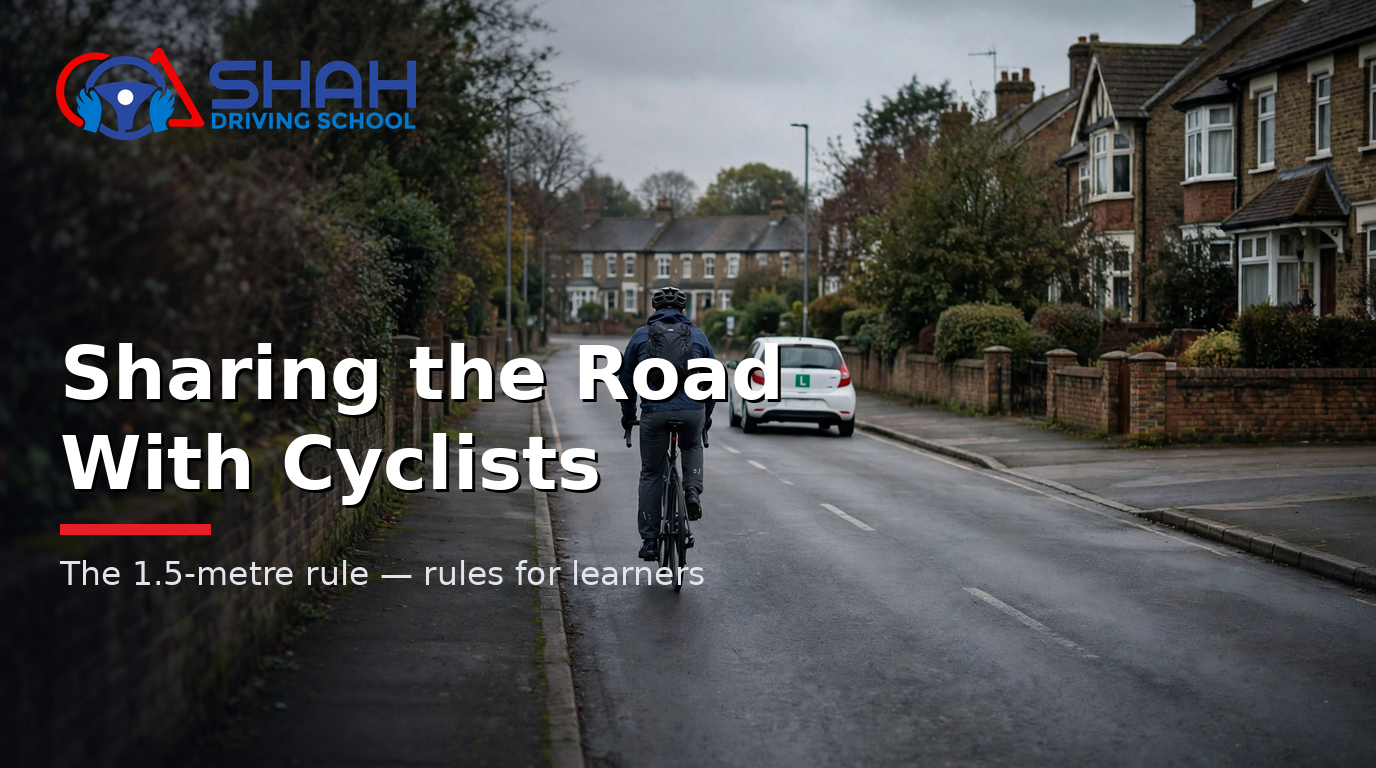

Sharing the Road With Cyclists: Cyclists are the road users learners misjudge most. They are smaller than a car, quieter than a car, and faster than most new drivers expect. They appear in your blind spot, they ride in the middle of the lane, and they swerve without warning for a drain cover you never saw.
One number decides the overtake: 1.5 metres. If you cannot leave that much room, you do not overtake. This guide explains the 1.5-metre rule, why cyclists ride where they ride, what to do at junctions, and what your examiner watches.
Highway Code Rule 163 says you should give motorcyclists, cyclists, horse riders and horse-drawn vehicles at least as much room as you would when overtaking a car. As a guide:
That last point is the one most drivers get wrong. If the road is too narrow for 1.5 metres, the answer is not to squeeze past. The answer is to wait. A few seconds behind a cyclist costs nothing. A close pass can cost a life.
The 30 mph threshold matters because most town driving happens at or below it. Our speed limits guide explains the limits in full, and our dual carriageway guide covers the faster roads where you need to give cyclists even more space. The gap is your thinking and stopping time — our stopping distances guide has the full table.
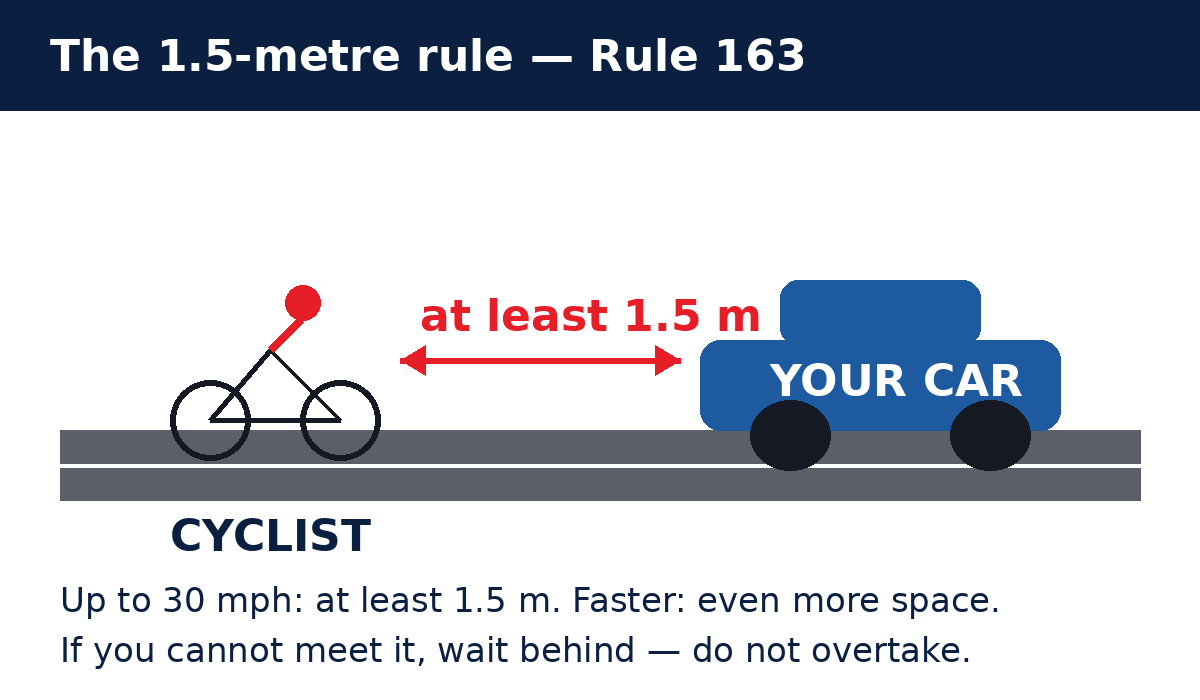
At least 1.5 metres up to 30 mph — more at higher speeds. If you cannot meet it, wait behind.
New drivers often ask why a cyclist is riding in the centre of the lane when there is room at the side. The answer is in Rule 213, and it is about safety — theirs.
On narrow sections of road, on quiet roads or streets, at road junctions and in slower-moving traffic, cyclists may ride in the centre of the lane, rather than towards the side of the road. It can be safer for groups of cyclists to ride two abreast in these situations. The Highway Code says to allow them to do so for their own safety, so they can see and be seen.
There are two more reasons a cyclist’s position might surprise you:
One more signal to learn: if the rider looks over their shoulder, it could mean they intend to pull out, turn right or change direction. Rule 212 says to give them time and space to do so. A shoulder check is a cyclist’s indicator.
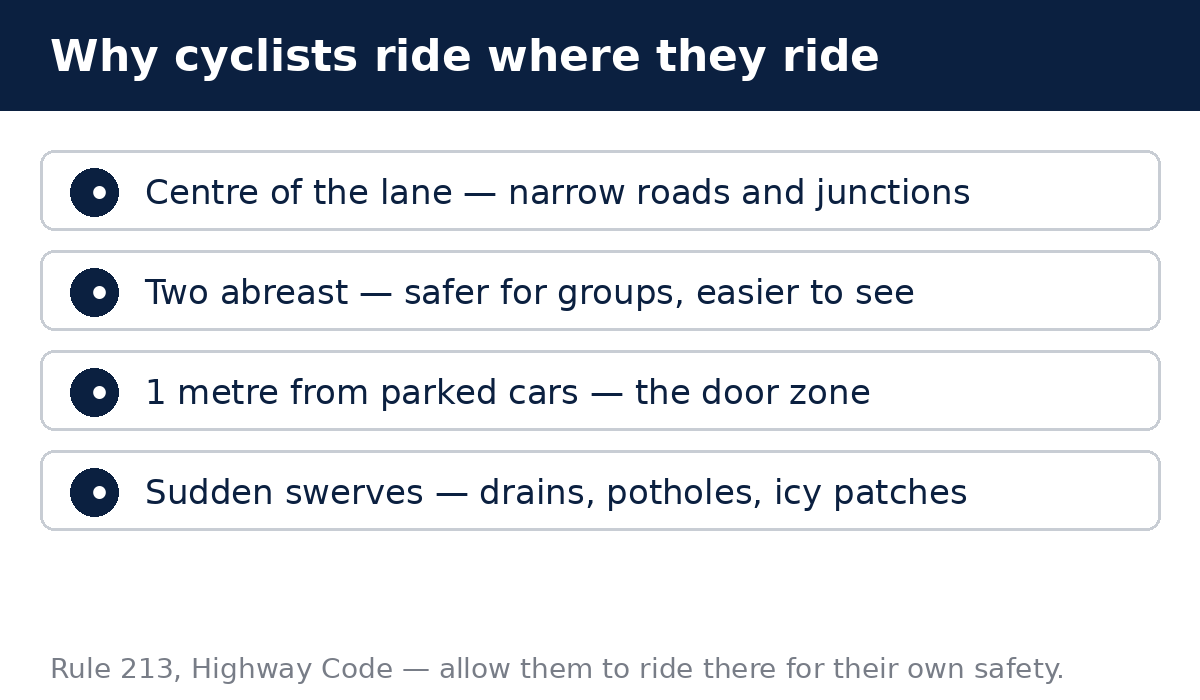
Centre of the lane, two abreast, the door zone — all for the cyclist’s safety.
Junctions are where most cyclist collisions happen, and the rule is simple: do not cut across a cyclist going ahead.
Rule H3 says you should not cut across cyclists, horse riders or horse-drawn vehicles going ahead when you are turning into or out of a junction, or changing direction or lane — just as you would not turn across the path of another motor vehicle. This applies whether they are using a cycle lane, a cycle track, or riding ahead on the road, and you should give way to them. Do not turn at a junction if doing so would cause the cyclist going straight ahead to stop or swerve. You should stop and wait for a safe gap in the flow of cyclists if necessary.
Rule 211 adds the detail. It is often difficult to see cyclists, especially when they are waiting alongside you, coming up from behind, coming out of or moving off from junctions, at roundabouts, overtaking you, or filtering through traffic. Always look out for them before you emerge from a junction — they could be approaching faster than you think. And when you turn right across a line of slow-moving or stationary traffic, look out for and give way to cyclists on the inside of the traffic you are crossing.
The left-turn trap is the one to learn by heart. Rule 167 says to stay behind if you are following a cyclist approaching a roundabout or junction and you intend to turn left. Do not cut across cyclists going ahead, including those using cycle lanes and cycle tracks. If you overtake a cyclist and then immediately turn left across their path, you have created the exact situation the rule exists to prevent.
At traffic lights, watch for advanced stop lines — the bike box. Rule 178 says motorists must stop at the first white line if the lights are amber or red, and should avoid blocking the marked area at other times. If you have already crossed the first white line when the signal goes red, stop as soon as possible and stop at the second white line. When the green signal shows, allow cyclists — including any moving or waiting alongside you — enough time and space to move off.
Cycle lanes are shown by road markings and signs, and the line type matters:
You should give way to any cyclists in a cycle lane, including when they are approaching from behind you. Do not cut across them when you are turning or changing lane. Be prepared to stop and wait for a safe gap in the flow of cyclists before crossing the cycle lane.
Cycle tracks — routes physically protected or away from motor traffic — work the same way. Give way to cyclists approaching or using the track when you are turning into or out of a junction, and be prepared to stop and wait. A cycle track may be used by cyclists travelling in both directions, so check both ways.
And one fact that surprises many drivers: cyclists are not obliged to use cycle lanes or cycle tracks. A cyclist on the road beside an empty cycle lane is not breaking the rules. They may be avoiding parked cars in the lane, a poor surface, or a lane that ends suddenly. Do not sound your horn at them. Give them the same 1.5 metres you would anywhere else.
Your examiner watches how you treat cyclists throughout the test. The faults that matter most are:
A close pass that makes a cyclist change speed or direction can be a serious fault — a fail. A close pass that causes actual danger can be a dangerous fault. The examiner also watches whether you remain behind cyclists at junctions, even if they are waiting to turn and positioned close to the kerb.
The habit that passes the test is the same habit that keeps cyclists safe: wait when you cannot give 1.5 metres, never cut across, and always look before you turn. If you are a new driver, read our first solo drive tips — sharing the road with cyclists is one of the skills that guide helps you build.
At least 1.5 metres at speeds of up to 30 mph, and more space at higher speeds. In bad weather or at night, give even more. If you cannot meet the clearance, wait behind.
Because it is safer for them. On narrow roads, at junctions and in slow traffic, cyclists may ride in the centre of the lane so they can see and be seen. Groups may ride two abreast for the same reason.
No. Do not overtake where you might come into conflict with other road users, including approaching or at a junction. Stay behind the cyclist and wait.
Wait behind the cyclist until you can. Do not squeeze past, and do not overtake into oncoming traffic. The delay is seconds; the risk is not worth it.
No. Cyclists are not obliged to use cycle lanes or cycle tracks. If a cyclist is on the road beside a cycle lane, give them the same 1.5 metres you would anywhere else.
More questions? Read our frequently asked questions page.
Sharing the road with cyclists comes down to three habits: 1.5 metres, never cut across, and wait when you cannot give the room. Learn them now, and they will be automatic by the time you pass your test.
If you are learning to drive in Bolton or Atherton, we will teach you to share the road on real streets, with real cyclists — in the town centre, on residential roads, and on the routes to the Bolton test centre on Weston Street. Book manual driving lessons with Shah Driving School. Call us on 0749 0662 777, or visit our contact page to book your first lesson. A cyclist is not an obstacle. They are a person, with no metal around them.
Highway Code rules: Using the road, Rules 159 to 203 (GOV.UK) — Rules 163, 167, 170, 178; Road users requiring extra care, Rules 204 to 225 (GOV.UK) — Rules 211–213; Introduction (GOV.UK) — Rule H3 and the hierarchy of road users; General rules, techniques and advice, Rules 103 to 158 (GOV.UK) — Rule 140.
WhatsApp us