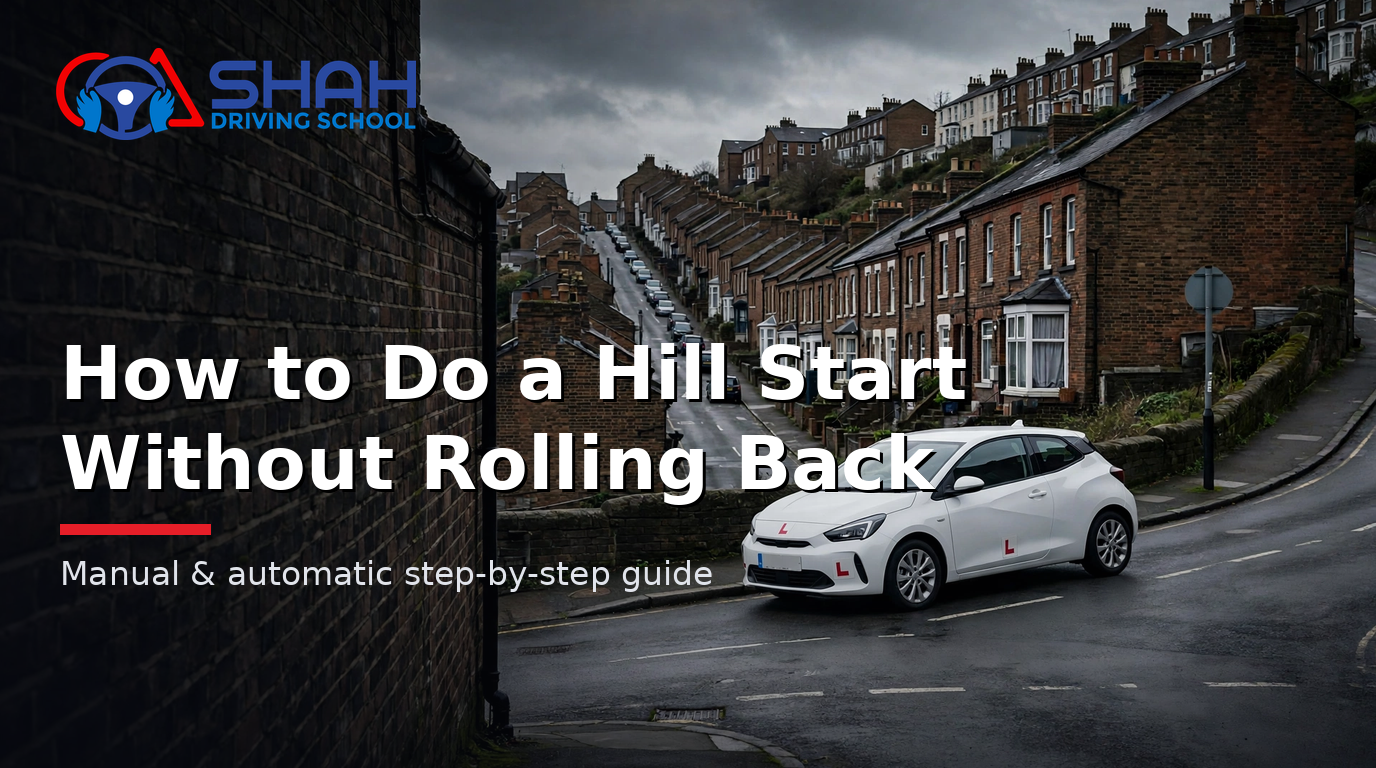
Every learner remembers their first steep hill. You stop at the top. A car waits behind you. Your heart beats faster. Then the light changes, and one question fills your mind: will I roll back?
Learning how to do a hill start without rolling back removes that fear completely. The skill is not about strength or speed. It is about sequence. Get the order right, and the car simply drives forward. This guide explains the full method for manual and automatic cars. Our Bolton instructors teach it exactly this way, step by step.
Why Cars Roll Back on Hills
Gravity explains everything here. On a slope, gravity pulls your car backwards the moment nothing holds it. On flat roads, the engine and brakes hide this force. On a hill, you feel it instantly.
A manual car rolls back for one main reason. The driver releases the handbrake before the clutch reaches its biting point. At that moment, no power reaches the wheels. The brake is off. Gravity wins.
Stalling has the opposite cause. The driver lifts the clutch too fast, or adds too little power. The engine cannot pull the car’s weight uphill, so it cuts out. Both problems share one cure: patient clutch control and the handbrake method below.
What the Examiner Wants to See on Your Test
The hill start is a named exercise in the UK driving test. The official DVSA examiner guidance lists it among the set stops, often worded as a “hill start” or “designated stop”. The examiner may ask you to pull up on a gradient, then move off again.
The examiner watches three things:
- Control. The car must not roll back noticeably.
- Observation. You must check mirrors and blind spots before moving.
- Composure. A calm restart after a stall impresses far more than panic.
Rolling back towards another road user can be marked as a serious fault. So master this skill early. It protects your test result and your confidence.
How to Do a Hill Start in a Manual Car: Step by Step
Use this handbrake method every time. It works on gentle slopes and steep hills alike.
- Stop with the handbrake firmly on. Pull it up properly. Select neutral if you will wait a while, or keep first gear ready for a short stop.
- Prepare to move. Press the clutch down and select first gear. Keep the handbrake on.
- Set the gas. Press the accelerator gently. Aim for roughly 1,500 to 2,000 revs in a petrol car. Steeper hills need slightly more.
- Find the biting point. Raise the clutch slowly. The car’s nose dips slightly. The engine note drops. You feel the car strain gently against the handbrake. Stop raising the clutch right there. Hold it still.
- Check all around. Look in your mirrors. Check your blind spot. Signal if another road user would benefit.
- Release the handbrake. Let it down smoothly while holding the clutch steady. The car should stay still or creep forward, never backwards.
- Move away. Add a little more gas. Ease the clutch up gradually. Steer straight, build speed, and continue as normal.
That pause at the biting point is the whole secret. Rush it, and you roll or stall. Nail it, and hill starts feel easy. Our guide to clutch bite point training in Bolton explains how to find that point faster.
How to Do a Hill Start in an Automatic Car
Automatic drivers have a simpler job. The car does the clutch work for you.
- Stop with the footbrake. Keep the car in Drive.
- Apply the handbrake for longer waits or steep slopes.
- When ready, check mirrors and blind spots.
- Release the handbrake if you used it.
- Move your right foot from the brake to the accelerator.
- Press the gas gently and smoothly. The car pulls forward.
Most automatics also creep forward slightly on their own. Many have hill hold systems too. Still, move your foot with purpose. A slow swap on a steep hill can allow a small roll. Our automatic driving lessons build this timing into your routine from lesson one.
Hill Start Assist: Helpful, but Never Rely on It
Many modern cars include hill start assist. The system holds the brakes for about two or three seconds after you release the pedal. That pause gives your feet time to swap pedals calmly.
Use it as a safety net, not a technique. Systems vary between cars. Some switch off in certain modes. Older cars lack it completely. Your test car might differ from your lesson car.
Learn the proper handbrake method first. Then treat assist as a bonus. Examiners reward real control, and real control travels with you into any car.
Common Hill Start Mistakes (and How to Fix Them)
Our instructors correct the same five errors every week:
- Releasing the handbrake too early. Fix: always confirm the biting point first. Feel the strain, then release.
- Lifting the clutch too quickly. Fix: raise it in two stages. Reach the bite, pause, then rise slowly as you move.
- Using too little gas. Fix: set the revs before you move the clutch. Steeper hill, slightly more revs.
- Watching only the road ahead. Fix: complete your mirror and blind spot checks before releasing the handbrake.
- Panicking after a stall. Fix: footbrake on, handbrake on, breathe, restart. A stall alone rarely fails anyone. Panic causes the next fault.
Each fix is small. Together, they transform the manoeuvre. Learners in our manual driving lessons practise these corrections on real Bolton gradients.
If You Start Rolling Back, Do This
Stay calm and act in this order:
- Press the footbrake firmly.
- Press the clutch down fully.
- Apply the handbrake.
- Take a breath. Check behind you.
- Restart the full routine from step one.
Never chase the roll with random pedal presses. Stop the car first. Then rebuild the start properly. The Highway Code’s rules on moving off safely stress control and observation at exactly this moment.
Where to Practise Hill Starts Around Bolton
Build up gradually with your instructor. Start on a gentle, quiet slope. Master the sequence there. Then move to steeper streets.
Our local area offers perfect training ground. The climb up Chorley Old Road towards Rivington tests your skills properly. Quiet residential streets in Smithills include useful gradients. Horwich has plenty of sloping side roads near the town centre. We cover these spots in our driving lessons in Horwich and across Bolton.
Practise at quiet times first. Avoid rush hour until the routine feels automatic. Never practise alone as a learner; UK law requires a qualified supervisor beside you.
FAQs About Hill Starts
Can you fail your driving test for rolling back on a hill start?
Yes, possibly. A small roll on an empty road may earn only a driving fault. Rolling back into the path of another vehicle or pedestrian can be a serious fault. Control and awareness keep you safe.
What revs should I use for a hill start?
In most petrol cars, around 1,500 to 2,000 rpm works well. Diesels usually need less. Steeper hills need a little more. Your instructor will calibrate this for your lesson car.
Should I use the handbrake or just the footbrake?
Use the handbrake method, especially while learning. It frees your right foot to set the gas early. That order prevents both rolling and stalling.
Do automatic cars roll back on hills?
They can roll slightly on steep slopes if you swap pedals slowly. Hill hold systems prevent most rolling. A firm handbrake habit removes the risk entirely.
How long does it take to learn hill starts?
Most learners feel comfortable within a few focused lessons. Short, repeated practice beats one long session. An intensive driving course can speed this up before a test.
More questions? Visit our frequently asked questions page.
Master Hills With a Local Instructor
A hill start without rolling back is pure technique. Sequence, patience and practice — nothing more. Learn it once, properly, and every gradient in Bolton becomes routine.
Shah Driving School teaches manual and automatic lessons across Bolton, Horwich, Atherton and Farnworth. Our DVSA-approved instructors turn nervous hill starts into second nature. Book your lessons today, or explore our driving lessons to find your course. Let’s get you moving uphill with confidence.