Few words strike more immediate dread into a learner driver’s heart during a practical assessment than the examiner asking you to reverse into a parking bay. However, having actionable reverse bay park driving test tips in your toolkit transforms this daunting reversing exercise into a calm, systematic routine.
Reversing into a bay is not a game of guesswork or luck. It is a precise mechanical discipline governed by clutch control, consistent reference points, and all-round observation. At Shah Driving School, our DVSA-approved driving instructors break down the manoeuvre so you can execute it cleanly, safely, and within the lines on test day.
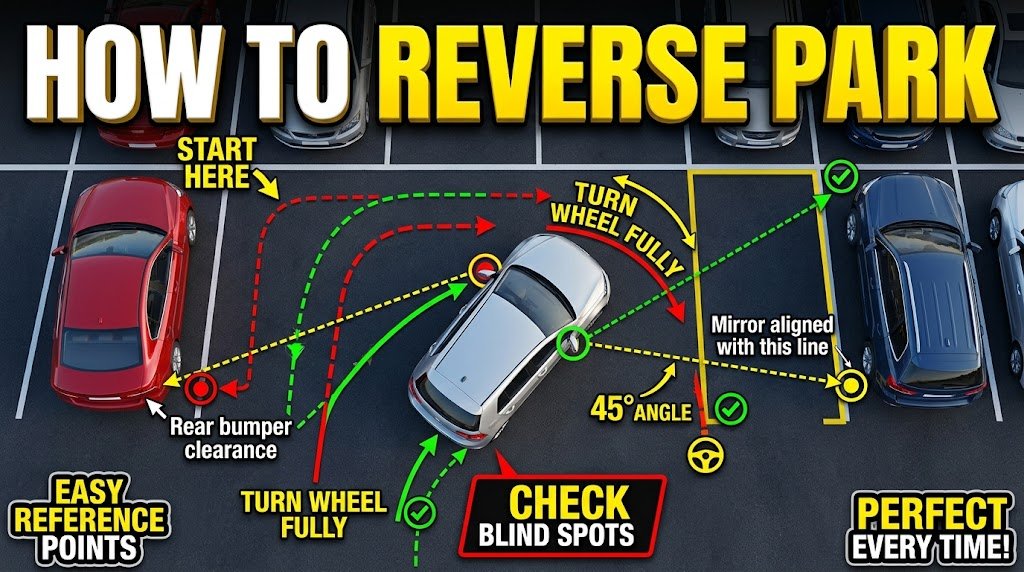
How to reverse park
What the DVSA Examiner Looks for During Bay Parking
According to the official DVSA driving test manoeuvres guidance, an examiner evaluates you against three core competencies during any reversing exercise:
Control: Keeping the vehicle moving at a strict walking pace using micro-movements of the clutch and brake, whilst turning the steering wheel briskly.
Accuracy: Finishing neatly between the white bay markings, straight, and reasonably centred, without mounting the kerb or crossing over into an adjacent space.
Observation: Maintaining continuous, 360-degree visual scanning for pedestrians, cyclists, and moving vehicles throughout the entire manoeuvre—not merely staring into your door mirrors.
What Constitutes a Driving Fault vs. a Serious Fault?
Understanding how examiners mark this manoeuvre removes the myth that you must be millimetre-perfect on your first attempt:
Driving Fault (Minor): Finishing slightly askew but safely inside the bay markings; stopping to pause and assess without safety risk; or pulling forward once to straighten up if you spot your angle is slightly off.
Serious Fault (Major Fail): Straddling a white line at the finish and leaving the car there; failing to stop for a pedestrian walking behind your car; failing to look over your blind spots before moving; or bumping firmly into a kerb or adjacent bollard.
Method 1: The 90-Degree “3-Line Reference” Routine
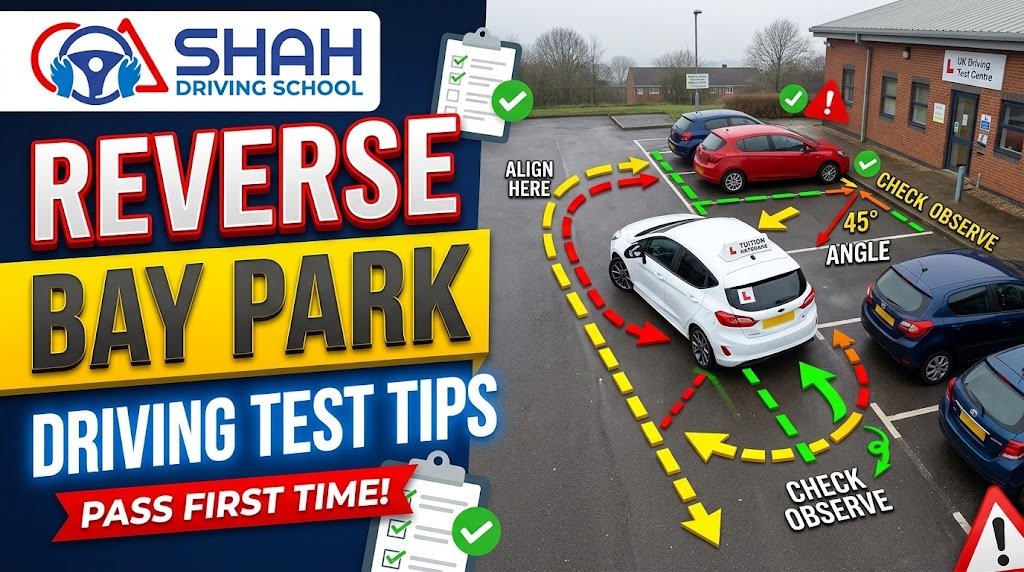
The 90-degree reverse bay park is the traditional method taught across UK driving schools. It is clean, predictable, and requires minimal room in front of the bays. Here are our proven reverse bay park driving test tips to execute this technique reliably:
Step 1: Position and Setup
Drive along the row of bays, keeping approximately 1 to 1.5 metres of clearance between your car and the ends of the parked bays.
Choose the bay you intend to reverse into (we will call this Bay 1).
Signal if there are other road users or pedestrians nearby who need to know your intentions.
Step 2: The “3-Line” Reference Point
Drive slowly past Bay 1.
Count the lines on the ground:
Line 1 is the near line of your target bay.
Line 2 is the far line of your target bay.
Line 3 is the far line of the bay next to it.
Stop your vehicle when your shoulder (or the side mirror, depending on your vehicle’s seating position and wheelbase) aligns precisely with Line 3.
Step 3: All-Round 360-Degree Observation
Apply the handbrake and select reverse gear. Selecting reverse immediately illuminates your white reversing lights, signalling your intention to everyone behind you.
Conduct a full 6-point check: right blind spot, right door mirror, interior mirror, through the windscreen, left door mirror, and left blind spot over your shoulder.
Step 4: The Turn
Release the handbrake, find your clutch bite point, and crawl backwards at a snail’s pace.
As soon as the car begins moving, apply full steering lock toward the bay (turn right if the bay is on your right; turn left if the bay is on your left).
Keep the vehicle moving slowly whilst checking your mirrors and surroundings continuously.
Step 5: Straightening Up
Watch both side door mirrors. As the car swings round, you will see the white bay lines appear.
The moment the body of your car sits parallel to the lines in both mirrors, quickly unwind the steering wheel by one and a half turns to straighten the tyres.
Continue rolling straight back until you are fully inside the bay, using your reference point for depth (such as a pillar, kerb, or reference in your door mirrors). Secure the car with the handbrake and select neutral.
Method 2: The 45-Degree Angle In (The “Drive-Away” Technique)
Many instructors and learners prefer the 45-degree method because it removes the extreme steering lock and allows you to reverse almost in a straight line.
Drive along the bays, keeping roughly 1 metre away from the bay openings.
Position your front bumper just past the middle of the bay you want to enter.
Check your mirrors and blind spots, then steer briskly at a 45-degree angle away from the bay into the roadway.
Straighten the wheel and bring the car to a complete stop.
In your side mirror, you should now see your target bay clearly opened up right behind your rear quarter.
Select reverse, complete your 360-degree observations, and reverse back with minor steering adjustments directly into the slot.
This approach significantly reduces the risk of miscalculating your turning arc and makes judging the lines much more intuitive.
[IMAGE: A learner driver performing all-round observation checks through the rear window and blind spots during a reverse bay park | ALT TEXT: Reverse bay park driving test tips – essential 360 observation checks during the manoeuvre]`
Crucial Reference Points Explained: Removing the Guesswork
Reference points differ slightly depending on whether you are driving a supermini like a Ford Fiesta, a hatchback like a Volkswagen Golf, or a compact crossover. However, establishing your personal reference points during professional manual driving lessons in Bolton or automatic driving lessons in Bolton guarantees consistency:
Point of Turn Reference: In many tuition vehicles, when the third white line intersects the middle of the passenger front door window, you are in the prime turning position.
Parallel Line Reference: Look at the bottom edges of both wing mirrors. When the gap between the white painted line and your car body looks equal and parallel on both sides, your vehicle is aligned.
Depth Stopping Reference: As you roll backwards, stop when the white line at the rear of the bay appears just under your wing mirror, or when the rear kerb lines up with your rear quarter light. You want your front bumper safely tucked behind the front bay line without bumping the rear kerb or post.
The Golden Rule: Observation Over Precision
One of the biggest misconceptions among learner drivers is believing that bay parking is solely an exercise in steering geometry. In reality, more driving tests are failed during bay parking due to poor observation than poor positioning.
When reversing, your front end swings outward into the roadway. This creates a collision risk for passing cars or pedestrians approaching from your front blind spots.
“If a pedestrian, cyclist, or car approaches within your hazard zone while you are moving, you MUST pause. Let them pass or assess their actions before continuing.”
The Observation Routine
Never stare at one mirror: Glancing exclusively at your left wing mirror leaves you completely blind to someone walking behind your vehicle from the right.
Look where you are going: When reversing straight back, your main view should be through the rear windscreen, supported by frequent glances to both door mirrors.
Strict compliance with the Official Highway Code rules for parking: Always give way to pedestrians and other moving traffic in public or test centre car parks.
How to Correct a Bad Angle Without Getting a Serious Fault
What happens if you begin turning and suddenly realise you are cutting across a line or heading straight for an adjacent car? Do not panic, and do not abandon the manoeuvre.
The DVSA does not penalise you for correcting your position, provided you do so calmly and safely:
Bring the vehicle to a controlled stop before you touch or cross the line dangerously.
Apply the handbrake if on a slope; select first gear (or Drive in an automatic).
Conduct a full 360-degree observation check. Look all around your vehicle before moving forward—examiners will fail candidates who pull forward without checking their surroundings!
Drive forward a car length or two, steering to straighten your car relative to the bay markings.
Stop, select reverse, re-check your mirrors and blind spots, and reverse straight back between the lines.
Taking a sensible correction shows the examiner that you possess road safety awareness and problem-solving skills under pressure.
Shah Driving school bolton
Local Car Parks: Bolton and Atherton Test Centre Nuances
Bay parking on your practical test can happen at either the very start of your test or at the very end when returning to the test centre car park.
Bolton Test Centre (Weston Street, BL3 2AW)
The car park at the Weston Street driving test centre features compact bays situated near industrial units. If you are asked to reverse into a bay at the end of your test here:
Take extra care with incoming test cars returning alongside you.
The tarmac surface has slight cambers and drainage gradients; maintain careful control over your clutch bite point to prevent unexpected rollbacks or surges.
Atherton Test Centre (Gibfield Park Avenue, M46 0SU)
Atherton’s modern business park facility has clearly demarcated parking bays, but it experiences frequent delivery vans and neighbouring business traffic. Priority management and continuous mirror-shoulder checks are vital here.
Outside of the test centres, our instructors frequently train students in large public car parks around Greater Manchester, such as Middlebrook Retail Park in Horwich or quieter supermarket bays in Leigh and Atherton. Practicing in varied layouts ensures you are not dependent on just one car park’s markings. If you have a test date fast approaching, our intensive driving crash course provides focused, repetitive manoeuvre clinics to perfect your technique in days.
Frequently Asked Questions (FAQs)
Can I use a reversing camera during the bay park on my driving test?
Yes, you are legally permitted to use reversing cameras and factory-fitted parking sensors during your test. However, you must not rely on the camera screen exclusively. If you fixate on the dashboard screen without looking over your shoulders, out the back window, and into your wing mirrors, the examiner will mark it as a serious observation fault.
Will I fail if my car is not completely centred in the bay?
No. As long as all four wheels are completely within the white painted lines and the vehicle is straight and safe, you have fulfilled the criteria. You do not need to be dead-centre to pass.
Can I open my door to check the lines during the reverse bay park?
While some drivers do this in everyday life, on a DVSA practical test it is generally discouraged while the vehicle is in motion due to safety risks. You can adjust your electric door mirrors downwards before you begin to see the lines clearly, as long as you reposition them before driving back on the road.
What if another car wants to get past while I am reversing?
Stop immediately. Secure the vehicle and assess the situation. If they wait for you, you can continue slowly once you are sure they are stationary. If they attempt to drive around you, remain stopped until they have cleared your space entirely, conduct your 360-degree checks again, and continue.
Master Your Test Manoeuvres with Local Experts
Reversing into a parking bay does not have to be an ordeal. With structured reference points, calm vehicle control, and rigorous observations, you can execute the reverse bay park cleanly on your practical test every single time.
Whether you are struggling with manoeuvres, building up your confidence, or preparing for a test at Bolton or Atherton, our experienced team is here to support you.
Ready to pass your driving test with confidence?
Call or WhatsApp: 0749 0662 777
Book Online: shahdrivingschool
Contact Shah Driving School today to arrange your professional manual or automatic driving lessons across Bolton, Atherton, Leigh, Westhoughton, Horwich, and surrounding areas!