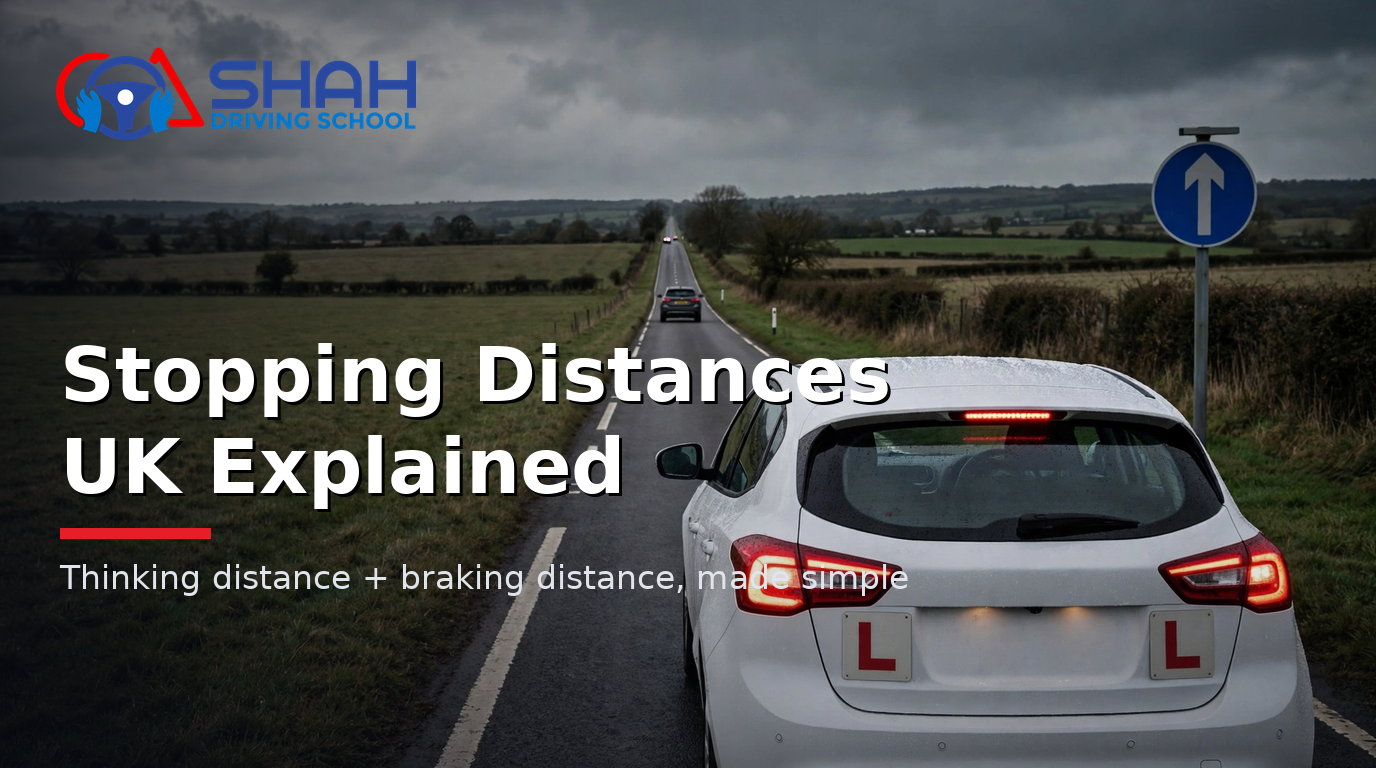
The car ahead brakes suddenly. Do you have room to stop? That question sits at the heart of safe driving. Yet most learners guess their stopping distance rather than know it.Stopping distances in the UK follow official figures in the Highway Code. Your theory test checks them. Your practical test judges how you use them. This guide explains the full chart in plain English, plus the simple on-road rule that keeps you safe every day. Our Bolton instructors teach this topic on real dual carriageways, not just from a book.
What Is a Stopping Distance?
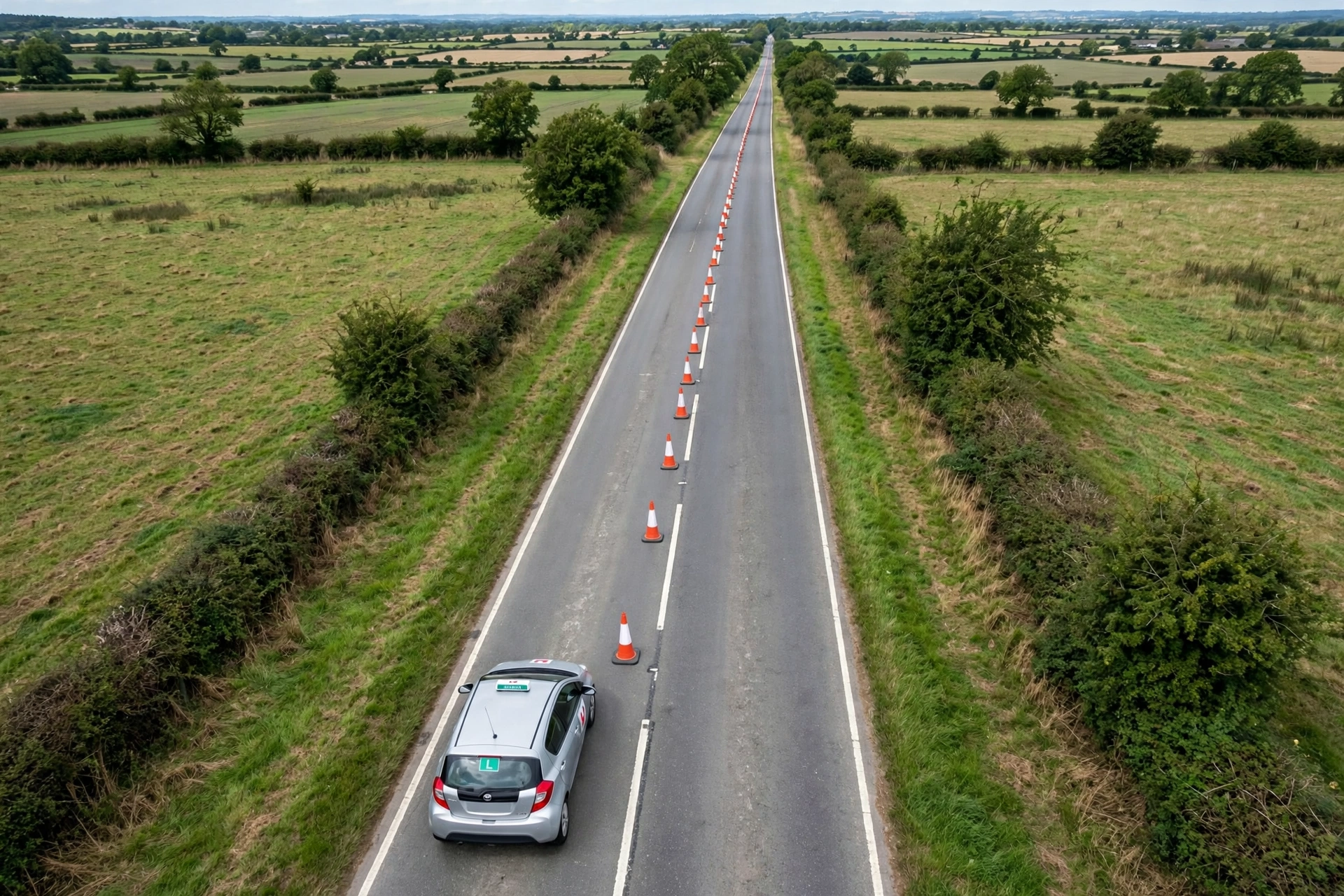
At 30 mph you need about six car lengths to stop — far more than most learners guess.
Your stopping distance is the total ground your car covers from spotting a hazard to standing still. It has two parts.
Thinking distance comes first. Your car keeps moving while your brain processes the hazard and your foot moves to the brake. Alertness decides this distance. Tiredness, distraction and alcohol all stretch it.
Braking distance follows. This is the ground covered while the brakes slow the car to a stop. Speed dominates this part. Double your speed, and the braking distance roughly quadruples.
Rule 126 of the Highway Code gives the golden principle: drive at a speed that lets you stop well within the distance you can see to be clear. Everything else in this guide builds on that sentence.
The UK Stopping Distances Chart
These are the official typical stopping distances for a car in good condition, on a dry road, with an alert driver:
Speed | Thinking distance | Braking distance | Total stopping distance | In car lengths |
|---|---|---|---|---|
20 mph | 6 m | 6 m | 12 m | about 3 |
30 mph | 9 m | 14 m | 23 m | about 6 |
40 mph | 12 m | 24 m | 36 m | about 9 |
50 mph | 15 m | 38 m | 53 m | about 13 |
60 mph | 18 m | 55 m | 73 m | about 18 |
70 mph | 21 m | 75 m | 96 m | about 24 |
Read the 30 mph row carefully. In a normal residential street, you need 23 metres to stop. That is roughly six car lengths. Most new drivers guess half of that.
Now look at 70 mph. The total reaches 96 metres, about the length of a football pitch. Speed eats road far faster than intuition suggests. That is why motorway gaps look huge, and why they must stay huge.
How to Remember the Chart for Your Theory Test
Stopping distance questions appear in almost every theory test. Two patterns make the chart easy to hold in your head.
Pattern one: thinking distance. In metres, it equals roughly the speed multiplied by 0.3. At 30 mph, thinking distance is 9 metres. At 50 mph, it is 15 metres. The thinking column grows in a straight line.
Pattern two: braking distance grows in squares. Compare 30 mph with 60 mph. The speed doubles. The braking distance jumps from 14 to 55 metres, almost four times longer. Examiners love testing this idea.
Learn the totals for 30, 50 and 70 mph as anchors. The other rows become easy estimates between them. Practise with real questions, not just the table.
The Two-Second Rule: Your Everyday Ruler
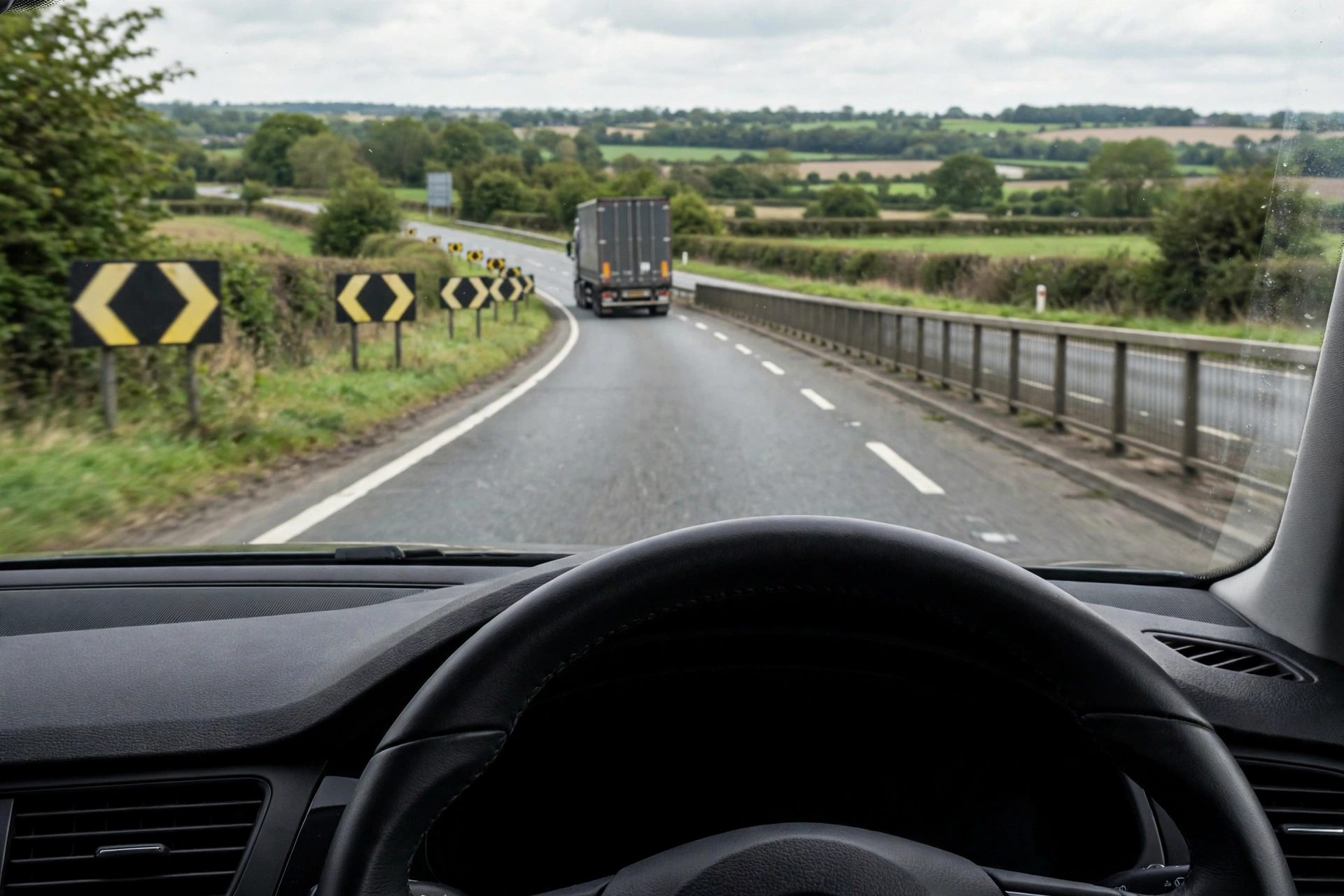
Use a fixed point and the phrase “only a fool breaks the two-second rule” to check your gap.
You cannot measure metres from the driver’s seat. So Rule 126 gives you a time gap instead. On faster roads, keep at least two seconds between you and the vehicle ahead.
Measure it with a fixed point. Choose a sign, a bridge or a road marking. When the vehicle ahead passes it, say: “Only a fool breaks the two-second rule.” Say it at normal speed. If you pass the same point before finishing, you are too close. Ease back and check again.
The beauty of a time gap is automatic scaling. Two seconds at 30 mph covers about 27 metres. Two seconds at 60 mph covers about 54 metres. The gap grows with your speed, exactly as your stopping distance does.
Our instructors build this habit during manual driving lessons on the A666 and A58. Within a few lessons, checking the gap becomes automatic.
When Stopping Distances Grow
The chart assumes a dry road, good tyres and an alert driver. Real life often removes all three advantages.
- Wet roads: Grip falls sharply. The Highway Code says your gap should at least double. Treat the whole stopping distance as doubled too.
- Ice and snow: Braking distances can grow up to ten times. At 30 mph, that could mean over 200 metres. Slow right down and leave enormous gaps.
- Tired or distracted drivers: Thinking distance stretches first. A glance at a phone adds metres before braking even begins.
- Worn tyres or brakes: Legal minimum tread is 1.6 mm, but grip fades well before that. Poor maintenance lengthens every stop.
- Heavy loads and downhill slopes: Weight pushes the car forward. Gravity adds its own push on hills, as our hill start guide explains.
- Larger vehicles: Lorries and buses need far more room. Never cut in closely ahead of them.
Bolton weather makes the wet rule your default setting for much of the year. Build the doubled gap into your normal driving, not your emergency driving.
Do Modern Cars Stop Faster Than the Chart?
Often, yes. Modern brakes, ABS and good tyres can beat these typical figures in perfect conditions. The chart dates from an era of older cars, and it builds in caution.
Do not plan your driving around beating it. The chart protects you on your worst day, not your best one. Rain, worn tyres or one slow reaction can erase a modern car’s advantage instantly.
Use the figures as minimums for your planning. Keep the gap even when your car feels capable of less. That restraint is what experienced drivers actually do.
Stopping Distances on Your Driving Test
The examiner watches your following position throughout the test. Driving too close to the vehicle ahead is a classic fault. It shows poor planning and leaves no margin for surprises.
Your emergency stop exercise tests the other half of the skill. The examiner expects a fast reaction and firm, controlled braking. Good stopping-distance knowledge makes that exercise calmer, because you already understand what the car needs.
On faster test routes, keep the two-second gap openly. Say nothing; just drive it. Examiners notice consistent gaps, especially in changing traffic.
Like the yellow box junction rules, this is a judgement skill. The examiner rewards the driver who plans space early, not the one who brakes late and hard.
FAQs About Stopping Distances
What is the stopping distance at 30 mph?
The typical total is 23 metres. That splits into 9 metres of thinking distance and 14 metres of braking distance. It equals roughly six car lengths.
How much does rain increase stopping distance?
Allow at least double. On wet roads, double your gap as a minimum. In heavy rain, poor visibility demands even more space and less speed.
What is the two-second rule?
It is a time gap for judging safe following distance. When the vehicle ahead passes a fixed point, you should reach it no sooner than two seconds later. The phrase “only a fool breaks the two-second rule” times it neatly.
Do stopping distances change for larger vehicles?
Yes. Large vehicles need a greater distance to stop. In tunnels, the Highway Code advises a four-second gap behind them. Their size and weight demand extra respect.
Will I be asked stopping distances in the theory test?
Very likely. Totals, the two parts, and weather effects all appear regularly. Learn the chart and the reasoning behind it, and those questions become free marks.
More questions? Read our frequently asked questions page.
Build Safe Gaps Into Your Driving
Stopping distances are not theory-test trivia. They are the space that protects you every single journey. Learn the chart, use the two-second rule, and double everything in the rain.
Shah Driving School teaches manual and automatic lessons across Bolton, Horwich, Atherton and Farnworth. Our DVSA-approved instructors practise real stopping distances on real roads with you. Book your lessons today, or explore our intensive driving courses if your test is close. Let’s put space between you and trouble.