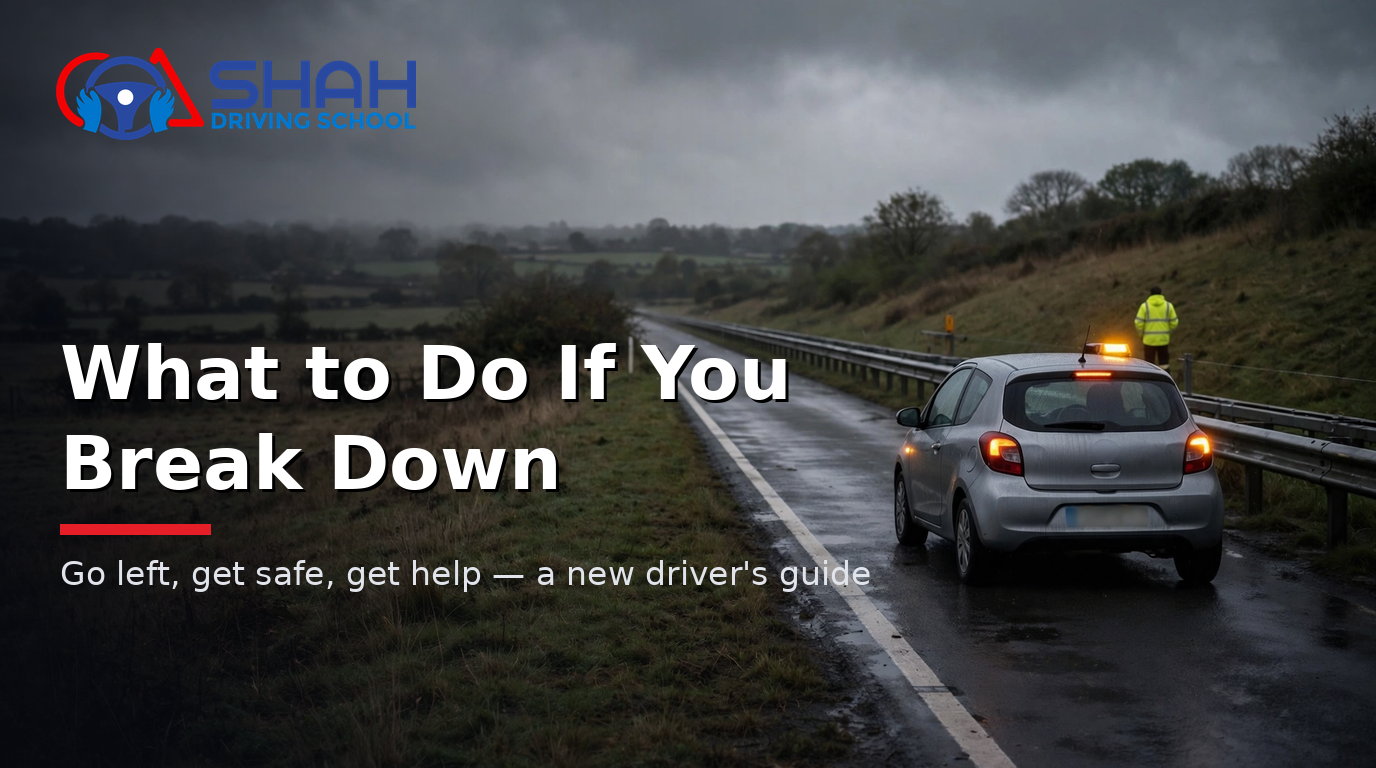

Every driver breaks down sooner or later. A flat tyre, a warning light, an engine that suddenly loses power. It happens to new cars and old ones, to new drivers and experienced ones. What matters is not whether you can fix it. What matters is the order of your decisions in the first minute.
The rule is simple: people first, car second. Get yourself and your passengers somewhere safe, warn other road users, and only then think about help. This guide covers the Highway Code rules, the motorway steps, and the kit every new driver should carry.
Highway Code Rule 275 says that if you need to stop because of a breakdown, you should try to stop in a place of relative safety — somewhere you, your passengers and your vehicle are less likely to be at risk from moving traffic.
On motorways and other high-speed roads, the safest place to stop is a service area. Other places of relative safety include lay-bys, emergency areas and hard shoulders. But be aware that a hard shoulder gives you far less protection than the others, because it sits right next to high-speed traffic.
Once you have stopped, you and your passengers should keep well away from your vehicle and from moving traffic where possible. If another vehicle hits your car, it can be forced into you. That is why the advice is always to get clear of the car, not to sit in it and wait.
National Highways and the Highway Code use the same three steps. Learn them now, so you do not have to work them out in a panic.
1. Go left. If your vehicle develops a problem, leave the motorway at the next exit or pull into a service area if you can. If you cannot, move into the left lane and pull into an emergency area or onto a hard shoulder. Stop as far to the left as possible, leaving space to get out of your vehicle, with your wheels turned to the left. If you can, stop just beyond an emergency telephone. Switch your hazard warning lights on, and use your sidelights if it is dark or visibility is poor. Do not stop in a live lane unless you have no choice.
2. Get safe. Exit your vehicle by the side furthest from the traffic, and make sure your passengers do the same. Get behind a safety barrier where there is one, and wait well away from your vehicle and moving traffic. Do not stand where your vehicle could be forced into you if another vehicle hits it. And do not go back to your vehicle — even if it is raining, cold or dark.
3. Get help. Use the free emergency telephone to get advice and assistance, or contact a breakdown recovery service. If you have stopped in an emergency area, you must use the emergency telephone and follow the operator’s advice before leaving. A lane may need to be closed so you can rejoin the carriageway safely. On a smart motorway, there is no hard shoulder at all, so the emergency areas are your safe place. If you cannot get to one, stay in the left lane as far over as you can. National Highways can be reached on 0300 123 5000.
If you cannot get to safety, the rules change. If you cannot get your vehicle to the left lane or a place of relative safety, and you cannot exit safely, stay in your vehicle. Keep your seat belts and hazard warning lights on, call 999 immediately and ask for the police — or press your SOS button if your vehicle has one. Put on high-visibility clothing if it is within easy reach. Do not attempt repairs, and do not place a warning triangle on the carriageway.
Bolton drivers meet this on the M61, the M60 and the A666. The motorway rules are the same everywhere. But the habit is local: know where the next service area is before you need it. Never assume the hard shoulder is a safe place to wait.
On a normal road, the steps are the same idea with more room to work:
If your car is in the road and is hidden by a bend, stand in a safe place further back so you can warn other road users of the hazard. And if you are passing the scene of someone else’s incident, stay alert for debris and slow-moving vehicles, but do not slow down unnecessarily — focus on the road ahead. Our stopping distances guide explains the gap you should keep at every speed.
When you call for help, the operator needs three things: where you are, what your vehicle is, and how to reach you.
If you have breakdown cover, call your provider. If you do not, you can still call a recovery company — but expect to pay a premium for immediate service. The RAC can be reached on 0333 2000 999 for members and non-members. Always face the traffic when you speak, so you stay aware of vehicles or debris coming towards you.
A breakdown and a collision follow different rules. If you are involved in an incident or collision:
If the collision causes damage or injury to any other person, vehicle, animal or property, you must stop. Give your own and the vehicle owner’s name and address, and the registration number, to anyone who reasonably asks for them. If you do not give your name and address at the time, you must report the collision to the police as soon as reasonably practicable. In any case, report it within 24 hours. If another person is injured and you do not produce your insurance certificate at the time, you must report it to the police within 24 hours. Produce your insurance certificate for the police within seven days.
A breakdown is far less stressful when the kit is already in the boot:
Keep the kit in the boot, and know where your hazard warning lights button is before your first drive. If you are a new driver, read our first solo drive tips — a breakdown is one of the things that guide prepares you for.
No. Do not attempt even simple repairs on a motorway or hard shoulder. Get safe, get behind the barrier, and call for help.
You can still call a recovery company, but you will pay a premium for immediate service. Check whether your car insurance or bank account already includes breakdown cover — many drivers have it without realising.
Tell the examiner straight away. They will help you get the car somewhere safe and arrange what happens next. A breakdown is not a fault — it is not your driving.
On an ordinary road, only if it is safe and you know what you are doing — and never between your car and the traffic. On a motorway, never. Your safety comes first; the car can be fixed later.
Use the free emergency telephone on a motorway — it connects you directly to the control room and tells them exactly where you are. On other roads, walk to a safe place and ask for help, or flag down another driver from a safe position.
More questions? Read our frequently asked questions page.
A breakdown is not a test of your mechanical skill. It is a test of your judgement — and judgement is what driving lessons are for. Go left, get safe, get help. In that order, every time.
If you are learning to drive in Bolton or Atherton, we will teach you what to do when things go wrong, not just when they go right. Book manual driving lessons with Shah Driving School. Call us on 0749 0662 777, or visit our contact page to book your first lesson. The car can be replaced. You cannot.
Breakdown rules: The Highway Code — Breakdowns and incidents, Rules 275 to 287 (GOV.UK). Motorway advice: National Highways — Driving on motorways. Practical steps: RAC — What to do if your car breaks down.
WhatsApp us