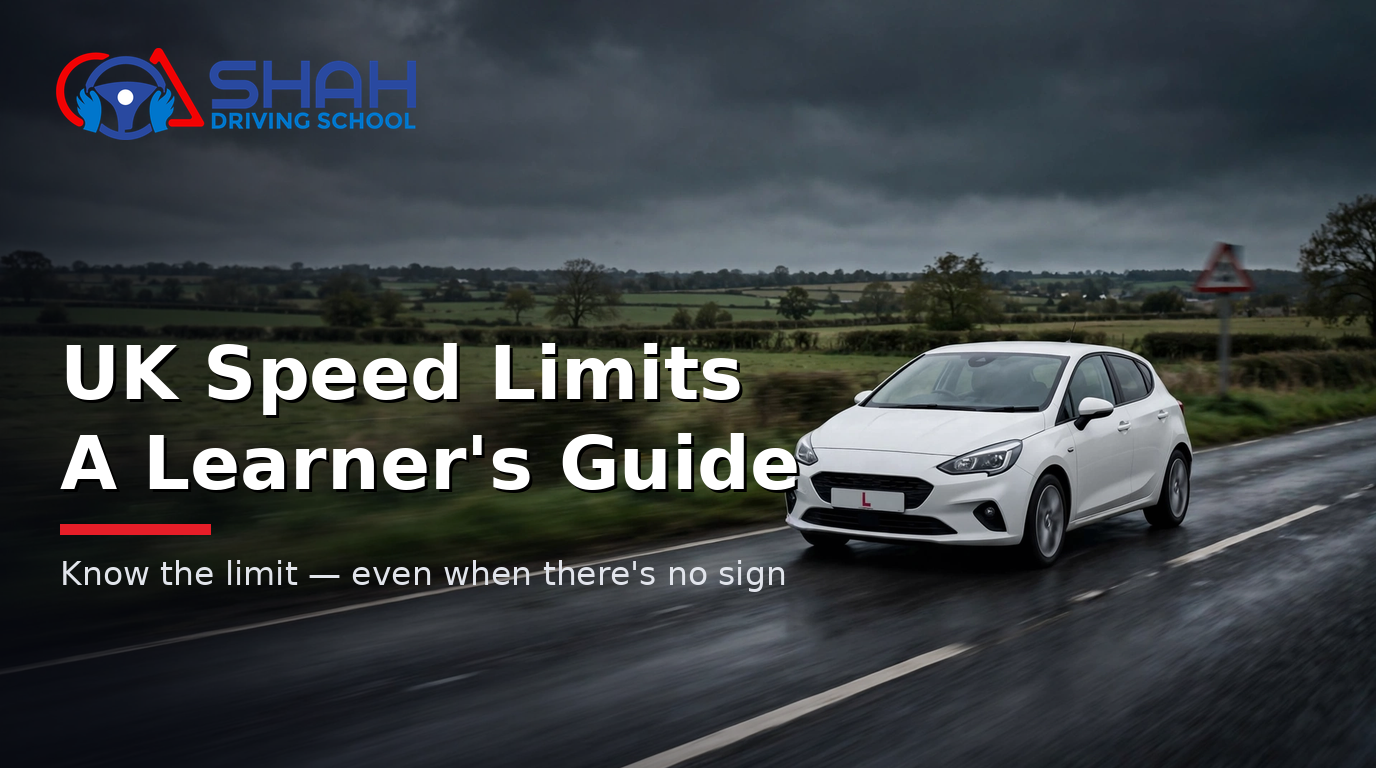

Quick question. You are driving on a road with no speed limit signs anywhere. What is the limit? If you hesitated, you are exactly who this guide is for.
UK speed limits follow a logical system, but nobody hands you the logic. Learners often guess from how the road “feels”, and that guess can cost points, fines, or a test. This guide explains the full system in plain English: the chart, the signs, the no-sign rule, and what your examiner expects. Learn it once, and you will read every road correctly.
These are the national limits for cars and motorcycles in Great Britain, confirmed on the official GOV.UK speed limits page:
|
Road type |
Cars & motorcycles |
Cars towing a trailer or caravan |
|---|---|---|
|
Built-up areas (street lights) |
30 mph |
30 mph |
|
Single carriageway |
60 mph |
50 mph |
|
Dual carriageway |
70 mph |
60 mph |
|
Motorway |
70 mph |
60 mph |
Vans and goods vehicles up to 7.5 tonnes follow slightly lower limits: 30 mph in built-up areas, 50 mph on single carriageways, and 60 mph on dual carriageways and motorways in most cases. Larger goods vehicles are lower again.
Two warnings about this chart. First, signed limits always beat it. A 40 sign means 40, whatever the chart says. Second, the chart shows maximums for good conditions, never targets for bad ones. We return to that point below.
Here is the rule that answers our opening question. A road with a system of street lighting is a restricted road. In England and Scotland, its limit is 30 mph, unless signs tell you otherwise. That is why 30 mph roads usually carry no repeater signs: the lamps themselves are the message.
On lit roads with a higher limit, like 40 or 50 mph, you will see small repeater signs at regular intervals. So the logic works backwards too. Street lights, no repeaters? Assume 30.
Outside built-up areas, look for the national speed limit sign: a white circle with a black diagonal stripe. It does not mean “no limit”. It means the national limit for that road applies. For a car, that is 60 mph on a single carriageway, and 70 mph on a dual carriageway or motorway.
One more trap catches many learners. A wide road with two lanes each way is not automatically a dual carriageway. A central reservation or barrier must separate the flows. Without one, it is a single carriageway, and the national limit is 60, not 70. You can brush up on every sign in our guide to UK traffic signs.
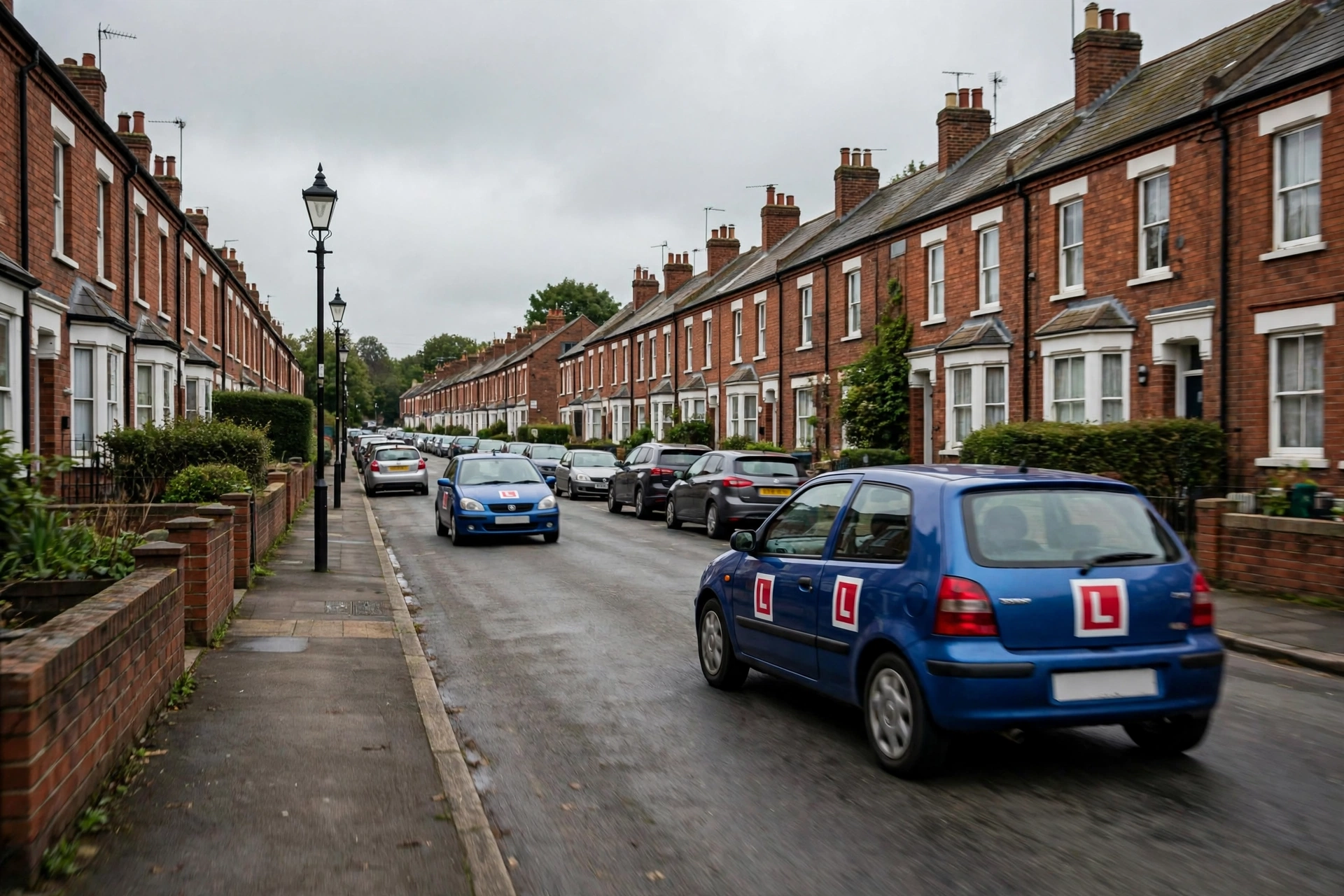
Street lights and no repeater signs? The limit is 30 mph in England and Scotland, 20 mph in Wales.
Many councils now set 20 mph limits near schools, homes and busy shopping streets. Bolton has them, like most UK towns. Always obey the signs; a signed 20 overrides the street-light rule.
Wales went further. Since September 2023, the default limit on restricted roads in Wales is 20 mph, not 30. If you drive into Wales, flip your assumption the moment you cross the border. Your theory test may ask about both defaults, so learn the pair: 30 in England and Scotland, 20 in Wales.
Why the lower limits? Survival physics. A pedestrian hit at 20 mph usually survives. At 40 mph, most do not. Twenty zones exist where people and cars mix most.
On smart motorways, gantries display the limit above each lane. A number inside a red circle is mandatory. You must obey it exactly, and cameras enforce it automatically.
Amber advisory signs are different. They recommend a slower speed for a hazard ahead, like fog or a queue. Treat them seriously, but they are advice, not law. The mandatory red ring is the one that fines you.
Limits can also change by time or place. Average speed cameras near roadworks measure your speed between two points. Slowing down only at the camera does not save you there.
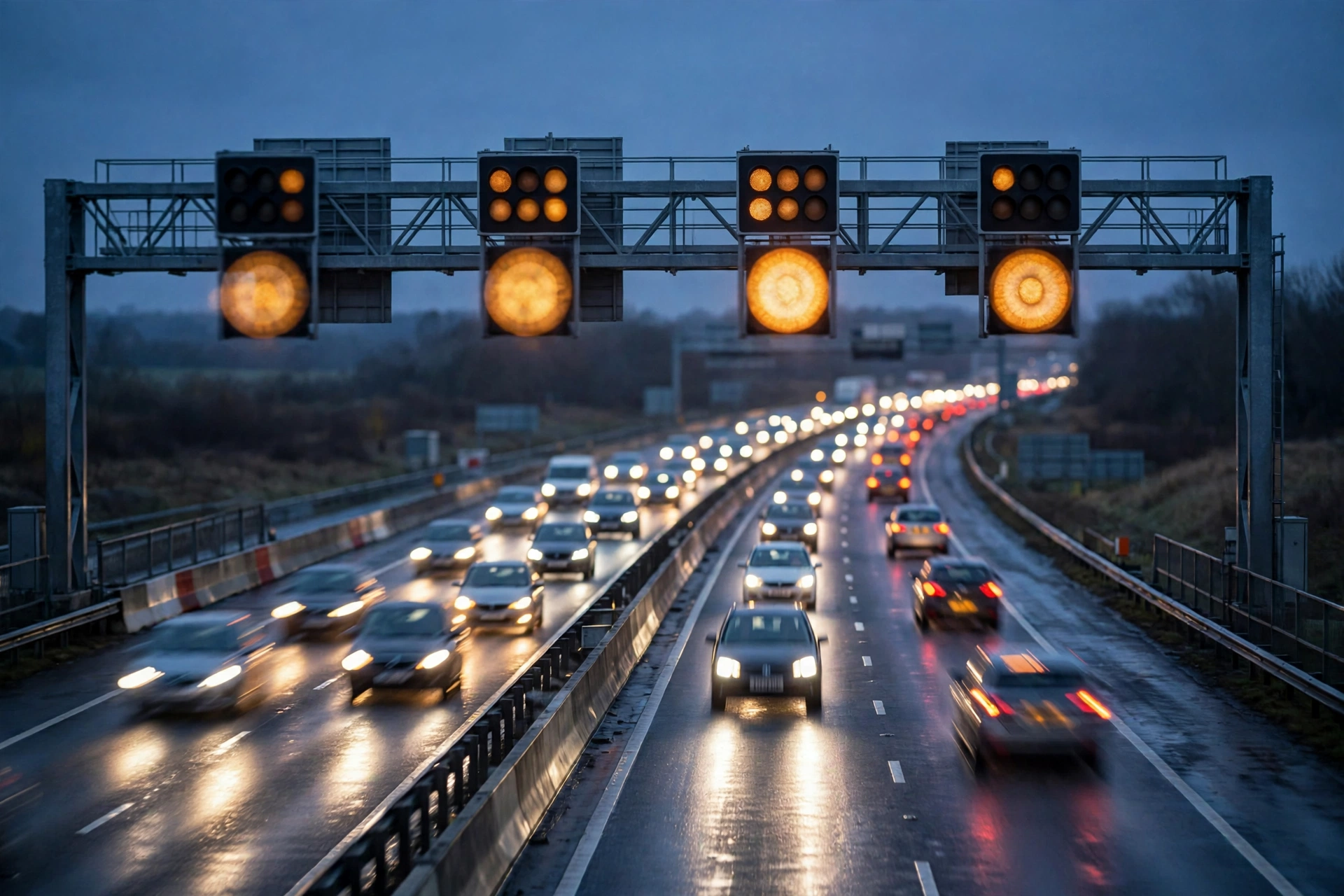
A speed shown in a red circle on a gantry is mandatory — cameras enforce it automatically.
Rule 125 of the Highway Code is clear: the limit is the absolute maximum, and it does not mean that speed is safe. You should slow down when the road bends, when you share space with pedestrians and cyclists, when weather worsens, and at night.
Think about our stopping distances guide. At 60 mph you need 73 metres to stop in the dry. On a narrow, wet country lane with blind bends, 60 may be legal but it is never sensible. Good drivers choose a speed for the road they can see, not the number on a sign they passed.
Our instructors repeat one sentence in manual driving lessons: drive so you can stop in the space you can see. That sentence will protect you on every road in Britain.
The standard fixed penalty for speeding is a £100 fine and 3 penalty points. Some drivers are offered a speed awareness course instead, for minor offences. Serious speeding goes to court, where fines and bans grow quickly.
For new drivers, the stakes are far higher. Under the New Drivers Act, collecting 6 or more points within your first two years means your licence is revoked. You return to learner status. You must apply again and retake both the theory and practical tests. One careless moment can undo a year of lessons.
Learners should also know this: in Great Britain, learners follow the same speed limits as everyone else. There is no special lower learner limit. Northern Ireland is the exception, where L-plate drivers are capped at 45 mph.
Examiners mark speed in both directions, which surprises many learners.
Too fast is the obvious danger. Exceeding the limit, even briefly, can be recorded as a serious fault, especially in a 20 or 30 zone. Roll downhill into a built-up area and the speed creeps up silently. Watch for it.
Too slow also earns faults. Crawling at 35 on a clear 60 mph road holds up traffic and shows poor confidence. The examiner wants progress appropriate to the road and conditions.
The target is simple: at the limit when it is safe, below it when it is not, and never above it. Practise reading limits aloud during lessons until recognition becomes instant. Mock tests on our intensive driving courses include exactly this drill on Bolton test routes.
Bolton teaches every limit type within a few miles. Town-centre streets are lit and 30, with 20 zones near schools. Routes like Chorley New Road change limits as they leave town, so watch the signs, not your memory. The A666 dual carriageway lets you practise higher-speed awareness, always watching for signed changes near junctions.
Your instructor will deliberately route you through limit changes. Each change is a small test: spot the sign, adjust smoothly, and check your speedometer. Master that rhythm and the real test feels familiar.
For cars and motorcycles, 60 mph. For cars towing a trailer or caravan, 50 mph. Vans are also 50 mph. The black-and-white diagonal sign means this limit applies.
Not in Great Britain. Learners follow the same limits as qualified drivers. The only UK exception is Northern Ireland, where L-plate drivers must not exceed 45 mph.
In England and Scotland, the limit is 30 mph. Street lighting defines a restricted road. In Wales, the same default is now 20 mph.
Legally, the limit is the maximum, and exceeding it is an offence. Enforcement practice varies by area, and you should never rely on any tolerance. Drive at or below the limit, with a small margin for safety.
Minimum limits exist but are rare. A blue circular sign with a white number sets one, usually in tunnels or on specific stretches. Most roads have none, but driving far below the flow without reason still creates danger and test faults.
More questions? Read our frequently asked questions page.
UK speed limits are a system, not a guessing game. Chart, street lights, signs, and conditions tell you everything. Learn the system and you will never need to guess again.
Shah Driving School teaches manual and automatic lessons across Bolton, Horwich, Atherton and Farnworth. Our DVSA-approved instructors train you on roads with every limit type, until reading them becomes second nature. Book your lessons today, and drive at the right speed from your very first lesson.
WhatsApp us