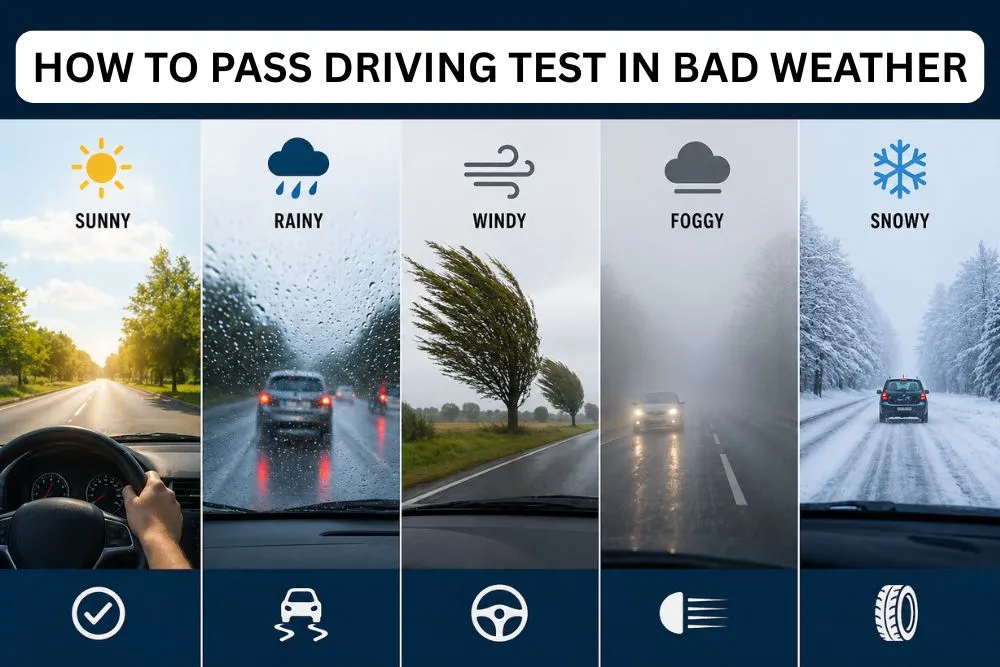
Taking a driving test in bad weather UK conditions is something most learners dread, and understandably so. Rain-soaked roads, reduced visibility, and unpredictable traffic behaviour can all pile extra pressure onto what is already one of the most nerve-wracking experiences of a young person’s life. But here’s the thing bad weather doesn’t have to mean a failed test. In fact, handled correctly, it can work in your favour.
This guide breaks down exactly how different weather conditions affect your test, what examiners are actually looking for, and how you can walk away with a pass certificate regardless of what the sky decides to do on the day.
Does Weather Actually Affect Your Driving Test Result?
The short answer: yes, significantly but not always in the way you’d expect.
Weather doesn’t cause failure on its own. What causes failure is a learner’s response to weather. Examiners aren’t marking you down because it’s raining. They’re watching whether you adapt your driving to suit the conditions. That’s a crucial distinction, and it’s one that far too many learners miss entirely.
The DVSA expects you to drive safely in real-world conditions. Real UK roads aren’t always dry, clear, and quiet. Therefore, your test reflects that reality.
How Rain Affects Your Driving Test Performance
Reduced Stopping Distances and Following Distance
Rain is the most common weather hazard learners encounter on test day in the UK. When roads are wet, your stopping distance at least doubles compared to a dry surface. From experience, many learners carry the same following distance they’d use on a dry day and this is one of the most frequent reasons for a serious or dangerous fault in wet conditions.
Examiners look for appropriate gap management. If you’re sitting too close to the vehicle in front, particularly on dual carriageways or approaching traffic lights, your examiner will note it immediately.
This often leads to failure because a learner who doesn’t account for wet braking distances poses a genuine safety risk. It’s not a minor fault. It’s a fundamental failure to adapt.
What you should do: In wet conditions, increase your following distance to at least four seconds more on faster roads. Use the “only a fool breaks the two-second rule” rhyme, then double it.
Spray, Wipers, and Visibility
Heavy rain creates spray from other vehicles that can briefly reduce your forward visibility to near zero, especially behind lorries. Many learners forget to turn their wipers on quickly enough, or leave them on the wrong speed setting. It seems trivial, but failing to manage your controls confidently signals to an examiner that you’re not fully in control of the vehicle.
Also, if visibility drops significantly, you must use dipped headlights. This is a legal requirement under the Highway Code when you cannot see further than 100 metres clearly. Forgetting this is a common test fault.
Also Read: Lane Discipline for Beginners UK – Simple Tips That Really Help
How Fog Affects Your Driving Test
Fog is relatively rare on test days, but it does happen particularly in autumn and winter mornings across rural and semi-rural areas of the UK. If you encounter fog during your test, the rules are clear.
You must use fog lights when visibility falls below 100 metres. However and this trips up many learners you must also switch them off when visibility improves. Leaving rear fog lights on in clear conditions can dazzle drivers behind you and is a fault in itself.
What the Examiner Is Actually Judging
Your examiner isn’t sitting there hoping the fog clears. They want to see that you:
- Reduce your speed proportionally to your visibility
- Increase following distance
- Use appropriate lights correctly
- Stay calm and don’t over-brake nervously
Panic braking in fog, or crawling at 10mph when visibility is perfectly adequate at 30mph, suggests poor hazard perception which is just as dangerous as going too fast.
How Wind and Autumn Leaves Affect Your Test
High winds might not seem as dramatic as fog or heavy rain, but they introduce subtle hazards that catch learners off guard.
Strong crosswinds affect vehicle stability, particularly on open roads, bridges, and motorways. Learners often don’t anticipate the steering correction required after passing a gap between two lorries or coming out of a tree-lined road. This isn’t taught explicitly enough in lessons, which is why it catches people out on test day.
Autumn leaves on the road create a hazard similar to ice they reduce grip significantly, especially when wet. Junctions, roundabouts, and pedestrian crossings with leaf coverage need extra care.
Real-life scenario: Imagine you’re approaching a mini-roundabout in a residential area during October. The road is carpeted with wet leaves. A learner who brakes sharply at the give-way line risks a skid. The correct approach is to slow progressively, well in advance, and avoid harsh inputs on the brake or steering. An examiner watching this will be assessing your hazard awareness from well before you reach the junction.
How Ice and Snow Affect Your Driving Test
Here’s something many learners don’t know: the DVSA does not automatically cancel tests because of cold weather. They will cancel if roads are genuinely dangerous, but light frost or a cold morning is not grounds for cancellation.
However, if you turn up to a test and conditions are truly hazardous, you can request to postpone without losing your fee. This is worth knowing because some learners feel pressure to go ahead even when they’re genuinely unsafe.
If you do drive in icy conditions:
- Accelerate and decelerate very gently
- Increase following distance to ten times the normal amount
- Use the highest gear possible to reduce wheel spin
- Avoid sudden steering inputs
From experience, many learners don’t understand that gentle inputs are the key to driving on ice. Smooth acceleration, smooth braking, smooth steering. Everything should feel considered rather than reactive.
What Examiners Are Really Looking For in Bad Weather
This is perhaps the most important section of this entire guide. Understanding the examiner’s mindset changes how you approach a test entirely.
Examiners are not looking for perfection. They’re assessing whether you are a safe and competent driver. In bad weather, that specifically means:
- Adaptation Are you changing your behaviour to suit conditions, or are you driving as though it’s a sunny day?
- Smoothness Are your inputs on the controls gentle and considered, or are you jerking the wheel and stamping on the brakes?
- Observation Are you scanning further ahead to anticipate hazards created by the weather? Standing water, slow-moving vehicles, pedestrians rushing with umbrellas all of these need to be spotted early.
- Confidence Are you hesitating unnecessarily because of the weather? Examiners also mark learners who become dangerously timid. Refusing to proceed at a clear junction because it’s raining is not cautious it’s a fault.
- Controls Wipers, headlights, demisters, rear fog lights. Are you using the correct controls at the correct time?
Also Read: Night Driving Tips for Beginners UK – Essential Guide for New Drivers
Common Mistakes Learners Make in Bad Weather (and Why They Cause Failure)
Mistake 1: Not Adjusting Speed
Driving at 30mph on a wet residential road might be legal, but if spray is reducing visibility and you’re following closely behind another car, you haven’t adapted. Examiners expect proportional responses.
Mistake 2: Forgetting Headlights
In heavy rain or overcast conditions, you should use dipped headlights. Many learners focus so hard on the road that they forget entirely. This is a fault and also makes you harder to see.
Mistake 3: Over-Correcting on Skids
If you feel the car sliding slightly particularly in wet or icy conditions over-correcting the steering makes it worse. This is often the result of going too fast in the first place, but it’s also a sign that a learner is reacting rather than anticipating.
Mistake 4: Excessive Caution
Stopping in the middle of a busy road because of heavy rain, refusing to move off at a roundabout due to puddles, or crawling at 15mph in a 30 zone without genuine reason these are faults. Examiners mark you for impeding the flow of traffic just as much as for speeding.
Mistake 5: Not Using Rear Demister
If your rear window is steamed up, you’re driving without clear rearward vision. This is a basic control issue and an immediate concern for any examiner.
Practical Steps: What to Do on Test Day in Bad Weather
Here’s your actionable checklist before you even move off:
- Check wipers are working and set to the right speed
- Turn on dipped headlights if visibility is reduced
- Activate rear demister and check rear visibility before moving
- Set your mirrors before the test begins not as you’re driving away
- Take a breath. Acknowledge the weather. Decide to adapt.
Once you’re driving:
- Increase following distance immediately at least double in rain
- Reduce speed proportionally to your visibility, not just to the limit
- Approach junctions earlier and more gently than on a dry day
- Look further ahead than normal to anticipate spray and standing water
- If fog lights are needed, use them then switch them off when conditions clear
- Keep steering inputs smooth and avoid sharp braking wherever possible
Quick Pre-Test Weather Checklist
- Wipers functioning on all speeds
- Dipped headlights on (in rain or low light)
- Rear demister on and effective
- Fog lights understood front and rear, when to use, when to switch off
- Following distance adjusted before you join any flow of traffic
- Speed appropriate to conditions, not just the posted limit
- Hazard perception engaged scan further ahead in poor visibility
- Tyres (already confirmed by your instructor) in good condition
Also Read: How Mock Driving Tests Help You Pass Faster | UK Learner Guide
People Also Ask: Driving Test in Bad Weather UK
Can you fail your driving test because of bad weather? You cannot fail because of bad weather itself. However, if you fail to adapt your driving to suit the conditions speeding, following too closely, or forgetting to use headlights those are faults that can cause failure.
Will the DVSA cancel my test if it snows? The DVSA will cancel tests if roads are considered genuinely dangerous due to snow or ice. Light frost or cold temperatures alone are not grounds for cancellation. You can also request a postponement if you feel unsafe, though this is assessed case by case.
Is it harder to pass your driving test in winter? Not necessarily harder, but different. Winter tests require more awareness of road surface conditions, visibility, and light usage. Learners who have practised in varied conditions often find winter tests very manageable.
Should I ask my instructor about driving in rain before my test? Absolutely. Make sure you’ve had at least a few lessons in wet or poor conditions before your test. Experiencing the feel of reduced grip under instruction is far better than encountering it for the first time during the test itself.
What happens if it starts raining during my driving test? Continue driving and adapt. Increase your following distance, use your wipers, switch on dipped headlights if needed, and reduce speed where appropriate. The examiner will be noting how you respond.
A Real-Life Scenario: The October Morning Test
Consider this common situation. It’s a Monday morning in mid-October. The test is booked for 9:15am in a market town. Overnight rain has left the roads wet, and the morning sky is overcast enough to warrant dipped headlights.
The learner arrives, does a show-me tell-me question correctly, and moves off. Within 200 metres, they’re behind a bus. They sit at roughly one car length behind their default habit from dry-day lessons and when the bus brakes at a stop, the learner brakes firmly and the car pitches forward noticeably.
The examiner notes this. Not as a fail yet but as something to watch.
At the next junction, the learner approaches well, checks effectively, and pulls out safely. Good. At a roundabout, they slow early, choose the correct lane, and exit smoothly. Excellent. The rest of the test is clean.
Result? A pass but with a minor for following distance. The instructor debrief covers wet-weather spacing, and the new driver heads home with their certificate.
The lesson here? One imperfect moment doesn’t define the test. Consistent, adapted, safe driving in those conditions does.
The DVSA Approach: What’s Changing
The DVSA has placed increasing emphasis in recent years on independent driving and real-world hazard awareness. This reflects a broader understanding that learners need to be ready for British roads as they actually are not as they appear in an ideal training scenario.
Weather is part of that reality. Moreover, with the rise of eco-driving principles and fuel-efficient techniques, smooth acceleration and gentle braking exactly what wet and icy conditions demand are increasingly viewed as marks of a confident, skilled driver rather than an overly cautious one.
The examiner’s role is evolving too. They’re not passive observers. They’re assessing your ability to become a safe driver for life. In bad weather, that assessment simply has higher stakes.
Conclusion: Weather Is a Test Within the Test
A driving test in bad weather UK conditions is genuinely manageable if you prepare correctly and maintain the right mindset. Weather doesn’t fail learners. Unprepared responses to weather do.
Go into your test having practised in rain. Know your lights, know your stopping distances, and understand that examiners aren’t there to catch you out they’re there to confirm you’re safe.
If the sky clouds over on test day, don’t panic. Adjust, adapt, and drive the way your instructor taught you. The certificate at the end is waiting for a driver who handles the real world not just the ideal one.
Also Read: Roundabouts in Bolton for Learners | Key Junctions to Practise Before Your Test
FAQs
- Can I refuse to take my driving test if the weather is dangerous?
Yes. If you genuinely believe conditions are unsafe, you can request a postponement. Contact the DVSA before your test or speak with your examiner on arrival.
- Do examiners mark learners differently in bad weather?
No. The same marking criteria apply regardless of conditions. However, examiners expect your driving to reflect the conditions you’re facing.
- Should I use fog lights in heavy rain?
Only rear fog lights are appropriate in heavy rain that reduces visibility below 100 metres. Front fog lights should only be used when visibility is seriously reduced.
- Does wet weather increase the chance of a test cancellation?
Rain alone rarely causes cancellations. Ice, snow, or flooding that makes roads genuinely dangerous may lead to DVSA-initiated cancellation.
- How can I build confidence driving in bad weather?
Ask your instructor for lessons specifically in wet or low-light conditions. Practice on varied roads and times of day so that poor weather feels familiar rather than threatening.