If you’re preparing for your driving test and searching for the best roundabouts in Bolton for learners, you’ve landed in exactly the right place. Bolton is a town with a fantastic variety of roundabouts from quiet, single-lane mini roundabouts to busier multi-lane junctions that will genuinely test your confidence and observation skills. Knowing which ones to practise, and understanding what examiners look for at each one, can make a real difference to your test result.
Roundabouts are one of the most common reasons learners struggle on their driving test. They require you to judge speed, read road markings, signal correctly, and prioritise other road users all at the same time. From experience, many learners feel fine on quiet roads but freeze the moment they see a roundabout with two or three exits and a lorry coming from the right. That’s exactly why targeted, deliberate practise matters.
Why Roundabouts Are So Important on the Bolton Driving Test
Bolton test routes regularly include roundabouts. The DVSA designs test routes to reflect real-world driving conditions, and in a town like Bolton with its mix of retail parks, dual carriageways, and residential areas roundabouts appear frequently. Examiners are not trying to trick you. They want to see that you can approach a roundabout safely, make good decisions, and emerge without causing inconvenience or danger to others.
What examiners are actually judging at roundabouts is this: your ability to give way correctly, your observation skills before emerging, your lane discipline during the roundabout, and your signalling on exit. They watch closely for hesitation that causes unnecessary delay, as well as overconfidence that leads to cutting up other drivers.
Understanding Roundabout Rules Before You Practise
Before exploring specific roundabouts in Bolton, it’s worth being clear on the fundamental rules.
The Basic Priority Rule
You must give way to traffic already on the roundabout coming from your right. This is a core rule in the Highway Code. Many learners know this in theory but struggle to apply it when the roundabout is busy, or when vehicles are approaching at speed.
Lane Discipline
Choosing the correct lane before you reach a roundabout is essential. For exits to the left or straight ahead, you typically use the left lane. For exits to the right, you use the right lane. However, always follow road markings they override general rules, and Bolton has several roundabouts where the markings differ from what you might expect.
Signalling
Signal left as you pass the exit before yours. This tells other drivers and the examiner that you know where you’re going and you’re in control. Forgetting to signal on exit is one of the most common faults recorded by examiners across the country.
Also Read: Top Observation Mistakes That Cause Driving Test Failures | UK Driving Guide
Common Roundabouts in Bolton That Learners Should Practise
Here are some of the key roundabouts in and around Bolton that regularly appear on test routes or provide excellent practise opportunities for learners.
1. Middlebrook Roundabout (Lostock)
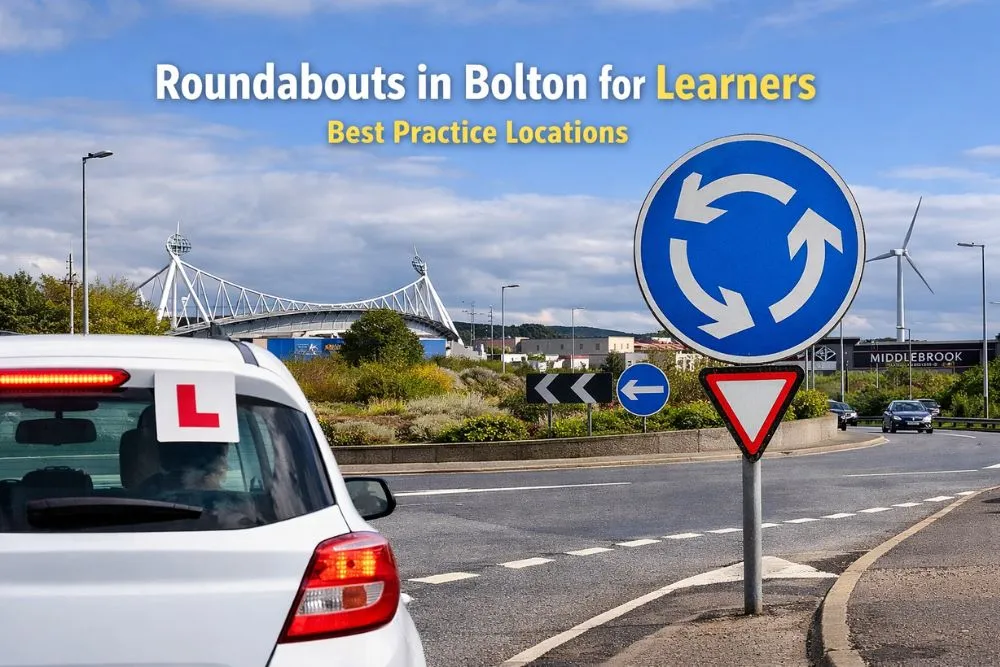
This is arguably one of the most important roundabouts for Bolton learners to master. Situated near the Middlebrook Retail Park and the Reebok Stadium area, this roundabout handles a significant volume of traffic throughout the day. It features multiple lanes, clear road markings, and a variety of exit options.
From experience, many learners find Middlebrook challenging because the approach roads are wide, which can make lane selection feel uncertain. The key here is to read the signs well in advance usually around 200 metres before the roundabout and position yourself correctly before you arrive.
Why this causes test failure: Learners who leave lane selection too late end up straddling lanes or making last-minute swerves. Examiners mark this as a serious fault because it creates genuine danger for other road users.
What to practise here: Approach at a steady speed, check your mirrors as you slow, select your lane early, and give way correctly to traffic from the right. On exit, remember to signal left and check your mirrors again before accelerating away.
2. St Peter’s Way Roundabout (Town Centre Area)
Located on the A666 St Peter’s Way, this roundabout sits on one of Bolton’s main arterial roads. It connects several key routes and is regularly busy during morning and evening rush hours. For learners, the challenge here is the speed of approaching traffic and the need to judge gaps confidently.
Examiners look closely at gap judgement at this roundabout. If you wait too long when a safe gap is available, that’s recorded as undue hesitation. However, if you emerge when the gap is genuinely too small, that’s a serious fault.
Instructor insight: The best approach is to arrive at the give way line having already slowed appropriately, looked right, and assessed the traffic. Don’t rush to stop, but don’t roll through without checking either. Be decisive.
3. Chorley New Road Roundabouts
The A673 Chorley New Road has several roundabouts as you travel between Bolton town centre and the outskirts toward Horwich. These vary in size and complexity, making this stretch an excellent training route.
The smaller roundabouts along here are great for building basic confidence, whilst the larger ones particularly those near busy junctions will prepare you for more demanding situations. Therefore, it’s worth asking your instructor to take you along this road at different times of day, including during busier periods.
Common learner mistake: Approaching too fast. Many learners are so focused on looking right for traffic that they forget to adjust their speed on approach. Arriving at a give way line too fast means you either have to brake harshly or emerge before you’re ready.
4. Plodder Lane / Farnworth Roundabouts
The Farnworth and Kearsley areas have several roundabouts that Bolton test centres use on certain routes. These are often quieter than the town centre roundabouts, which makes them brilliant for early-stage practise.
If you’re just getting to grips with roundabouts, this area allows you to build the muscle memory of looking, signalling, positioning, and emerging without the pressure of heavy traffic. As a result, many instructors use Farnworth roads to build initial confidence before moving learners onto busier roundabouts.
5. Waters Meeting Road / Halliwell Road Area
This northern part of Bolton includes roundabouts that connect residential roads with busier routes. The roundabouts here are excellent for practising observation because they require you to deal with vehicles coming from multiple directions, including cyclists and pedestrians crossing nearby.
Examiner mindset here: Examiners want to see that you check for vulnerable road users not just cars. If you emerge from a roundabout without checking for a cyclist on your left, that’s a serious observation fault.
Also Read: How to Improve Mirror Checks While Driving – A Guide for Learners
Real-Life Scenario: What Happens When It Goes Wrong
Imagine you’re approaching the Middlebrook roundabout on a weekday afternoon. You’ve checked your mirrors, selected the left lane for a straight-ahead exit, and you arrive at the give way line. A car is approaching from the right it’s moving at speed. You wait.
The car passes. There’s now a clear gap. But you hesitate for another three seconds. Another car appears. You wait again. The examiner notes this as undue hesitation.
Now imagine a different version. You approach, assess the gap correctly, emerge smoothly, maintain your lane through the roundabout, signal left before your exit, check your mirror, and pull away cleanly. That’s what a pass looks like.
The difference isn’t skill it’s practise and familiarity with the junction.
What Examiners Are Genuinely Looking For at Roundabouts
Examiners follow DVSA marking guidelines and assess each roundabout interaction on the same key points:
- Observation: Did you look right before emerging? Did you check for cyclists and pedestrians?
- Priority: Did you give way to traffic on the roundabout correctly?
- Positioning: Did you use the correct lane throughout?
- Signalling: Did you signal on approach (where required) and on exit?
- Speed: Did you approach at an appropriate speed and accelerate smoothly on exit?
- Undue hesitation: Did you emerge when it was safe to do so, without sitting unnecessarily?
A single serious fault on a roundabout such as failing to give way or cutting across a lane will fail your test immediately. Minor faults accumulate, so even small issues with signalling or positioning can add up across multiple roundabouts on the same test.
Common Mistakes Learners Make on Bolton Roundabouts
Not Reading the Road Markings
Bolton has several roundabouts where the lane markings don’t follow the standard pattern. Learners who rely on habit rather than observation will end up in the wrong lane.
Creeping Forward Without a Clear Gap
Many learners inch forward at the give way line without a proper clear gap. This makes drivers on the roundabout brake unexpectedly which is a serious fault because it creates danger.
Forgetting to Signal on Exit
This is one of the most frequently recorded minor faults at roundabouts nationally. It’s an easy one to fix build it into your routine every single time you exit any roundabout during practise.
Braking Harshly on the Roundabout
Smooth driving matters. If you brake sharply mid-roundabout because you’ve misjudged your position, examiners note this as poor vehicle control.
Looking Left Instead of Right
Sounds obvious, but under pressure, some learners look the wrong way first. You must look right that’s where priority traffic comes from.
Also Read: Best Places to Practise Driving in Bolton | Quiet Areas for Beginners
Practical Steps to Improve at Bolton Roundabouts
Here’s what you should do to genuinely improve:
- Walk the roundabout first. If possible, visit the Middlebrook roundabout or St Peter’s Way roundabout as a pedestrian or passenger. Look at the lane markings, the signs, the traffic patterns. Understanding a junction visually before driving it builds real confidence.
- Practise at quiet times first. Ask your instructor to take you to these roundabouts early on a Sunday morning before building up to rush-hour practise. The fundamentals are the same but confidence grows with repetition.
- Talk yourself through it. Many instructors encourage learners to narrate their thinking aloud: “I’m approaching, I’m checking right, gap is clear, I’m going.” This builds deliberate decision-making.
- Practise every exit. Don’t just practise going straight ahead. Practise left exits, right exits, and U-turns where permitted. Different exits require different lane positions and signalling.
- Build a post-roundabout review habit. After every roundabout, ask yourself: Did I position correctly? Did I signal on exit? Did I check my mirrors after? Self-evaluation accelerates improvement.
Quick Checklist: Roundabout Routine for Learners
Use this checklist every time you approach a roundabout during practise:
- Check mirrors (centre and left) as you begin to slow
- Read road signs and markings well in advance (aim for 200 metres)
- Select correct lane before reaching the roundabout
- Reduce speed appropriately on approach
- Look right before the give way line
- Give way to traffic on the roundabout from the right
- Check for cyclists and pedestrians before emerging
- Maintain your lane position through the roundabout
- Signal left as you pass the exit before yours
- Check your mirror before exiting
- Accelerate smoothly as you leave the roundabout
- Cancel your signal if it hasn’t self-cancelled
People Also Ask
What roundabouts are on the Bolton driving test route? Bolton test routes typically include roundabouts on St Peter’s Way, the Lostock/Middlebrook area, and several along Chorley New Road. Your examiner will choose a route based on traffic conditions on the day, so it’s important to be comfortable with a wide range of roundabouts rather than just memorising one route.
How do I know which lane to use on a roundabout? Always follow the road markings and signs on approach. As a general rule, use the left lane for exits to the left or straight ahead, and the right lane for exits to the right. However, road markings always take priority over general rules.
What is the most common roundabout fault on driving tests? Nationally, the most common roundabout fault is incorrect use of lanes. Locally in Bolton, examiners also frequently record issues with signalling on exit and undue hesitation when emerging.
Latest DVSA Approach to Roundabouts
The DVSA continues to emphasise independent driving and real-world judgement as core competencies for new drivers. This means examiners are looking beyond mechanical rule-following they want to see that learners can read a junction, make sensible decisions, and drive in a way that’s safe for everyone.
In recent years, the DVSA has also increased attention on vulnerable road users at roundabouts. Cyclists, motorcyclists, and pedestrians crossing near roundabout exits are regularly involved in incidents involving new drivers. Examiners will mark observation faults robustly if a learner fails to check for these road users.
Conclusion
Mastering the roundabouts in Bolton for learners is not about luck it’s about deliberate, structured practise at the right junctions. Start with quieter roundabouts in Farnworth to build your foundations, then progress to the more demanding multi-lane roundabouts at Middlebrook and St Peter’s Way.
Remember that examiners aren’t looking for perfection they’re looking for safety, good judgement, and control. If you can approach a busy Bolton roundabout, select the right lane, give way correctly, signal on exit, and emerge smoothly, you’re demonstrating exactly the standard the DVSA expects.
Work through the checklist above on every roundabout during every lesson. Review your decisions after each one. Build the habit, not just the knowledge and your test result will reflect it.
FAQs
- How many roundabouts will I encounter on the Bolton driving test?
Most Bolton test routes include between three and six roundabout interactions, depending on traffic conditions and the route selected by your examiner.
- Can I fail my test for hesitating too long at a roundabout?
Yes. Undue hesitation waiting when a safe gap is clearly available is a recordable fault and can result in a serious mark if it causes inconvenience or danger to other drivers.
- Do I need to signal when going straight on at a roundabout?
You don’t need to signal on approach when going straight ahead, but you must signal left as you pass the exit before yours. Always check the road markings for any local exceptions.
- Is the Middlebrook roundabout on the Bolton test route?
The Lostock and Middlebrook area is used on some Bolton test routes. Because test routes can vary, your instructor will be the best person to advise on the specific routes used from your test centre.
- What’s the best way to practise roundabouts as a learner in Bolton?
Combine lessons with a qualified instructor with additional supervised practise with a parent or supervising driver. Focus on different roundabouts, at different times of day, until the routine becomes automatic.