Lane discipline for beginners in the UK is one of those skills that sounds straightforward on paper but feels completely different once you’re actually behind the wheel. You’re managing the clutch, checking mirrors, watching the speed limit, and suddenly there’s a roundabout ahead with three lanes and a lorry pulling in beside you. It’s a lot.
From experience, many learners focus heavily on clutch control and steering in their early lessons but underestimate how much lane discipline affects both their safety and their driving test result. The truth is, poor lane positioning is one of the most common reasons learners pick up serious or dangerous faults on test day and most of the time, they didn’t even realise they’d done something wrong.
This guide breaks it all down in plain English. Whether you’re still in early lessons or approaching your practical test, understanding lane discipline properly will make you a safer, more confident driver and give you a much better chance of passing first time.
What Is Lane Discipline and Why Does It Matter?
Lane discipline simply means staying in the correct lane, positioning your vehicle properly within that lane, and moving between lanes safely and at the right time.
In the UK, we drive on the left-hand side of the road. This shapes everything about how lanes work from dual carriageways to town centre junctions. Poor lane discipline doesn’t just look untidy to an examiner; it can genuinely confuse other road users and create dangerous situations.
The Highway Code is clear on this. Rule 151 states that you should keep left unless overtaking. Rule 288 covers motorway lane discipline. However, the principles apply everywhere from a two-lane high street to a busy ring road.
Good lane discipline means:
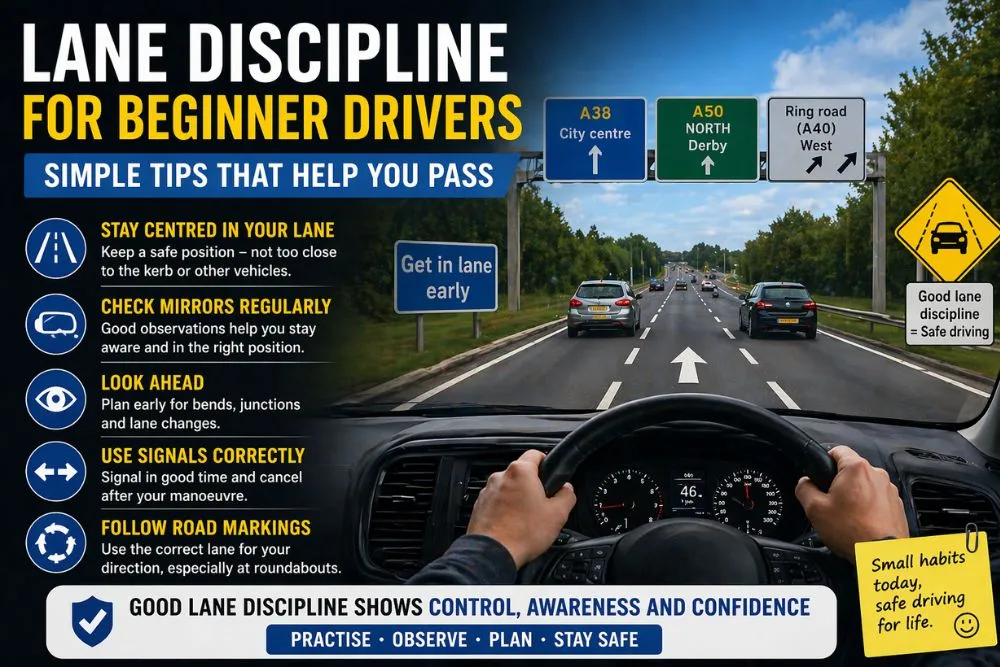
- Keeping your vehicle centred within your lane
- Not drifting towards the kerb or the centre line
- Moving lanes only when it’s safe and necessary
- Signalling early and clearly before any lane change
- Choosing the correct lane well in advance of junctions
Also Read: Night Driving Tips for Beginners UK – Essential Guide for New Drivers
The Examiner’s Perspective: What They’re Actually Judging
Examiners look for consistent, confident lane positioning throughout the entire test not just at complex junctions. Many learners assume the examiner only notices big mistakes. In reality, they’re building a picture of your overall driving standard from the moment you pull away.
What examiners are watching for includes:
- Consistent positioning on normal roads Are you hugging the kerb out of nerves? Are you drifting towards the centre line? Both suggest a lack of vehicle awareness.
- Lane choice at junctions and roundabouts Did you approach in the correct lane? Did you position early enough? Did you end up in the wrong lane after the manoeuvre?
- Lane changes on dual carriageways and multi-lane roads Did you check mirrors, signal, check the blind spot, and move smoothly? Or did you drift across without warning?
- Consistency under pressure Many learners position well on quiet roads but drift when traffic builds up or a large vehicle comes the other way. Examiners notice this.
This often leads to failure because the examiner records each instance of poor positioning. One or two minor faults may be forgiven, but a pattern of poor lane discipline quickly becomes a serious fault or multiple minors that add up to a fail.
Real Driving Examples: UK Scenarios You’ll Actually Face
Town Centre Junctions
Imagine you’re approaching a crossroads in a busy town centre. There are two lanes left for turning left, right for going straight on or turning right. You need to turn right, so you move into the right lane.
However, as you go around the corner, you naturally drift wide and end up straddling the centre of the road on the exit. This is a very common mistake. You’ve chosen the right lane correctly, but your exit position lets you down.
The fix: As you complete the turn, aim to arrive back in the left lane (if turning right) cleanly, without drifting. Think about your exit point before you enter the junction, not after.
Roundabouts
Roundabouts are where lane discipline causes the most test failures. From experience, many learners understand which exit they need but struggle to translate that into the correct lane positioning.
A basic rule for UK roundabouts:
- Turning left (first exit): Approach in the left lane, stay left, signal left as you pass the exit before yours.
- Going straight ahead (second exit): Approach in the left lane on most smaller roundabouts, no signal on approach, signal left after passing the first exit.
- Turning right (third exit or further): Approach in the right lane, signal right on approach, move to the left lane as you come around, signal left before your exit.
Where learners go wrong: They choose the right lane but fail to move back into the left lane when exiting, cutting across traffic. This creates a serious fault and, in real life, a collision risk.
Dual Carriageways
On a dual carriageway, the left lane is for normal driving. The right lane is for overtaking only. Many learners, particularly those who’ve only driven on town roads, sit in the right lane out of comfort or habit.
This is known as “middle-lane hogging” and examiners will penalise it. Moreover, since 2013, the police can issue fixed penalty notices for this behaviour. It’s not just a test issue it’s a real-world offence.
Also Read: How Mock Driving Tests Help You Pass Faster | UK Learner Guide
Common Mistakes Beginners Make with Lane Discipline
1. Approaching the Kerb When Nervous
When a large vehicle comes the other way, many learners instinctively move left sometimes too far left. Clipping the kerb or mounting the pavement is an automatic serious fault.
Why this causes failure: It shows a lack of vehicle control and spatial awareness. The examiner will likely intervene.
2. Straddling Lane Markings
Some learners drive with their wheels on or near the white lane markings, unsure which lane they should fully commit to. This is especially common on multi-lane roads or when approaching roundabouts.
Why this causes failure: It confuses other drivers, creates danger, and shows indecision all things examiners flag immediately.
3. Late Lane Changes
Leaving a lane change too late for example, realising you’re in the wrong lane 50 metres before a junction causes rushed, dangerous manoeuvres.
Why this causes failure: A hurried lane change without proper mirror and signal procedure is almost always a serious fault. The examiner will have recorded both the incorrect lane choice and the poor correction.
4. Forgetting the Blind Spot Check
When changing lanes, mirrors alone aren’t enough. Every lane change requires a proper over-the-shoulder blind spot check before you move.
Why this causes failure: Failing to check the blind spot is a serious fault, particularly on faster roads. Examiners watch your head movement.
5. Cutting Corners on Left Turns
On a left turn, some learners swing wide to the right before turning like they’re driving a lorry. This takes them into oncoming traffic momentarily.
Why this causes failure: It’s dangerous and suggests poor vehicle positioning awareness.
Practical “Do This” Steps for Better Lane Discipline
Here’s what you can start applying right now in your lessons:
Before any junction or roundabout: Ask yourself, “Which lane do I need?” as soon as you can see the road markings or signs. Give yourself time to get into position calmly.
On normal roads: Your left-hand tyres should be roughly one metre from the kerb. Use reference points your instructor shows you the position of the kerb in your left wing mirror is a reliable guide.
When changing lanes: Follow this sequence every time Mirrors (centre, then relevant door mirror), Signal, Blind spot check, Move. Make this a habit, not an afterthought.
On roundabouts: Before you reach the roundabout, say aloud (or in your head) which exit you’re taking and which lane you need. Decision first, then position.
On dual carriageways: Unless you’re actively overtaking, be in the left lane. Move right to overtake, move back left once clear. Don’t linger in the right lane.
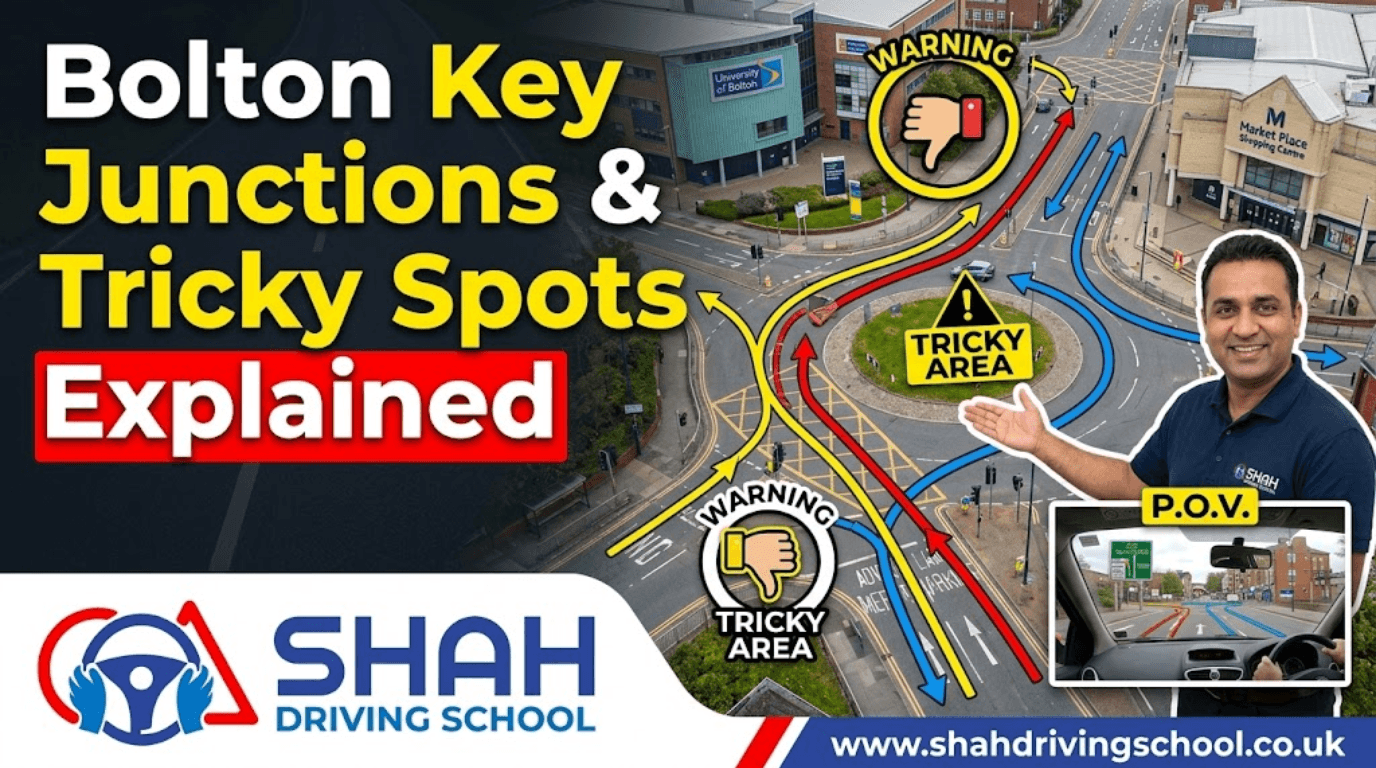
Also Read: Roundabouts in Bolton for Learners | Key Junctions to Practise Before Your Test
Quick Lane Discipline Checklist
Use this before and during every drive:
- Am I in the correct lane for my intended direction?
- Have I positioned early not at the last second?
- Are my wheels centred in the lane, not on the markings?
- Before a lane change mirrors, signal, blind spot check?
- Am I signalling clearly and with enough notice?
- On a roundabout do I know my exit and correct approach lane?
- On a dual carriageway am I in the left lane unless overtaking?
- Am I maintaining a consistent position under pressure?
- After a turn am I returning to the correct lane cleanly?
- Am I checking mirrors every 8–10 seconds on moving roads?
People Also Ask
What is lane discipline in driving? Lane discipline means staying correctly positioned within your lane, choosing the right lane for your direction in advance, and changing lanes safely using mirrors, signals, and blind spot checks.
What causes lane discipline faults on a UK driving test? Common causes include straddling lane markings, late lane changes, incorrect roundabout approach lanes, and failing to check blind spots before moving across.
How do I stay in the centre of my lane? Use reference points like the position of the road markings relative to your bonnet. Your instructor will help you identify the visual cues specific to your vehicle.
Is middle-lane driving illegal in the UK? Yes. Since 2013, middle-lane hogging on motorways and dual carriageways is a careless driving offence, carrying a fixed penalty and points on your licence.
Do examiners fail you for minor lane drift? One or two instances might only generate a minor fault. However, a consistent pattern of poor positioning throughout the test will accumulate into a fail.
Real-Life Scenario: The School Run Roundabout
Picture this. It’s 8:45am on a Tuesday. You’re on your driving test. The roads are busy parents dropping off kids, delivery vans, and commuters all heading through the same small roundabout near a school.
You need the third exit effectively turning right. You approach in the right lane as you should, signal right, and give way to traffic already on the roundabout. So far, so good.
But as you come around, you’re so focused on finding your exit that you forget to signal left and move across into the left lane before exiting. You leave the roundabout still in the right-hand lane, cutting across a car that was coming around in the left lane.
The examiner marks it as a serious fault. Not because you chose the wrong lane on the approach but because you didn’t complete the manoeuvre correctly.
This scenario happens regularly in test centres across the UK. The lesson? Roundabout lane discipline doesn’t end when you find your exit. It ends when you’ve left the roundabout safely in the correct lane.
Latest DVSA Approach to Lane Discipline
The DVSA regularly updates its guidance to reflect real-world driving demands. In recent years, there’s been a stronger emphasis on independent driving during tests longer stretches where you follow sat-nav directions or road signs without instructor prompts.
This means examiners now observe lane discipline across a wider and more varied range of road types than before. You might be directed onto a dual carriageway, through a town centre, across a complex roundabout, and back through residential streets all in one test.
The DVSA’s National Standard for driver and rider training makes clear that safe, consistent positioning is a core competency. It’s not an optional extra it’s fundamental.
Also, with more learners taking their test in urban areas with complex lane layouts, examiners are increasingly focused on whether drivers can handle multi-lane roads independently, without relying on verbal guidance. Practising on a range of UK roads not just familiar quiet streets is more important than ever.
Conclusion: Confidence Comes From Understanding the Rules
Lane discipline for beginners in the UK isn’t something you master in one lesson. It builds gradually as you understand the rules, practise them across different road types, and develop an eye for positioning.
The good news is that it’s entirely learnable. Every mistake you make in lessons is one you won’t make on test day as long as you understand why it was wrong and how to correct it.
Focus on getting into the right lane early. Develop your mirror-signal-blind spot routine until it’s automatic. Ask your instructor to take you on dual carriageways and complex roundabouts, even if they feel daunting. The more exposure you get, the more natural it all becomes.
You’re not just learning to pass a test. You’re building habits that will keep you and everyone around you safer for the rest of your driving life. That’s worth getting right.
FAQs
Q: How early should I move into the correct lane before a junction?
A: As soon as you see the lane markings or direction signs ideally with enough time to position smoothly without rushing or cutting across traffic.
Q: Can I be failed for driving too close to the kerb?
A: Yes. Consistent kerb-hugging suggests poor spatial awareness and can generate minor faults that accumulate. Mounting the kerb is a serious or dangerous fault.
Q: What’s the correct lane for going straight on at a roundabout?
A: On most smaller roundabouts, approach in the left lane with no signal. On larger roundabouts with marked lanes, follow the road markings.
Q: How do I check my blind spot without swerving?
A: Keep your steering steady and make a quick, deliberate glance over your shoulder. Practise this in lessons until it becomes a smooth, controlled movement.
Q: Does lane discipline apply in car parks?
A: While car parks aren’t usually part of driving tests, good lane habits apply everywhere. Follow marked lanes, one-way systems, and keep a safe, centred position.