
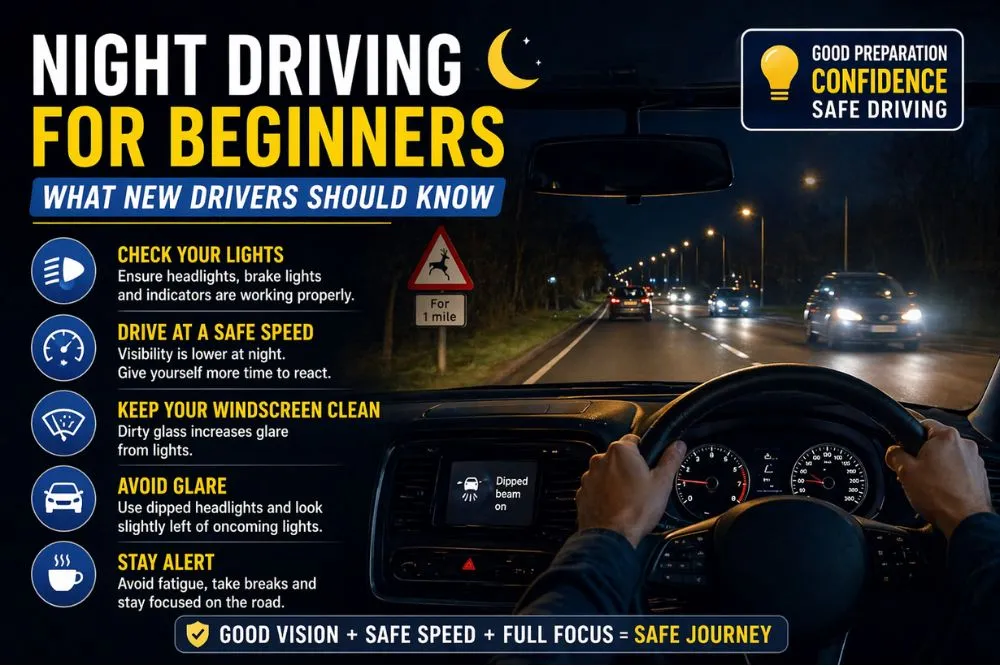
If you’re searching for night driving tips for beginners in the UK, you’ve already taken the right first step recognising that driving after dark is a genuinely different skill to daytime driving. Many new drivers pass their test, get behind the wheel after sunset for the first time, and feel an immediate wave of anxiety. The roads look unfamiliar. Headlights dazzle. Junctions feel harder to read. That reaction is completely normal.
From experience, many learners underestimate how much the loss of natural light changes their perception of speed, distance, and hazards. During the day, your peripheral vision, depth perception, and ability to read road markings all work together effortlessly. At night, you’re relying far more heavily on your headlights, your mirrors, and your anticipation skills. The good news? These are all things you can learn, practise, and master.
This guide walks you through everything a new UK driver needs to know about driving at night from understanding your headlights to reading roundabouts in the dark, staying safe on rural roads, and building genuine confidence behind the wheel.
Night driving is more demanding because your visibility is dramatically reduced. During daylight, you can see hazards, pedestrians, cyclists, and road signs from a significant distance. After dark, your effective vision is largely restricted to what your headlights illuminate typically around 30 to 50 metres on dipped beams.
However, it’s not just about seeing less. Your brain also processes visual information more slowly in low light. Reaction times can be slightly slower, and judging the speed of oncoming vehicles becomes harder. Add in the glare from other drivers’ headlights, wet road reflections, and the general fatigue that often comes with late-night driving, and you have a combination of challenges that beginners simply haven’t encountered during their lessons.
In the UK, a significant proportion of fatal road accidents happen during hours of darkness, despite there being far fewer vehicles on the road at night. That statistic isn’t meant to alarm you it’s meant to explain why taking night driving seriously, from the very beginning, matters enormously.
Also Read: How Mock Driving Tests Help You Pass Faster | UK Learner Guide
One of the first things any new driver must understand is when to use dipped headlights versus full beam (also called main beam). In the UK, you must use headlights from sunset to sunrise, and also during poor daytime visibility such as heavy rain or fog.
Dipped headlights point slightly downward and to the left. They illuminate the road ahead without blinding oncoming drivers. Full beam projects a much wider, brighter light straight ahead brilliant for unlit rural roads, but dangerous if used when other vehicles are present.
The rule is straightforward: switch to full beam only on unlit roads when no other vehicles are approaching. The moment you see oncoming headlights, switch back to dipped. Failing to do this is not just inconsiderate it actively creates a hazard by temporarily blinding the other driver.
From experience, many learners forget to switch back from full beam because they’re concentrating so hard on everything else. Make it a habit to check your beam setting every time you approach a built-up area or see lights ahead.
Front and rear fog lights are there for a specific purpose: use them only when visibility drops below 100 metres due to fog or heavy precipitation. Using fog lights in normal conditions dazzles other drivers and is actually an offence under the Highway Code. Switch them off as soon as conditions improve.
In UK town centres at night, pedestrian behaviour becomes far less predictable. People leaving pubs or restaurants may step into the road unexpectedly. Areas around takeaways, nightclubs, and late-night bus stops require extra vigilance.
A common scenario: you’re driving through a town centre at 11pm. The road looks clear. But a pedestrian wearing dark clothing steps off the kerb between parked cars. In daylight, you’d have spotted them from 40 metres away. At night, they may only appear at 15 metres, leaving you a fraction of a second to react.
The practical lesson here is to reduce your speed significantly in pedestrian areas at night, even if the road appears empty. This is called defensive driving planning for what might happen, not just reacting to what is happening.
Roundabouts are among the most misread features on UK roads in the dark. Without daylight to help you see vehicles approaching from the right, you need to rely far more on their headlights. However, because headlights sweep around in arcs, judging the exact position and speed of a vehicle on a roundabout becomes more difficult.
The key advice here is to slow your approach more than you would during the day. Give yourself more time to assess the situation. Do not assume a gap is safe simply because you’d have taken it at noon. Many night-time collisions on roundabouts happen because a new driver misread the distance of an approaching vehicle whose headlights were partially obscured.
Rural roads at night are where new drivers often feel most vulnerable and where the risks are genuinely higher. There are no streetlights, road markings may be faded, and hazards can appear suddenly: animals crossing, cyclists without adequate lighting, potholes, and sharp bends.
On unlit rural roads, use full beam wherever safe to do so. However, be prepared to drop back to dipped instantly. Position yourself slightly left of centre on narrow lanes so that oncoming headlights don’t push you towards the verge. Reduce your speed to a level where you could stop safely within the distance your headlights illuminate this principle is known as “driving within your lights.”
Also Read: Roundabouts in Bolton for Learners | Key Junctions to Practise Before Your Test
Although the DVSA practical driving test can be conducted partially in the dark during winter months, many new drivers don’t realise that examiners are assessing exactly the same competencies just in more challenging conditions.
Examiners look for appropriate use of headlights, correct mirror usage, and whether the candidate adjusts their speed and following distance to account for reduced visibility. A driver who maintains the same motorway-adjacent speed on an unlit A-road that they’d use at midday will be flagged immediately.
More specifically, examiners notice whether you anticipate hazards ahead rather than reacting late. This shows genuine understanding of the environment. They also observe whether your road positioning adapts for example, giving more space to cyclists in the dark, who are far harder to spot, and allowing extra clearance when overtaking parked vehicles.
This often leads to failure because new drivers treat night conditions as identical to daytime conditions but with the lights on. They’re not. The entire psychological approach must shift towards greater caution and earlier anticipation.
This is arguably the most widespread error. Overdriving your headlights means travelling at a speed where, if a hazard appeared at the edge of your illuminated zone, you would not have enough distance to stop safely. Many new drivers cruise at 60mph on a rural road with dipped beams that only light 40 metres ahead. The stopping distance at 60mph is over 73 metres. The mathematics are stark.
The two-second rule during the day becomes a three-second rule at night, at minimum. Wet roads, reduced reaction time, and limited visibility all demand more space between you and the vehicle ahead. From experience, learners who tailgate at night do so because the road feels quieter and less busy which creates a false sense of safety.
When an oncoming vehicle doesn’t dip its lights, many new drivers either freeze or stare directly at the headlights both dangerous responses. Instead, look towards the left edge of the road (the kerb or white line) to maintain your lane position without looking into the source of glare. Slow down slightly and allow the vehicle to pass. Do not flash your lights aggressively or swerve.
At night, your mirrors show headlights rather than vehicles. This means a vehicle that appeared far away in your mirror may actually be closer and travelling faster than you’d estimate in daylight. Check mirrors earlier and more often, particularly before braking.
Before you set off:
While driving:
Managing fatigue:
Also Read: Top Observation Mistakes That Cause Driving Test Failures | UK Driving Guide
Yes, night driving is objectively more challenging for new drivers. Reduced visibility, headlight glare, and increased fatigue all contribute. However, with correct technique and preparation, it becomes manageable with practice.
Use full beam only on unlit roads when no other vehicles are approaching or ahead of you. Switch back to dipped headlights as soon as you see other road users, whether ahead or oncoming.
Reduced visibility combined with excessive speed is the most common factor. Many drivers fail to adjust their speed to match their visibility range, particularly on unlit rural roads.
Yes. Learner drivers can and should practise night driving before their test, particularly during winter months when tests may be partially conducted after dark. Practise with a qualified instructor first.
Look towards the left edge of the road the kerb line or white line rather than at the oncoming headlights. Slow down slightly, and avoid looking directly at the light source.
Imagine you’ve recently passed your test and you’re driving home after a family dinner at 9pm on a November evening. The roads through your town centre are lit, but once you leave the main roads, the countryside ahead is completely dark.
You’re on a familiar B-road, but it looks completely different at night. Your dipped headlights show you about 40 metres ahead. You’re doing 50mph the limit but something feels wrong. You realise you’re overdriving your headlights. You ease off to 40mph, give yourself more margin, and almost immediately feel more in control.
Halfway home, a deer appears at the edge of your headlights. Because you’ve slowed down, you have enough time to brake gently and wait for it to move. At 50mph, that may well have been a collision.
This is exactly the kind of real-world learning that turns a new driver into a safe driver. The speed limit is a maximum, not a target especially at night.
The DVSA (Driver and Vehicle Standards Agency) consistently highlights night driving as one of the key areas where newly qualified drivers face elevated risk. Their research into newly qualified driver collisions shows that young drivers are disproportionately involved in night-time accidents in the months immediately following their test.
As a result, the DVSA encourages new drivers to continue structured learning even after passing through post-test courses such as Pass Plus, which includes a dedicated night driving module. This module helps new drivers experience and manage night-time conditions under the guidance of a qualified instructor before venturing out fully independently.
The Highway Code also places clear obligations on drivers regarding lighting. Rule 226 states that headlights and fog lights should be used when visibility is seriously reduced, and Rule 115 addresses the use of dipped headlights when following another vehicle to avoid dazzling the driver ahead.
Night driving for beginners in the UK doesn’t have to be frightening. It does, however, require a deliberate change in mindset, technique, and preparation. The drivers who adapt quickly are those who treat night conditions as a different environment entirely not simply daytime driving with the lights on.
Reduce your speed. Increase your following distance. Use your headlights correctly. Keep your windscreen clean. Stay alert to pedestrians, cyclists, and animals. And above all, never drive when you’re too tired to concentrate.
Every experienced driver was once exactly where you are now nervous, uncertain, and learning. The difference between those who become confident night drivers and those who remain anxious is simply practice, patience, and the right knowledge. You now have the knowledge. The rest is time behind the wheel.
Q: Should new drivers avoid driving at night?
Not entirely but limit long or complex night drives in the early weeks, and always ensure you’ve had some guided practice first.
Q: Do I need fog lights on at night if it’s not foggy?
No. Fog lights are for visibility below 100 metres only. Using them unnecessarily dazzles other drivers and is a Highway Code offence.
Q: Is night driving part of the UK driving test?
It can be, particularly during winter. Examiners use whatever conditions are present, so night driving experience before your test is genuinely beneficial.
Q: How do I know if my headlights need adjusting?
If your lights seem low or vehicles seem poorly lit ahead of you, a garage can check headlight alignment. Misaligned headlights are a common MOT failure point.
Q: Does Pass Plus cover night driving?
Yes. Pass Plus is a post-test course with a night driving module, designed specifically to help newly qualified drivers build confidence in conditions not always covered during lessons.
WhatsApp us