You approach a busy junction. A yellow grid covers the road ahead. The car in front edges forward, and a gap seems to open. Do you follow, or do you wait? Many learners guess wrong here.
Yellow box junction rules confuse even experienced drivers. Yet the rule itself takes one sentence to learn. This guide explains that rule properly, including the single exception, the fines, and what your examiner expects. Our Bolton instructors use these exact steps on local test routes every day.
What Is a Yellow Box Junction?
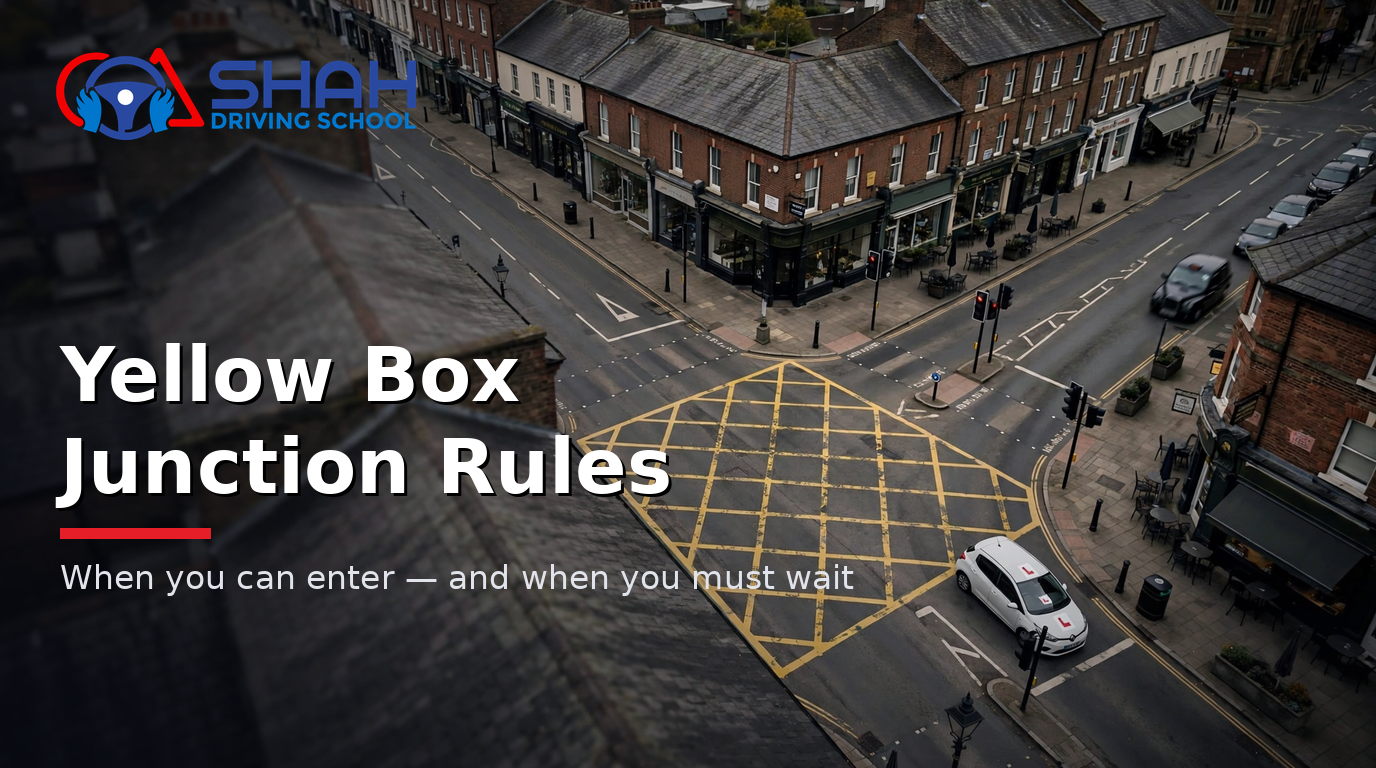
A yellow box junction is a criss-cross grid of yellow lines painted across a junction. You will find them at busy crossroads and traffic-light junctions. Some also sit outside fire and ambulance stations.
The purpose is simple: keep the junction clear. If cars stop inside the box, crossing traffic cannot move. The whole junction locks up within minutes. The empty grid gives emergency vehicles a clear path too.
No sign is needed for the rules to apply. The yellow markings alone carry the full legal force. You can revise all common markings in our guide to UK traffic signs and road markings.
!Close-up of yellow criss-cross box junction markings on the road
The Golden Rule: Highway Code Rule 174
Rule 174 of the Highway Code gives the rule in plain words: “You MUST NOT enter the box until your exit road or lane is clear.”
So before your wheels touch the yellow paint, look beyond the box. Ask one question: is there a full space for my car on the other side? If yes, cross in one smooth movement. If no, wait behind the stop line.
Notice what the rule measures. It is not about space inside the box. It is about space beyond it. Traffic moving slowly ahead of you does not guarantee your exit. Judge the exit, not the car in front.
Most fines happen for one lazy habit: following the vehicle ahead without checking. That driver may stop suddenly inside the box. You then stop behind them, trapped on the yellow grid. Wait for your own clear exit instead.
The One Exception: Turning Right
One situation allows you to wait inside the box. You want to turn right. Oncoming traffic, or other vehicles also waiting to turn right, block your path. In that case, you may enter the box and wait.
The conditions matter:
- Your exit road must be clear.
- Only oncoming traffic or other right-turning vehicles may stop you.
- You wait in the box, positioned for your turn, wheels straight until you move.
The lights may change to red while you wait there. Do not panic. You entered the box legally. Complete your turn carefully once oncoming traffic stops. Make sure pedestrians have cleared your exit road first.
But watch the limit of this exception. If a queue blocks your exit road, you cannot use it. A blocked exit means you wait outside the box, even when turning right.
Box Junctions at Traffic Lights and Roundabouts
Traffic lights add one extra layer. At a signalled junction, the stop line still controls you. A red light means stop, even if the box and your exit look clear. Enter only on green, and only when your exit space exists.
Amber needs the same judgement. Stop at the line unless you are too close to stop safely. Never accelerate into a box hoping the queue clears.
Signalled roundabouts carry a stricter version of the rule. Rule 174 says you must not enter the box there unless you can cross it completely without stopping. The turning-right exception does not apply on a signalled roundabout.
Common Mistakes Learners Make
Our instructors see the same five errors during manual driving lessons and automatic lessons alike:
- Following the car ahead blindly. Always judge your own exit space.
- Entering on green without looking beyond the box. Green allows progress; it never guarantees it.
- Stopping half in the box. If a full space is doubtful, wait. A half-space is not a space.
- Forgetting the right-turn conditions. A blocked exit cancels the exception.
- Creeping forward under pressure. Horns from behind change nothing. Your judgement protects your licence.
Each mistake comes from rushing. Slow your approach by two seconds. That pause lets you read the whole junction calmly.
What Fine Do You Get for Stopping in a Yellow Box?
Stopping in a yellow box when you should not is a moving traffic offence. Councils enforce many box junctions with cameras, including across Greater Manchester. A penalty charge notice typically costs £70 outside London, or £130 in London. Paying within 14 days usually halves the amount.
Your vehicle only needs to stop inside the box briefly to trigger a notice. The camera records your entry and your stop. Appeals exist, but prevention is far cheaper and simpler.
Remember why the penalty exists. One stopped car can block buses, crossing traffic and emergency vehicles. The fine protects the flow of the whole junction.
Yellow Box Junctions on Your Driving Test
The box junction is not a set exercise like the hill start. The examiner will not announce it. You will simply meet boxes on normal Bolton test routes.
The examiner watches your planning and judgement at every junction. Entering a box with a blocked exit shows poor forward planning. It can earn a driving fault. Blocking crossing traffic completely may be marked more seriously.
Stay calm if traffic stops unexpectedly after you entered legally. The examiner judges your decisions, not your luck. A composed hold shows maturity. Rehearse these junctions during intensive driving courses and mock tests before the real day.
A Bolton Box Junction Every Learner Should Know
Bolton town centre has a box junction learners meet early and often. It sits where Trinity Street meets Newport Street, close to the town centre routes our pupils practise weekly.
Rush hour fills its exits quickly. Buses cross the junction, and queues build from both directions. It teaches the golden rule perfectly: look beyond the box before you commit.
Your instructor will likely route you through it before your test. Practise waiting at its line without stress. That patience is exactly the skill the examiner wants to see.
How to Approach Any Box Junction: A 4-Step Routine
- Spot the box early. The yellow grid is visible well ahead. Lift off the gas and cover the brake.
- Read your exit. Look past the box to your exit lane. Confirm a full car-length space waits there.
- Decide before the line. Clear exit? Proceed smoothly. Blocked exit? Stop behind the line and wait.
- Cross in one movement. Avoid stopping on the grid. Keep your pace matched to the traffic beyond.
Turning right? Add one step. Signal, enter when your exit is clear, and wait only for oncoming traffic. This routine works at every box junction in Britain, and it forms part of your theory test knowledge too.
FAQs About Yellow Box Junction Rules
Can I stop in a yellow box junction at all?
Only in one situation. You may wait inside the box when turning right, blocked only by oncoming traffic or other right-turning vehicles. Every other stop inside the box breaks the rule.
What if my exit is clear but the traffic light is red?
Stop at the white line. A clear exit never overrides a red light. Wait for green, then re-check your exit before entering.
What happens if traffic stops suddenly after I entered legally?
Hold your position calmly and move as soon as the exit clears. Enforcement reviews the footage. Entering with a clear exit differs from entering a box whose exit was already blocked.
Do yellow box junction rules apply at roundabouts?
Yes, where boxes are marked, especially at signalled roundabouts. There you must cross completely without stopping. Normal roundabout rules apply everywhere else.
Can I enter the box to make room for an emergency vehicle?
Never block the box to help. Keeping the box empty is what helps emergency vehicles most. If one approaches from behind, follow normal Highway Code guidance and move aside only where it is safe and legal.
More questions? Read our frequently asked questions page.
Learn Junction Confidence With Local Instructors
Yellow box junction rules reward one habit: look beyond the box before you enter it. Master that judgement and these junctions become calm, routine moments in any drive.
Shah Driving School teaches manual and automatic lessons across Bolton, Horwich, Atherton and Farnworth. Our DVSA-approved instructors practise real town-centre junctions with you, step by step. Book your lessons today, or explore our driving lessons to find the right course. Let’s make every junction feel easy.