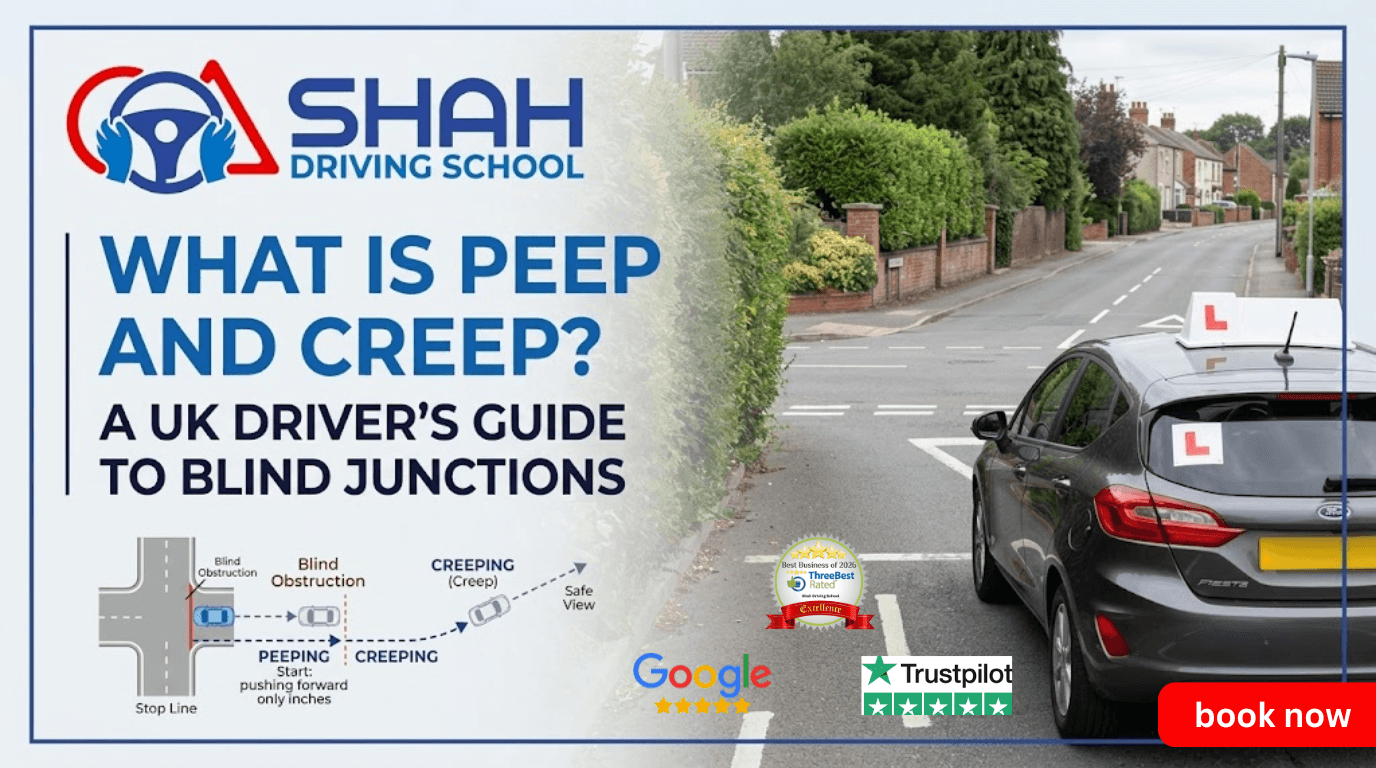
If you’re learning to drive in the UK, you’ve likely heard your instructor say “peep and creep” at some point. But what does it actually mean, and when should you use it? This guide breaks down the peep and creep technique clearly and practically — so you know exactly what to do when you encounter a blind or obstructed junction during your lessons or on your driving test.
Ready to get started? Book your driving lessons with Shah Driving School
What Does “Peep and Creep” Mean?
The phrase “peep and creep” is used to describe how you should emerge safely from a blind or partially obstructed junction. It means using very slow clutch control to inch your car forward gradually, improving your view of the road, while continuously looking both ways for oncoming vehicles.
In simple terms:
- Peep — edge your car slowly forward to gain a better line of sight
- Creep — continue moving at an extremely low speed using clutch control until you can clearly see the road in both directions
The golden rule is this: the point at which it’s safe to emerge is not when you think it’s clear — it’s when you can see that it’s clear. That includes checking for cars, motorcycles, cyclists, and pedestrians approaching from both directions.
Open Junctions vs Closed Junctions
To understand when peep and creep apply, you first need to know the difference between an open and a closed junction.
An open junction is one where you have a clear view of the road in both directions as you approach. You can assess the traffic situation before you even reach the stop or give way line.
A closed junction, on the other hand, is one where your view is restricted by a wall, hedge, parked vehicles, or a building positioned close to the road. You simply cannot see enough from the line itself to make a safe decision. That is precisely when peep and creep become essential.
[Internal Link: Learn how Shah Driving School prepares you for every junction type — Link to Driving Lessons Page]
When Should You Use the Peep and Creep Technique?
You will not always know a junction requires peep and creep until you are almost at the stop line. The clearest warning sign is a STOP sign, which tells you the junction is particularly hazardous and demands full attention.
Beyond that, consider using peep and creep whenever:
- Buildings, fences, or hedges block your view of approaching traffic
- Parked vehicles on either side of the road cut off your sightlines
- You are emerging from a narrow side road onto a busier main road
- Visibility is reduced due to poor weather, a tight bend, or a dip in the road
How to Perform Peep and Creep — Step by Step
Always approach any junction using the MSPSL routine — Mirrors, Signal, Position, Speed, Look — at an appropriate speed that allows you to stop safely if needed.
Once you’ve reached the junction and cannot see clearly, follow these steps:
- Stop at the give way or stop line — Never roll past it without first attempting to look
- Select first gear — If approaching from a higher gear, block change straight into first, around five metres from the junction line
- Find the clutch biting point — Gently raise the clutch to the point of engagement; this gives you precise control over your speed
- Peep forward gradually — Ease the car forward inch by inch, just enough to improve your view without entering the flow of traffic
- Look left and right continuously — Keep scanning both directions as your view opens up; never fix your eyes in one direction only
- Only go when you are certain it is safe — As The Highway Code (Rule 170) states, do not cross or join a road until there is a gap large enough for you to do so safely
Shah Driving School Tip: Cover the brake pedal lightly as you creep forward. This keeps you ready to stop immediately if a vehicle appears without warning. Never rush this process — patience here could prevent a serious collision.
Peep and Creep on a Hill
Emerging from a closed junction on an uphill slope requires a slightly different approach, and it catches many learner drivers out.
On a flat road, covering the brake as you creep is straightforward. On a hill, however, you will need a degree of gas to prevent the car from rolling back. You cannot set the gas with your foot on the brake, so you will need to find the right moment to release the brake, set the accelerator lightly, and bring the clutch to the biting point before inching forward.
If necessary, use the handbrake after stopping at the line to hold the car securely while you prepare to move. This is a technique your instructor at Shah Driving School will practise with you in a safe, controlled environment before you encounter it in traffic.
Struggling with hill starts and clutch control? See our structured driving lesson plans
Why This Technique Matters on Your Driving Test
Peep and creep is not just good practice — it is directly assessed during your DVSA practical driving test.
According to the DVSA, observation at junctions has been the single most common reason for driving test failures every year since 2006. The faults recorded include not looking in both directions, emerging into oncoming traffic, and pulling out when traffic is too close.
Failing to use peep and creep correctly at a closed junction could result in a serious or dangerous fault, both of which mean an automatic fail. Getting this technique right is therefore not optional; it is essential.
What The Highway Code Says About Junction Observation
The peep and creep technique is firmly grounded in The Highway Code.
Rule 170 instructs drivers to look all around before emerging and not to cross or join a road until there is a gap large enough to do so safely.
Rule 171 states that you must stop behind the line at a junction displaying a STOP sign and wait for a safe gap in the traffic before moving off.
Rule 172 confirms that you must give way to traffic on the main road when emerging from a junction with broken white lines across the road.
Importantly, the updated Highway Code also requires you to give way to pedestrians, cyclists, and horse riders at junctions — so while you’re peeping and creeping, you must be alert to vulnerable road users too, not just other motor vehicles.
🔗 Official Resource: Read the full junction rules in The Highway Code on GOV.UK
🔗 Official Resource: Visit the DVSA’s Safe Driving for Life hub for further guidance on driving standards and test preparation.
Common Mistakes Learner Drivers Make at Closed Junctions
Avoid these frequent errors that can cost you your driving test:
- Creeping out too fast — Speed defeats the purpose entirely; slow, controlled movement is what the technique demands
- Only looking one way — Always check left and right, repeatedly, before committing to emerge
- Sitting completely still — If you can’t see from the line, you must creep forward to gain visibility; staying static achieves nothing
- Assuming a signalling vehicle will turn — Never assume a car with its indicator on will actually turn. Wait until you can see it doing so
- Ignoring cyclists and pedestrians — Two-wheel road users and pedestrians can appear quickly and quietly; always account for them
- Rushing under pressure — Even if traffic is building behind you, do not let that pressure push you into emerging before it is safe
How to Build Confidence at Closed Junctions
The best way to master peep and creep is through consistent, structured practice with a qualified instructor who can guide you in real-world conditions.
Start by practising clutch control at very low speeds in a quiet area. Once you are comfortable holding the car at the biting point and moving forward in a controlled way, progress to actual junctions where your instructor can supervise your observation and decision-making.
At Shah Driving School, our DVSA-approved instructors break down every technique — including peep and creep — into clear, manageable steps. We build your skills gradually and safely, so that by the time you sit your test, handling closed junctions feels second nature.
Book your first driving lesson with Shah Driving School today
Conclusion
Mastering the peep and creep technique is a fundamental part of becoming a safe and confident driver on UK roads. Whether you’re approaching a quiet residential side street or a busier town centre junction with restricted sightlines, knowing how to handle a closed junction calmly and correctly could prevent a serious accident — and help you pass your driving test first time.
Do not leave it to chance. Learn it properly, practise it consistently, and get it right when it counts.
Start your driving journey the right way — Book lessons with Shah Driving School
Information sourced from The Highway Code (GOV.UK) and DVSA guidance. All driving advice is intended for learner drivers preparing for the UK practical driving test.