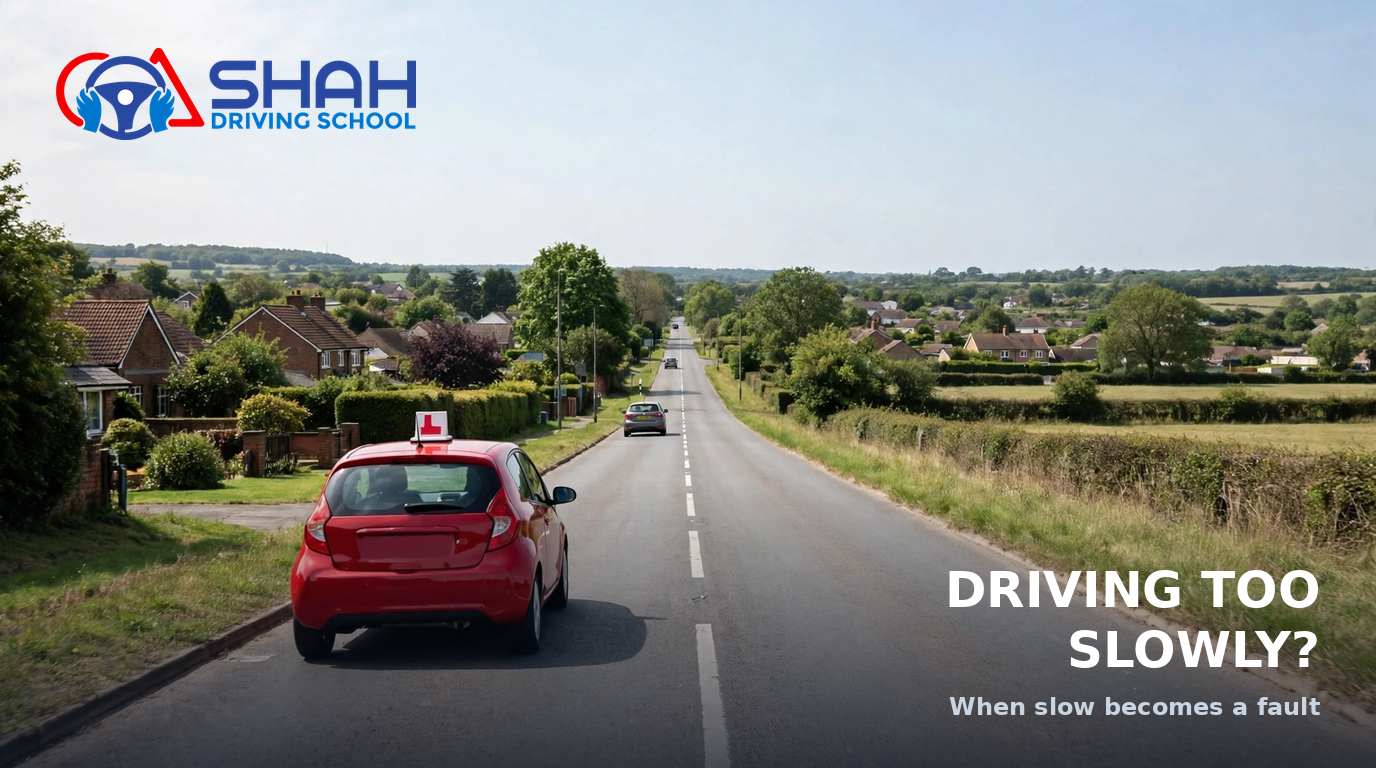

Yes, driving too slowly can fail your driving test. Examiners mark progress: driving at a speed that suits the road and traffic, without holding other road users up. Slow down without a reason, and faults follow.
That surprises many learners. Slow feels safe. But the test is not asking for slow. It is asking for appropriate speed. In DVSA’s 2025-26 list of the most common reasons for failing, maintaining progress on speed entered the top ten at number ten. This guide explains where the line sits, and how to stay on the right side of it. It is written by the Shah Driving School instructor team.
Start with the rule that confuses people. A speed limit is the maximum allowed, not a speed you must reach. Highway Code Rule 124 says you must not exceed the limit for the road and your vehicle. Rule 125 adds that the limit does not mean that speed is safe in all conditions. Rule 146 says it plainly: do not treat speed limits as a target.
So nobody expects you to drive at the limit everywhere. On a bend, near pedestrians, in bad weather or at night, slower is correct. Our full guide to UK speed limits covers the limits themselves. This article is about the other side of the line: when slower stops being careful and starts being a fault.
Think of speed as a zone, not a number. Too fast for the conditions is dangerous. Too slow without a reason holds traffic up and creates its own risks. The examiner is looking for the middle zone: a speed that fits the road, the traffic and what you can see.
GOV.UK’s guide to understanding your test result marks progress in two parts: appropriate speed, and undue hesitation. Undue hesitation means slowing down or waiting when you did not need to. The examiner watches this throughout the test, not just in one moment.
The common progress faults are practical ones. Not emerging from a junction when it is safe to go. Driving unnecessarily slowly and holding up following traffic. Driving well below the limit on clear roads. Waiting for another driver who has clearly given way to you. Each of those is driving too slowly for the situation, even though the car is moving safely in every other way.
One brief hesitation will not usually decide a test on its own. You pass with no more than 15 driving faults and no serious or dangerous faults. The problem is a pattern. A learner who cruises well below the limit on every clear stretch, and waits at every junction for a perfect gap, collects progress faults all the way round. That pattern is what fails people.
In lessons, the pattern is easy to spot. The learner is careful at every junction, which sounds good. But the car cruises far below the limit on every clear stretch. Gaps that were safe get refused. By the end of the drive, driving too slowly has shaped the whole journey. That is the pattern examiners are marking, not one cautious moment.
There is also a safety point behind the marking. A car travelling far below the flow of traffic forces others to brake, bunch up or overtake. Examiners are not punishing caution. They are checking that you can keep traffic moving safely, the way you will need to after you pass.
Slowing down for a reason is good driving, and examiners do not mark it. Reduce speed for bends and hazards. Slow down where pedestrians, cyclists or horse riders share the road. Take more care in bad weather and at night, when you can see less. On residential streets with parked cars and children about, slow and careful is exactly right.
The test behind all of this is simple: can you stop safely within the distance you can see to be clear? If the answer needs a slower speed, slow down. Our guide to stopping distances explains how speed and stopping distance connect. Appropriate speed always starts from what you can see.
A useful question on test day is: what am I slowing down for? If you can name the hazard, the bend, the crossing or the parked cars, your speed is probably right. If the honest answer is nerves, habit or a speedometer you keep checking, you may be driving too slowly for the road in front of you.
The difference is reason. Slowing for a bend, a crossing or a narrow street has a reason the examiner can see. Sitting well below the limit on a clear, dry road with good visibility has none. Driving too slowly only becomes a fault in the second case.
From the passenger seat, the too-slow habit usually has one of three causes. The first is fear of speeding. Learners watch the speedometer instead of the road, and hold the car well under the limit to feel safe. The second is unfamiliar faster roads. A learner who has mostly driven in town meets a clear 50 or 60 mph road and stays at town speed. The third is late decisions. If you reach a junction still deciding, you slow down to buy time, and the car behind pays for it.
The speedometer trap deserves a mention of its own. Checking your speed is part of driving. Staring at the dial is not. Learners who fixate on the number drive to the instrument instead of the road. Their speed drops every time their eyes drop. A quick glance, then eyes back up, keeps both speed and observation honest.
None of these mean you are a bad driver. They mean the skill is unfinished. Progress is a confidence skill built on planning: the earlier you read the road, the less you need to slow down to think.
Three habits fix most of it.
Look further ahead. Most unnecessary slowing starts with looking too close. Lift your eyes to the far end of the road. You will see junctions, signs and hazards earlier, and your speed will settle naturally.
Build speed after junctions. On clear roads, accelerate smoothly up to a speed that fits the road and traffic. Check mirrors before speeding up, then settle. Practise this on faster roads in lessons, including dual carriageways. Our dual carriageway guide for beginners covers building speed on slip roads and faster routes.
Decide early at junctions. Approach at a speed that lets you judge the gap while rolling. Look, assess, look again, then go or wait. One clear decision beats three nervous ones. This is also where independent driving practice helps: our guide to independent driving and sat nav on your test shows how making your own decisions in lessons builds exactly this confidence.
Driving too slowly fails tests quietly. There is no single dramatic moment, just a pattern of held-up traffic and missed gaps. The fix is not to drive faster everywhere. It is to drive at the speed the road asks for: slower where hazards demand it, and up to a sensible pace where the road is clear. If progress faults are showing up in your lessons, compare our manual driving lessons and automatic driving lessons, or ask us a question through the contact page. Call 0749 0662 777 to talk through your test preparation.
WhatsApp us