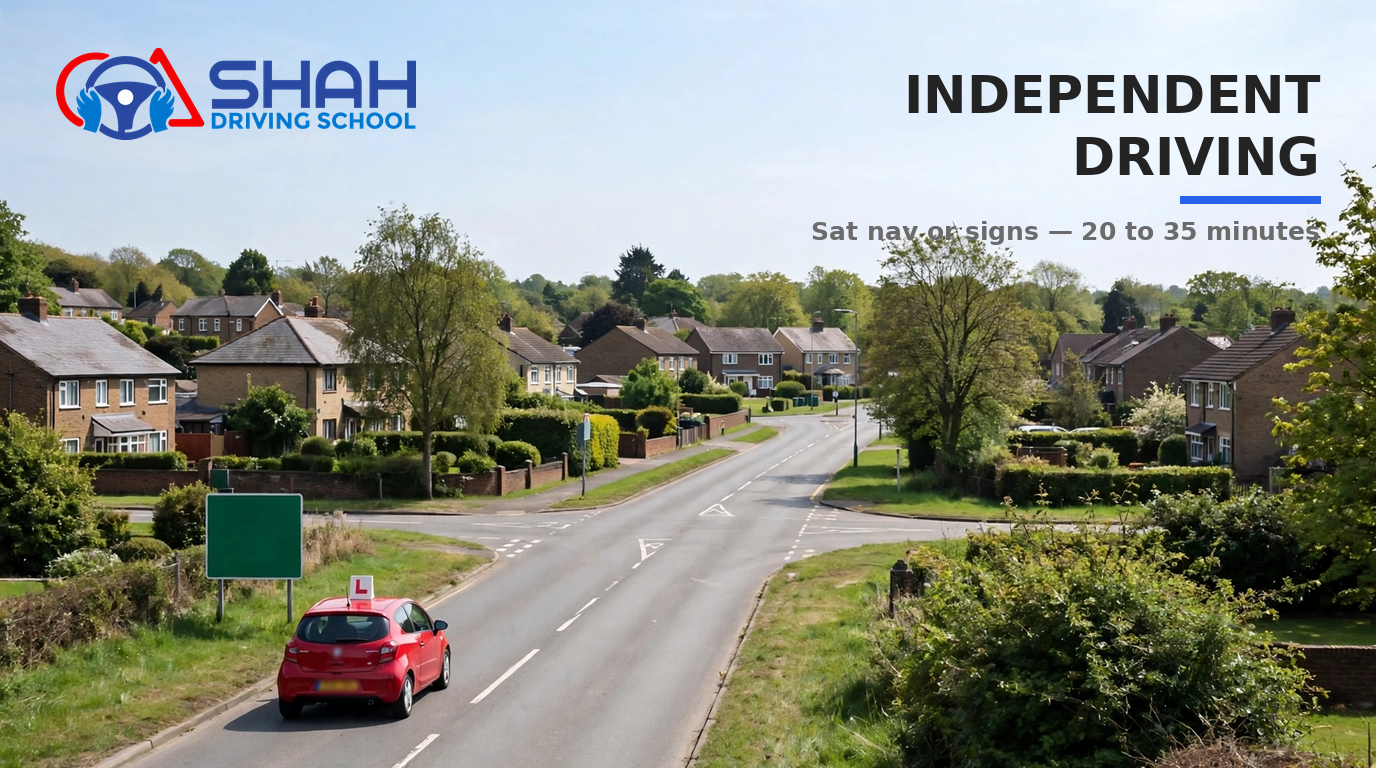

Independent driving lasts 20 to 35 minutes of your test. You follow directions from a sat nav, traffic signs, or a mix of both. The examiner tells you which one, and sets the sat nav up for you.
The section exists for a simple reason. After you pass, nobody sits beside you giving directions. You will follow signs, sat navs and your own judgement. Independent driving is the test checking that you can already do that safely.
That is the part learners worry about most. The examiner goes quiet, and suddenly the route is your job. This guide explains what actually happens in that section, what the examiner is marking, and how to practise it so it feels ordinary. It is written by the Shah Driving School instructor team.
Your test has four parts: an eyesight check, the show me tell me questions, general driving ability, and one reversing manoeuvre. Independent driving sits inside the general driving part. You drive for around 35 minutes in total, in varied road and traffic conditions, but not on motorways.
For the independent section, the examiner stops giving turn-by-turn directions. Instead, you follow the sat nav, the signs, or both. Outside that section, the examiner gives directions as normal. The driving standard expected does not change. Only the source of directions changes.
From the passenger seat, the shift is smaller than learners expect. The junctions are the same. The mirrors, signals and speed control are the same. The only new job is deciding where to go next while you drive. That is why we practise it as a driving skill, not a memory test.
The examiner will tell you which you have to follow. If it is the sat nav, they set it up for you. You cannot use your own sat nav, and you do not need to touch theirs. Listen to the instruction, glance only when it is safe, and keep your eyes on the road.
If you are following traffic signs, the examiner names a place or a route to follow. Signs can be hidden by trees or parked vehicles. GOV.UK says that if you cannot see a sign, the examiner will give you directions until you can see the next one. You are not expected to guess a sign you cannot see.
Using the sat nav well is a small skill of its own. Instructions come in stages: an early warning, then the turn itself. Listen to the early warning and prepare. Do not stare at the screen waiting for the arrow to move. A quick glance when the road is clear is enough. If an instruction surprises you, drive the road in front of you first. A late but safe turn beats a sudden swerve every time.
Following signs needs the same early habit. Read the sign as soon as it is readable. Find your place name, note the lane arrows, and position the car early. Learners who read signs at the last moment change lanes late. Late lane changes are where mirrors get forgotten.
Test routes are not published. You cannot learn the exact route in advance, and you do not need to. Independent driving tests whether you can follow directions on roads you have not memorised. That is the point of the section.
Learners often treat this section as a navigation exam. It is not. The examiner is still marking your driving: observation at junctions, mirror checks before changing direction, lane choice, speed, and how you respond to other road users. The sat nav only replaces the examiner’s voice.
The method we teach is simple: listen, picture, prepare. Hear the instruction early. Picture the junction or roundabout it describes. Prepare the car in good time: mirrors, signal, position, speed. Learners who wait until the last moment end up steering and deciding at the same time. That is when faults happen.
The faults we see most in this section are decision faults, not steering faults. A learner hears an instruction, stares at the sat nav, and stops checking mirrors. Another reaches a junction still deciding, then stops in a live lane to think. Another changes lane late and cuts across traffic. None of those faults come from the sat nav. They come from deciding too late. Independent driving rewards early decisions.
Roundabouts show this clearly. A sat nav may say take the second exit. Your job is still the same as always: approach at a safe speed, choose the correct lane, observe properly, and signal at the right time. Our guide to T-junctions and crossroads covers the observation routine that makes those decisions calmer.
A wrong turning is not a fault. The examiner will help you get back on route. What earns faults is the reaction: harsh braking, swerving, stopping in a live lane, or making an illegal correction to get back.
So the rule is simple. If you miss a turning, keep driving safely. Follow the road. The sat nav will recalculate, or the examiner will guide you back. We cover this in full in our guide to going the wrong way on your driving test. It is worth reading before test day, because knowing the rule removes most of the panic.
Good independent driving looks calm. The car is positioned early. Mirrors are checked before every change of direction. Speed adjusts before junctions, not at them. When an instruction is unclear, the driver keeps the car safe and lets the route sort itself out.
Notice what is missing from that picture: perfection. A good candidate can still take a wrong turning. They can still hesitate once at a junction. The standard is safe, legal driving with faults kept minor and few. Independent driving does not raise that standard. It only removes the examiner’s voice.
Independent driving improves fastest when lessons include quiet stretches. We build it in three stages.
Silent drives. Your instructor gives a destination, then stays quiet. You make the decisions. The instructor only speaks for safety. Start with ten minutes, then build up.
Sign-following drives. Pick a place name and follow the signs to it. This trains you to read direction signs early, which is exactly what the signs version of the test asks for.
Review drives. After each independent stretch, talk through what happened. Where did you decide late? Which sign did you miss? That reflection is where the learning happens.
Parents and supervisors can help too. On practice drives, give a destination instead of directions. Let the learner choose the route and make small mistakes safely. Then talk about the decisions afterwards. That quiet practice is worth more than extra turn-by-turn miles.
If you only ever drive with turn-by-turn instructions, test day feels like a cliff edge. If independent stretches are normal in lessons, the test section feels like another lesson. That is the standard to aim for.
Independent driving is not a memory test and it is not a trap. It is 20 to 35 minutes of ordinary driving where the directions come from a sat nav or signs instead of the examiner. Practise it in lessons, keep driving if you go wrong, and let your driving do the work. If you want lessons that build this skill properly, compare our manual driving lessons and automatic driving lessons, read our guide to driving test myths, or ask us a question through the contact page. Call 0749 0662 777 to talk through your test preparation.
WhatsApp us