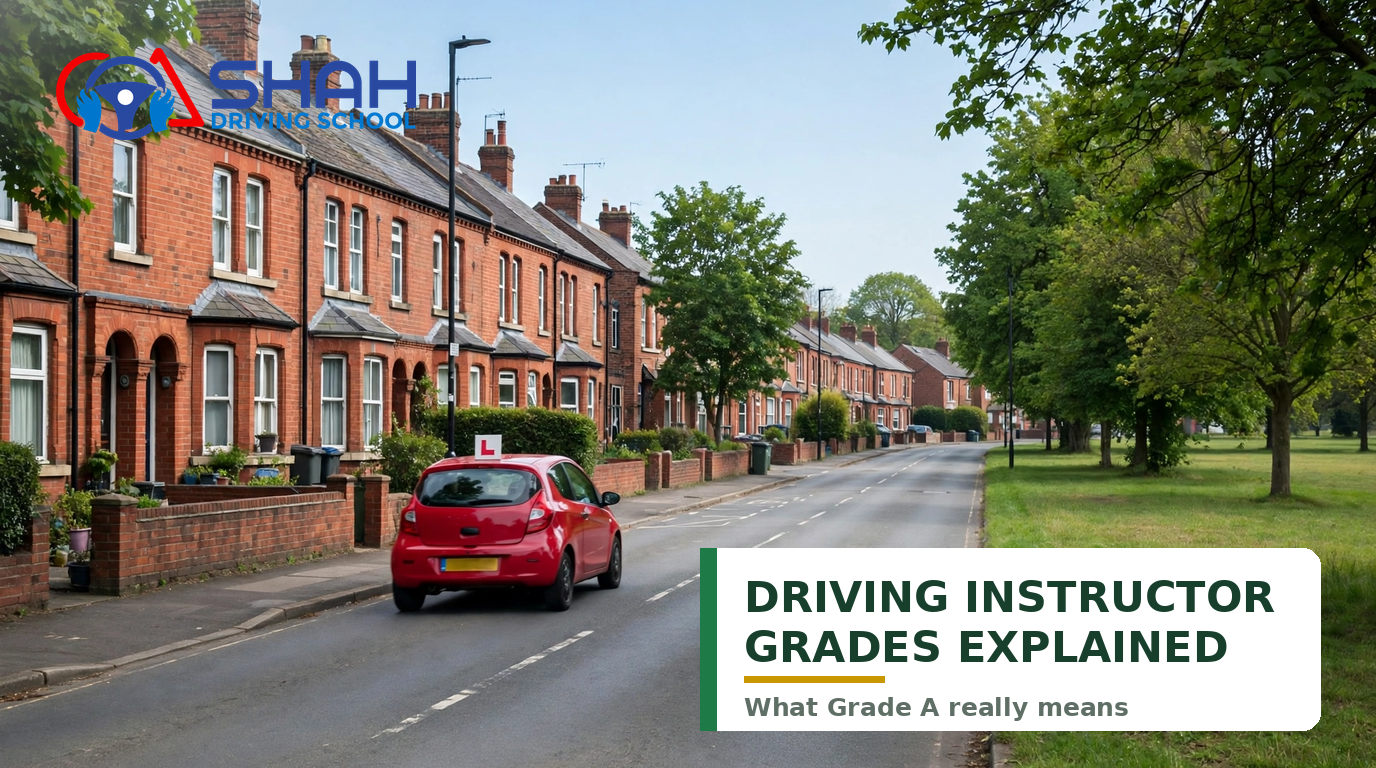

Grade A means the instructor scored 43 to 51 out of 51 in the DVSA standards check. It is the top grade, and GOV.UK describes it as a high standard of instruction.
That is the short answer. The useful answer needs one more sentence: driving instructor grades are a judgement on one observed lesson. It is not a pass-rate badge. It is not a guarantee that you will pass first time. It tells you how well that instructor taught on the day an examiner watched them teach.
This guide is written by the Shah Driving School instructor team in Bolton. It explains what the examiner is really looking for, what Grade B means, and the questions worth asking before you book.
An ADI is an approved driving instructor. To stay on the ADI register, instructors usually take a standards check every four years. DVSA can also ask for a check based on pupils’ driving test results.
The check is not a driving test for the instructor. A DVSA examiner watches the instructor give a client-centred lesson to one of their pupils for about 45 minutes. The pupil drives for about 40 minutes of that lesson. At the start, the instructor and pupil agree the goal for the lesson and talk through risk management. That part should take no more than three minutes. At the end, the pupil gets about three minutes to reflect on how it went.
From the passenger seat, that structure is the whole point. A tidy lesson has a clear goal. The instructor spots risk early, before it becomes a problem. Feedback is short, specific and usable. A messy lesson does the opposite: no clear goal, late instructions, and feedback the pupil cannot act on.
In a strong lesson, you can feel that structure working. The goal is agreed in plain words. The practice matches the goal, so a pupil working on junctions is not suddenly asked to reverse park. Feedback comes in small pieces the pupil can use straight away. At the end, the pupil can say what improved and what still needs work. That is the kind of evidence the examiner is marking.
The examiner marks 17 areas of competence. They sit in three groups: lesson planning, risk management, and teaching and learning skills. Each area scores from 0 to 3. Add them together and you get the total out of 51.
The score bands are simple. Grade A is 43 to 51. Grade B is 31 to 42. 0 to 30 is a fail. Grade A and Grade B both keep the instructor on the ADI register. A fail means the performance was unsatisfactory.
Driving instructor grades come from those 17 scores added together. That is why one weak area rarely decides the result on its own. The total matters, and so does the pattern behind it.
There is one trapdoor in the marking. An instructor automatically fails if the risk management score is 7 or less. They also fail if the examiner has to stop the lesson because someone has been put in danger. That is why risk management matters so much. Good teaching is not only about explaining clearly. It is about keeping the lesson safe while the pupil learns.
If an instructor fails, they get up to two more attempts. Fail three times and they are removed from the ADI register. They would then have to retake the ADI tests to join the register again.
You may still see older instructors talk about grades 4, 5 and 6. Those came from the old ADI check test. The standards check replaced that system on 7 April 2014. If someone quotes an old grade, ask when they last took a standards check.
Grade A is the stronger result. It means the examiner saw a high standard of instruction across the lesson. The planning was clear. Risk was managed well. The teaching helped the pupil improve during the lesson, not just complete it.
Grade B is not a bad instructor. It is a pass. GOV.UK’s older grading announcement called Grade B a sufficient level of competence, and the current result page says a Grade B instructor stays on the ADI register. In plain English: the instructor met the standard. There may be areas to improve, but they are qualified to teach you.
The honest difference is margin. A Grade A instructor showed more consistent evidence across the 17 competencies on that day. A Grade B instructor showed enough evidence to pass. Neither grade tells you exactly how that instructor will suit you. Some pupils need calm repetition. Some need firmer challenge. Some need an instructor who explains junctions with diagrams. Some learn best by doing, then reflecting.
Grade A also does not tell you whether the instructor teaches in a manual or automatic car. It does not tell you how far ahead they are booked. It does not tell you whether their style suits a nervous learner. Those are booking questions, not grading questions.
That is why we tell learners not to choose on grade alone. A grade is evidence. It is not the whole decision.
Trap one: treating the grade like a pass rate. Driving instructor grades come from an observed lesson. They are not the percentage of pupils who pass. Pupil results can be one reason DVSA asks an instructor to book a check, but the grade itself is awarded for teaching during the check. If an advert turns Grade A into “you will pass”, be careful. No instructor can promise your result. Our guide to driving test myths explains why test outcomes never work like a guarantee.
Trap two: forgetting the badge and the date. Anyone you pay to teach you must be a qualified ADI or a trainee driving instructor. Instructors display a badge in the windscreen: green for a qualified instructor, pink for a trainee. The grade belongs to the ADI standards check system, so ask which badge the instructor has now. Then ask when the grade was awarded. A recent Grade B can tell you more than an old Grade A from years ago, because standards checks usually run on a four-year cycle.
Price is not a grade either. Instructors set their own prices, and there is no minimum or maximum cost. A higher price does not prove a higher grade. A lower price does not prove a lower one. Judge the teaching evidence first, then the price.
This is also where local detail helps. If you are comparing DVSA approved driving instructors in Bolton, look past the headline. Check the badge. Ask about the grade. Then judge the lesson plan.
You do not need an interrogation. Four questions will tell you most of what matters about driving instructor grades, badges and lesson plans.
Are you a qualified ADI or a trainee? The badge should match the answer: green for qualified, pink for trainee. Both can legally charge for lessons, but you should know which one you are booking.
What grade did you get, and when? A good instructor should be able to answer plainly. Grade A is 43 to 51. Grade B is 31 to 42. The date matters because the check is usually every four years.
How will you plan my lessons? Listen for goals, not vague promises. A strong answer sounds like this: we agree what we are working on, practise it in the right places, then review what changed. That is the same client-centred structure the examiner looks for.
What happens if I am not ready? This is the trust question. A careful instructor will not rush you into a test to protect a pass-rate claim. They will tell you what still needs work. Price matters too, but it should not be the only measure. Our guide to block booking vs pay-as-you-go helps you compare lesson packages without guessing.
If the answers are vague, that is information too. An instructor who cannot explain their grade, their badge or their lesson plan is showing you how the lessons may feel. Clear answers usually mean clear teaching.
Driving instructor grades are worth understanding because they make teaching visible. Grade A means a high standard was seen in the standards check. Grade B means the instructor met the standard and stays qualified. The best choice is the instructor whose grade, badge, plan and manner all fit the way you learn. You can read more about Shah Driving School, compare our manual driving lessons and automatic driving lessons, or ask us a question through the contact page. Call 0749 0662 777 if you want to talk it through before booking.
WhatsApp us