
A country lane looks empty. There are no traffic lights, no queues and often no one ahead of you. That empty feeling invites speed. Speed is exactly what a country lane punishes.
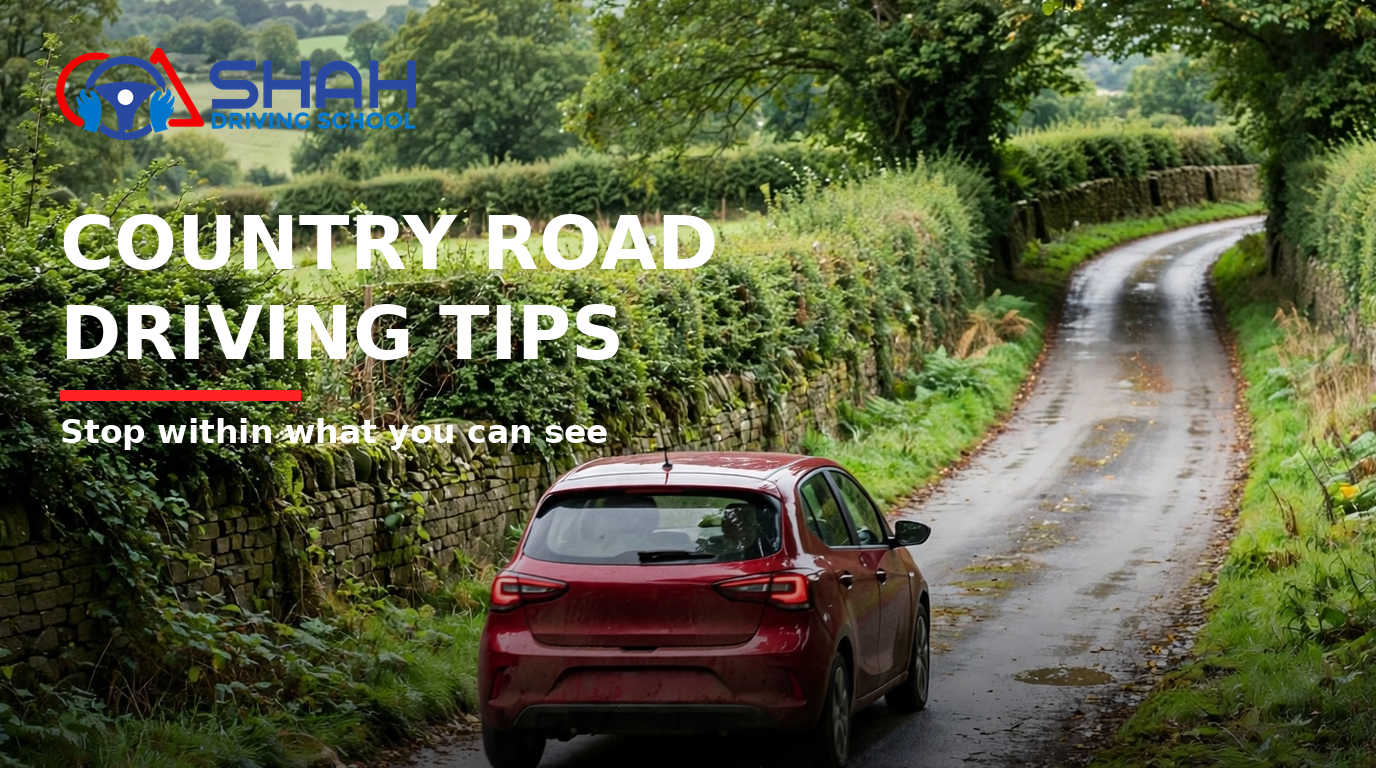
A bend can hide a tractor. A crest can hide a horse. A gateway can hide a walker. These country road driving tips come down to one habit: never drive faster than the distance you can see to be clear. If you can stop in what you can see, the lane holds no surprise you cannot handle.
This guide explains how to build that habit on the rural routes around Bolton, Horwich and Rivington, and how the Highway Code rules behind it work.
The Highway Code gives country roads their own rule. Rule 154 asks drivers to take extra care on country roads. It asks for lower speed on the approach to bends, which can be sharper than they look, and at junctions and turnings, which may be partly hidden. It also asks drivers to be ready for pedestrians, horse riders, cyclists, slow-moving farm vehicles and mud on the road.
The rule ends with the habit this whole guide is built on: make sure you can stop within the distance you can see to be clear.
That habit appears twice in the Highway Code. Rule 126 asks drivers to travel at a speed that lets them stop well within the distance they can see to be clear. Two rules, one message. Your speed must fit your view, not the other way round.
The numbers show why this matters. At 60 mph, the official stopping distance is 73 metres. That is 18 metres of thinking distance and 55 metres of braking distance. On a winding lane, you may only see 30 or 40 metres ahead. At 60 mph, you would need nearly twice that to stop. The safe speed on that lane is far below the limit. Our full guide to stopping distances in the UK explains the official chart in detail, including how wet roads at least double the gap you need.
Think of it as a simple test before every bend. Can you see far enough to stop? If not, slow down until you can.
Most country-road surprises arrive at bends. A bend hides what is round it, and the Highway Code warns that bends can be sharper than they appear. The safe move is to slow down on the approach, before you can see round it. Braking hard mid-bend is the move that causes trouble.
On right-hand bends, keep well to the left. Rule 160 explains why: it improves your view of the road ahead and helps you avoid traffic coming the other way. On a narrow lane, an oncoming car can appear with very little warning. Road position buys you sight distance.
The same thinking applies to the brow of a hill and to hump bridges. You cannot see what is beyond the crest, so you must be ready to stop in what you can see. Junctions and farm turnings on country roads may also be partly hidden by hedges and trees. Slow down, look early, and expect a vehicle to emerge.
Overtaking on a country road is mostly a “don’t”. Rule 166 says not to overtake where there is any doubt, or where you cannot see far enough ahead to be sure it is safe. Its examples are a corner or bend, a hump bridge and the brow of a hill. That covers most of a winding lane. If you are stuck behind a slow vehicle, wait for a straight stretch with a clear view. Our guide to overtaking safely covers the full set of rules, including when you must not overtake at all. Never overtake at a level crossing either — rural routes cross railway lines more often than town routes do.
Some country lanes are single-track roads. They are only wide enough for one vehicle, and they may have special passing places. Rule 155 explains how they work.
If a vehicle comes towards you, or the driver behind wants to overtake, pull into a passing place on your left. If the passing place is on your right, wait opposite it so the other vehicle can use it. Give way to road users coming uphill whenever you can, because restarting uphill is harder for them. If you have already passed the nearest passing place, reverse back to it to let the other vehicle pass. Slow down when you pass pedestrians, cyclists and horse riders, even in a passing place.
One more rule is easy to forget. Rule 156 is a single line: do not park in passing places. A parked car in a passing place removes the only place two vehicles can pass, and it can block a lane for everyone behind it.
Single-track etiquette is simple. Use the passing places, give way uphill, and be patient. A quick thank-you wave costs nothing and keeps the lane friendly.
Most country lanes carry the national speed limit. For cars on a single carriageway, that limit is 60 mph. The white circular sign with a black diagonal stripe marks it. Many learners read that sign as a target. It is not.
Rule 125 states that the speed limit is the absolute maximum. It does not mean it is safe to drive at that speed in all conditions. The rule lists the moments to reduce speed: where the road layout presents hazards such as bends, when sharing the road with pedestrians, cyclists and horse riders, in poor weather, and at night when other road users are harder to see. A country lane can present all four at once.
The right speed on a narrow lane is often far below 60 mph. Let the view decide. If you can see 100 metres of clear road, 50 mph may be fine. If you can see 40 metres round a bend, 30 mph may already be too fast. Our guide to UK speed limits explains the full national speed limit table and how limits change by vehicle and road type.
One more habit from Rule 154: reduce your speed where country roads enter villages. Villages bring parked cars, pedestrians, side turnings and often a lower limit. The lane’s open-road feeling ends at the village sign. Your speed should change with it.
A country lane is shared space. The road users you meet there are slower, less protected and harder to see than town traffic. Here is how to handle each one.
Horses are the road user learners meet most often on country lanes, and the one that needs the most care. Rule 215 asks drivers to slow down to a maximum of 10 mph when they see a horse on the road. Be patient. Do not sound your horn or rev your engine. When it is safe, pass wide and slowly, allowing at least 2 metres of space.
Horse riders are often children. Riders may ride in double file when escorting a young or inexperienced horse or rider. Look out for the rider’s signals, and heed a request to slow down or stop. Treat every horse as a potential hazard. Horses are flight animals and can move incredibly quickly if startled, despite the rider’s efforts. The Code puts it plainly: there are three brains at work when you pass a horse — the rider’s, the driver’s and the horse’s.
Rule 214 covers animals on the road. Drive slowly when passing them. Give them plenty of room and be ready to stop. Do not scare them by sounding your horn, revving your engine or accelerating rapidly once you have passed. Look out for animals being led, driven or ridden, and keep your speed down at bends and on narrow country roads.
If a herd of animals blocks the road, stop and switch off your engine until they have left the road. Watch out for animals on unfenced roads, where they can wander onto the carriageway without warning.
Country lanes often have no pavement. Walkers use the road itself, sometimes round bends where drivers cannot see them early. Rule 206 asks drivers approaching pedestrians on narrow rural roads without a footway to always slow down and be prepared to stop, giving them plenty of room as they drive past. Walkers may step onto the verge to let you through. Give them time to do it. Do not squeeze past at speed.
On narrow roads, cyclists may ride in the centre of the lane rather than towards the side. Rule 213 explains that this helps them see and be seen, and groups may ride two abreast for their own safety. Allow them to do so. Cyclists may also swerve suddenly to avoid drain covers or oily, wet or icy patches, so give them plenty of room and watch for sudden changes of direction. Our guide to sharing the road with cyclists covers the 1.5-metre overtaking clearance and the full set of rules.
Slow-moving farm vehicles are part of country-road life. Tractors with trailers are long, wide and slow, and they hide the road ahead. Drop back to see past them, and remember another slow vehicle may be in front of the one you can see. If in doubt, do not overtake. The tractor will usually pull in or turn off before long. Patience costs seconds. A blind overtake can cost far more.
Mud on the road is a hazard in its own right. Rule 154 lists it alongside the road users to be prepared for. Mud reduces grip, especially under braking, and it can hide the road surface beneath it. Slow down where you see mud, keep your steering smooth, and avoid sudden braking on it. In winter, the same lanes add ice and fog to the list. The country road driving tips in this guide still apply: slow down until you can stop in what you can see.
Driving test routes from Bolton can include rural roads around Horwich and Rivington. Examiners watch how you handle them, and the same habits apply as anywhere else: speed choice, observation and patience.
Speed choice matters most. An examiner notices a learner who slows before a bend they cannot see round, and one who does not. Stopping-distance discipline matters too. Following a tractor at a safe gap shows the same judgement as following any vehicle at a safe distance. On a single-track stretch, calm use of passing places and a sensible decision to reverse show confidence. A calm reaction to a horse or a farm vehicle shows control. None of this needs special technique. It needs the one habit: stop within what you can see.
For cars, the national speed limit on a single carriageway country road is 60 mph. That is the absolute maximum, not a target. The safe speed on a narrow, winding lane is often far lower. Let the distance you can see decide your speed, and slow down for bends, villages, poor weather and other road users.
Pull into a passing place on your left, or wait opposite a passing place on your right so the other vehicle can use it. Give way to road users coming uphill whenever you can. If you have passed the nearest passing place, reverse back to it. Never park in a passing place.
No. Do not overtake where you cannot see far enough ahead to be sure it is safe, and a bend is the Code’s own example of such a place. Wait for a straight stretch with a clear view, drop back first so you can see past the tractor, and only overtake when you are sure there is room to complete the move.
Slow down to a maximum of 10 mph. Be patient, and do not sound your horn or rev your engine. When it is safe, pass wide and slowly, allowing at least 2 metres of space. Heed any signal from the rider to slow down or stop, and remember that horses can move very quickly if startled.
Slow down. Mud reduces grip, especially under braking, and it can hide the road surface. Keep your steering smooth and avoid sudden braking on muddy stretches. The Highway Code lists mud among the hazards to be prepared for on country roads, alongside pedestrians, horse riders, cyclists and slow-moving farm vehicles.
Country lanes reward the driver who reads the road early. That reading comes with practice, and the best practice is real time on real routes with an instructor beside you. Our manual driving lessons in Bolton and Atherton cover rural routes as well as town driving, so the first time you meet a single-track lane or a horse on a bend, you will not be on your own.
Book a lesson or ask a question through our contact page, or call 0749 0662 777. If you have a question about lessons, our frequently asked questions page may already answer it.
WhatsApp us