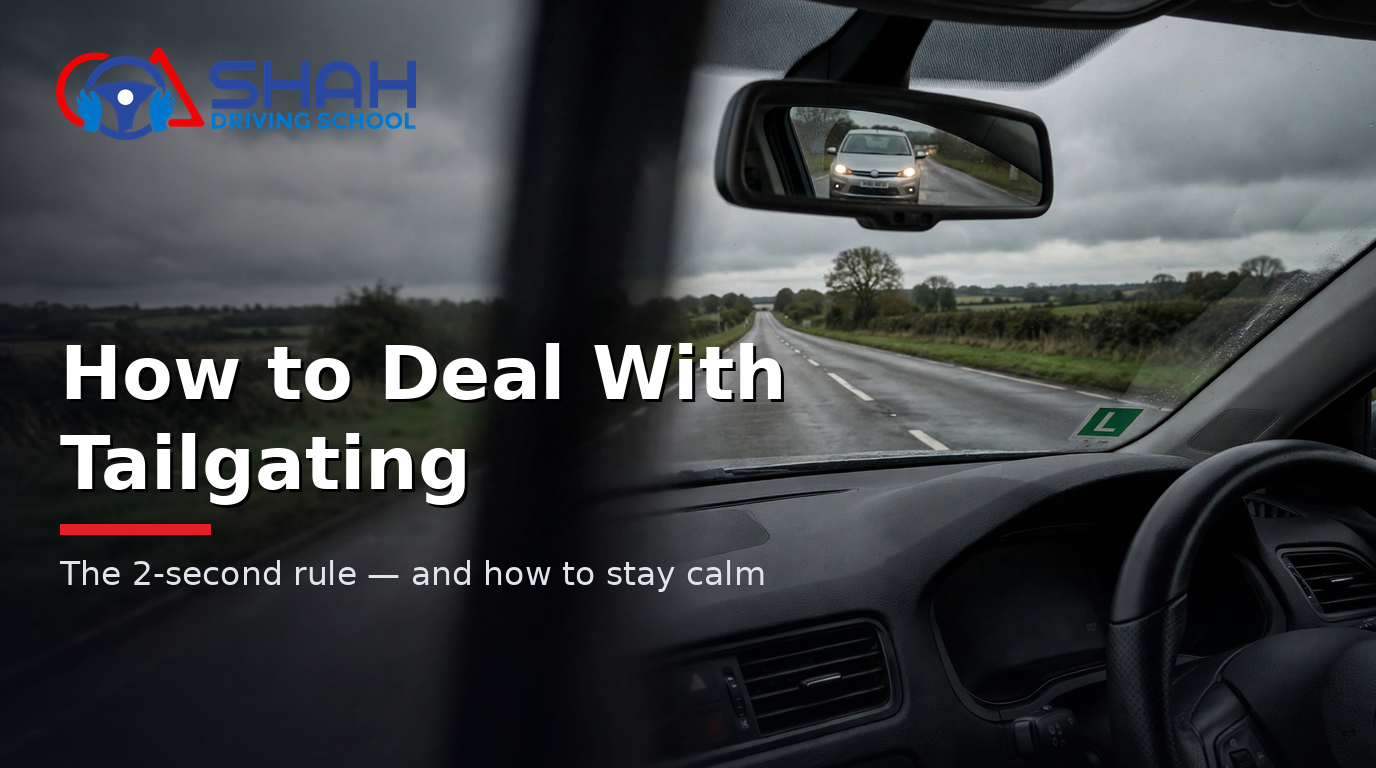

How to Deal With Tailgating: A car fills your rear-view mirror. It is so close that you can see the driver’s face, and every time you glance up, it is still there. Your shoulders tighten, your speed creeps up, and you start thinking about braking — just a little — to send a message.
Stop. There is one number that decides everything about tailgating: 2 seconds. If the gap between you and the vehicle in front is less than that, you cannot stop safely if it brakes suddenly. This guide explains what tailgating is, how to measure the gap, what it costs, and — most importantly — what to do when someone is tailgating you.
Tailgating is when the gap between you and the vehicle in front is too small for you to stop safely if it suddenly brakes. That is the Highway Code’s definition, in Rule 126. It is not just rude. It is dangerous and intimidating, and it can cause collisions — especially at speed.
National Highways says tailgating is a factor in around 1 in 8 collisions on England’s motorways and major A-roads. It is also the single biggest issue that drivers find irritating or intimidating about other road users — and that intimidation can lead to conflict and confrontation.
It is not always deliberate. You can tailgate without meaning to: another vehicle cuts in front of you, or you misjudge the speed of the vehicle ahead. But intention does not change the physics. If the car in front brakes hard and you have no gap, you will hit it.
Rule 126 says you should drive at a speed that lets you stop well within the distance you can see to be clear, and leave enough space between you and the vehicle in front so you can pull up safely if it suddenly slows down or stops. The safe rule is never to get closer than the overall stopping distance.
On faster roads and in tunnels, the practical rule is at least a two-second gap. Here is how to measure it:
The gap grows with the weather. On wet roads, double it to 4 seconds. On icy roads, increase it still further — up to ten times, which means 20 seconds. In a tunnel, large vehicles should allow a four-second gap, and if you stop in a tunnel, leave at least a 5-metre gap to the vehicle in front. Our stopping distance guide has the full table, including thinking and braking distance at every speed.
Tailgating is against the law. It falls under driving without due care and attention — careless driving, under Section 3 of the Road Traffic Act 1988. Rule 126 says that dangerous and careless driving offences, such as tailgating, are enforced by the police.
If the police spot you driving too close to the vehicle in front, the standard outcome is a £100 fixed penalty and 3 penalty points on your licence. More serious cases go to court, where the fine can be unlimited, with 3 to 9 points and a possible ban. In the worst cases — a serious collision caused by tailgating — it can mean a driving ban or even a prison sentence.
For a new driver, those 3 points matter more than most. Six points within two years of passing means your licence is revoked and you have to retake your theory and practical tests. One tailgating penalty is halfway there. Our speed limits guide explains the new-driver rules in full.
Being tailgated can make you feel intimidated, scared and bullied. It can feel aggressive and personal, even when the driver behind does not mean it that way. But reacting badly only makes it worse. National Highways’ advice is:
There is one more move that most drivers miss: increase the gap to the vehicle in FRONT of you. If you have more room ahead, you can slow down gently instead of braking hard — and the tailgater behind you gets more time to react too. On a dual carriageway, the same idea applies: keep left, keep your speed steady, and let them go. Our dual carriageway guide covers lane discipline in detail.
If the tailgater is aggressive — flashing lights, sounding the horn, making gestures — do not engage. Pull over safely when you can, let them pass, and let it go. If you feel threatened, drive to a public place or a police station, and call 999 if you are in danger. Never stop to confront another driver.
Most of this guide is about being tailgated. But the other half is about not doing it yourself.
If you catch yourself sitting on someone’s bumper, the fix is simple: ease off the accelerator, let the gap grow, and stay there. It costs you nothing. It might save you everything.
Your examiner watches your following distance. On the test report, “follow another vehicle at a safe distance” is its own fault heading, and the common faults are exactly what you would expect: not using the two-second rule, driving closer than thinking distance in heavy traffic, and stopping too close to the vehicle ahead in queues.
Normally, following too closely is recorded as a driving fault — a minor. It only becomes a serious or dangerous fault when it creates actual danger, for example if the vehicle in front brakes and you have to swerve or the examiner has to act. But minors add up: you can have at most 15 driving faults and still pass, and a habit of tailgating will collect them quickly.
One thing is not a minor. Brake-testing a driver who is following too closely is classed as an illegal or dangerous act on the test. The RAC warns the same thing for everyday driving: do not police the road to teach a tailgater a lesson, and do not repeatedly touch your brakes to make your point — it only increases the risk of a collision.
If you are a new driver, read our first solo drive tips — following distance is one of the habits that guide helps you build.
Yes. Tailgating falls under careless driving (driving without due care and attention). The standard penalty is a £100 fixed penalty and 3 points. More serious cases go to court.
At least 2 seconds on faster roads and in tunnels. Double it to 4 seconds on wet roads, and up to 20 seconds on icy roads.
Stay calm, keep your speed steady, keep left, and let them overtake. Increase the gap to the vehicle in front of you so you can slow down gently. Never brake-check them and never speed up.
Brake-checking is dangerous in itself, and deliberately braking to punish the driver behind can be treated as careless or dangerous driving. The RAC’s advice is clear: do not do it — it only increases the risk of a collision.
Following too closely is normally a driving fault (minor). It only becomes a serious or dangerous fault — and a fail — when it creates danger. But repeated minors add up, and you can only have 15 in total.
More questions? Read our frequently asked questions page.
Tailgating is a habit, not a personality trait. The gap is a choice you make every few seconds, and it is the cheapest insurance you will ever buy: two seconds of space, and the calm to keep it.
If you are learning to drive in Bolton or Atherton, we will teach you following distance on real roads, in real traffic — on the A666, on dual carriageways, and on motorway slip roads. Book manual driving lessons with Shah Driving School. Call us on 0749 0662 777, or visit our contact page to book your first lesson. Two seconds. That is all it takes.
Tailgating advice: National Highways — Tailgating and how to avoid it. Practical guidance: RAC — Tailgating: Is it illegal in the UK?. Highway Code: General rules, techniques and advice for all drivers and riders, Rules 103 to 158 (GOV.UK).
WhatsApp us