
Every learner in Bolton faces the same choice before their first lesson: pay for each lesson as you go, or pay for a block of hours upfront and get a lower hourly rate. Both buy the same lessons, with the same instructor, in the same car. The difference is money — and risk.
The cheaper per-hour option is not always the cheaper total. A block saves money only if you actually use all of it, with an instructor you are happy with, on a schedule that holds. This guide works out the maths on Shah Driving School’s own published prices, explains when each option wins, and lists the six questions to ask before you hand over a lump sum.
Pay-as-you-go means one lesson at a time. You book a lesson, you pay for that lesson, and you owe nothing more. If your schedule changes, you stop. If the instructor is not right for you, you switch without losing money.
Block booking means buying a set number of hours upfront — usually 10 — at a discounted hourly rate. You pay the full amount before the first lesson in the block, and you work through the hours over the following weeks.
Shah Driving School’s current published prices (from shahdrivingschool.uk — confirm before booking):
|
Option |
Price |
Per hour |
|---|---|---|
|
Single lesson (manual or automatic) |
£35 / hour |
£35.00 |
|
Beginner package — 10 hours |
£300 |
£30.00 |
|
Standard package — 10 hours |
£325 |
£32.50 |
|
Intensive course — 10 hours |
£350 |
£35.00 |
|
Intensive course — 15 hours |
£515 |
£34.33 |
|
Intensive course — 20 hours |
£680 |
£34.00 |
|
Driving test cover — 2 hours |
£100 |
separate service |
The Beginner package is the introductory offer for new learners. The Standard package is the regular 10-hour block. The driving test cover is a separate two-hour test-day service — it is not part of a lesson block.
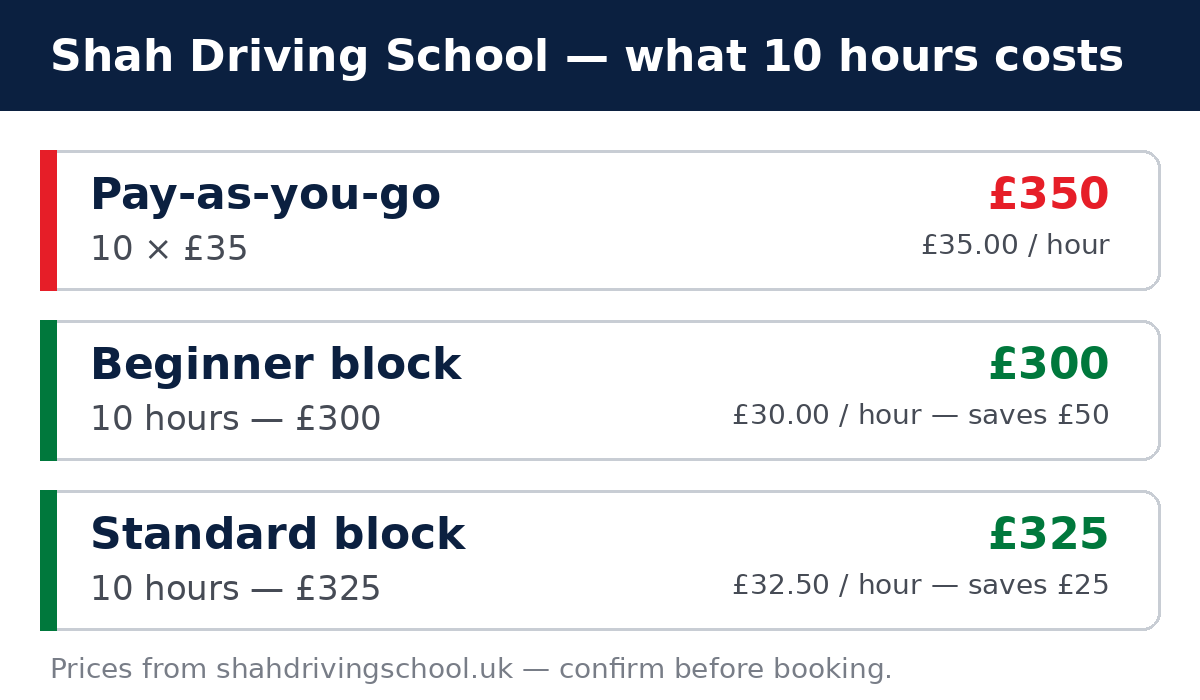
Ten hours compared: pay-as-you-go £350, Beginner block £300, Standard block £325.
Ten hours is the fairest comparison, because that is the block size Shah sells:
Nationally, block discounts typically shave 5–15% off the hourly rate, so both Shah blocks sit inside the usual range — the Beginner block at the generous end, the Standard block in the middle.
Now scale it up. The DVSA’s long-standing planning figure is that the average learner needs around 45 hours of professional lessons plus about 22 hours of private practice before reaching test standard. There is no legal minimum — some learners need fewer hours, some need more. As an illustration only: 45 hours pay-as-you-go at £35 costs £1,575, while the same 45 hours in Beginner blocks would cost £1,350 — a £225 difference on paper. But most learners will not take all 45 hours in one package type, and nobody can promise a total before they have seen you drive. Treat that figure as a planning illustration, never as a promised price.
For national context: the DVSA’s October 2025 instructor survey found the most common price for a one-hour lesson was £36–£40, charged by just over half of the instructors who responded. Shah’s £35 an hour sits just below the most common national band — useful context if you are comparing schools.
Our driving lesson cost guide has the full breakdown of what lessons cost across the UK.
A block only saves money if its terms work for you. Shah’s own block terms are not published on the website, so ask the school directly before you pay — and ask any school the same six questions:
Get the answers in writing. A block is a contract, not a handshake.
Block booking and intensive courses are different choices, and the prices show it. A block is the same weekly pace at a lower hourly rate — £30 or £32.50 an hour instead of £35. An intensive course is the same hourly rate, concentrated over a shorter period — 10 hours for £350 is £35 an hour, exactly the same as pay-as-you-go.
Intensive courses suit learners who can take time off and want to pass quickly. They do not save money per hour. If someone sells you an intensive course as a discount, check the maths: £350 for 10 hours is not a saving, it is a schedule.
Our intensive driving courses page explains the 10, 15 and 20-hour options in detail.
Whichever way you pay, the biggest saving is needing fewer paid hours — and that comes from practice between lessons. The DVSA’s 22 hours of private practice is not a filler number; it is where the skills from your lessons actually settle. If a family member can supervise you, our supervising guide explains the rules: the supervisor must be 21 or over, have held a full licence for three years, and sit in the front passenger seat for the whole session.
Three more habits that cut the total:
Yes — per hour. At Shah, a 10-hour Beginner block costs £300 instead of £350, saving £50. But it is only cheaper if you use all the hours.
No. Take two or three lessons pay-as-you-go first, make sure the instructor suits you, then switch to a block.
That depends on the school’s terms — expiry dates and refund policies vary. Ask before you pay, and get the answer in writing.
Usually yes. Most schools, including Shah, let you move to a block once you are settled — ask when you book.
No. The DVSA controls practical-test appointments, and no school can guarantee a pass. A fixed number of hours cannot guarantee test readiness either — readiness depends on how you drive, not how much you paid.
Start pay-as-you-go. Take two or three lessons, check the instructor is right, check your schedule holds, then switch to a block and bank the saving. That order gives you the discount without the risk — and the risk is the whole point. A block is a good deal for a learner who is already settled. For everyone else, £35 a lesson is the smarter first step.
Shah Driving School teaches manual driving lessons and automatic lessons across Bolton, Horwich, Atherton and Farnworth — call 0749 0662 777 or contact us to book your first lesson, or ask about block packages once you are underway. And if you have just passed, our first solo drive guide covers what changes on day one.
WhatsApp us