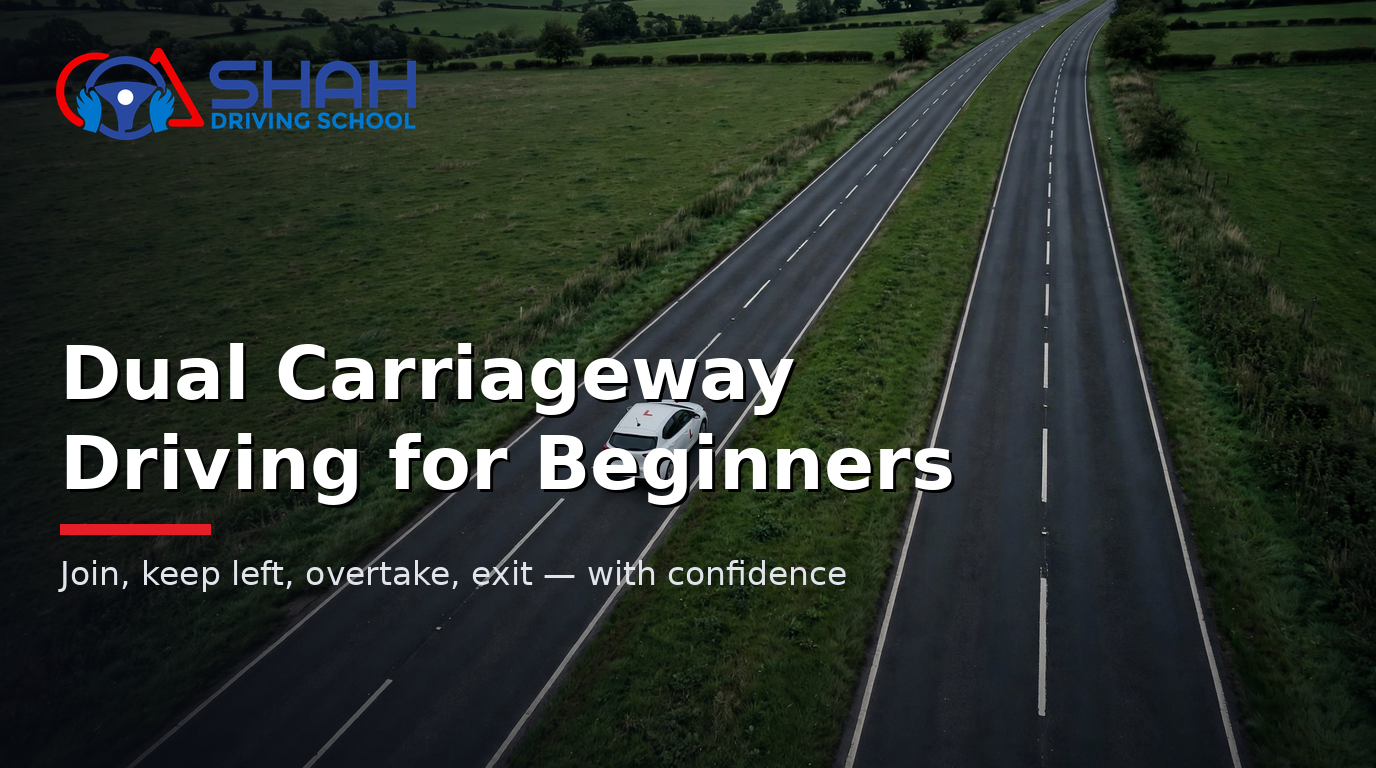

Dual Carriageway Driving for Beginners: Your first dual carriageway drive is a milestone. The road widens, the speed rises, and suddenly town driving feels like a different world. Many learners find it intimidating — but a dual carriageway is simply four skills in sequence: join, keep left, overtake, exit. Master those and faster roads become routine.
This guide walks through each skill step by step, with the rules examiners mark and the mistakes beginners make. Our Bolton instructors build dual carriageway confidence gradually, starting on quieter stretches before test routes.
A dual carriageway is a road with two separate carriageways, one for each direction, divided by a central reservation — a strip of grass, a barrier, or a raised kerb. Each carriageway can have one, two or more lanes.
The national speed limit of 70 mph applies to cars unless signs say otherwise. But a dual carriageway is not a motorway. It can have roundabouts, traffic lights, side turnings, bus stops and even farm entrances. That mix is exactly why learners must take them seriously.
One important fact: learners can drive on dual carriageways. Unlike motorways, where learners need an approved instructor in a dual-control car, dual carriageways are open to all learner practice with a qualified supervisor.
Joining badly is the most common beginner error. The slip road exists for one job: getting you up to the speed of the traffic you are about to join.
Some junctions end the slip road at a give way line instead of a merge lane. Then you stop and wait for a proper gap, exactly like emerging at a T-junction.
The Highway Code rule is simple: on a dual carriageway, the left lane is your home. Move to the right lane only to overtake, and return left as soon as it is safe.
Sitting in the right lane for no reason — middle-lane hogging — is not just poor driving. Since 2013 it has been a fixed-penalty offence carrying a £100 fine and 3 penalty points. Examiners mark it as a fault on test.
At higher speeds, everything needs more space. Keep at least the two-second gap to the car ahead in good conditions, and double it in the wet. Our stopping distances guide shows why: at 70 mph you need 96 metres to stop. That is longer than most learners expect, and it is the number that should shape your following distance.
Speed also plays tricks. After cruising at 70, everything feels slow — which is why checking your speedometer matters, especially after you leave the carriageway.
Overtaking at speed follows the same MSM routine as everywhere, with extra emphasis:
Never undertake — pass on the left — unless traffic in the right lane is moving in slow queues and conditions make it clear this is permitted. On a clear carriageway, undertaking is a serious fault.
Watch for the slipstream effect near large vehicles. Lorries push a bow wave of air that can nudge a light car as you pass. A firm grip and a steady line handle it; overcorrecting does not.
Missing an exit on a dual carriageway means a long detour, so exits reward planning:
If you miss your exit, carry on to the next one. Never reverse, never stop on the carriageway, and never swerve across lanes at the last second. A missed exit costs minutes. A dangerous correction can cost far more.
Some junctions ask you to cross a dual carriageway rather than join it — for example, turning right from a side road. The rule depends on the central reservation:
Never stop with your car sticking out of a shallow reservation. If the whole car does not fit, the gap is not there.
Examiners love dual carriageways because they test judgement at speed. They mark:
The balance is the same as everywhere: confident but careful. Our UK speed limits guide covers the numbers; lessons teach the feel. Mock tests on our intensive driving courses include dual carriageway sections on Bolton test routes.
Around Bolton, sections of the A666 give you real dual carriageway practice close to home. Your instructor will introduce them when your town driving is solid rushing onto faster roads too early builds fear, not skill.
Yes. Learners may drive on dual carriageways with a qualified supervisor or instructor. Motorways are the restricted ones — learners need an approved instructor in a dual-control car for those.
No. Seventy is the national limit for cars where no other limit is signed. Many dual carriageways have signed 60, 50 or 40 limits, especially near towns and junctions. Always follow the signs.
Carry on to the next exit or junction and rejoin your route. Never stop, reverse, or cut across lanes on the carriageway to correct a missed exit.
Where a slip road exists, use it to build speed and merge. Some older junctions join directly from a give way or stop line — then you emerge like at a T-junction, with extra care because traffic moves much faster.
Only in a genuine emergency, and then on the hard shoulder or verge where one exists, with hazard lights on. Never stop to check directions, answer the phone, or wait for someone.
More questions? Read our frequently asked questions page.
Join at the right speed. Keep left unless overtaking. Overtake with the full routine. Exit with early planning. Those four skills turn the dual carriageway from intimidating to ordinary.
Shah Driving School teaches manual and automatic lessons across Bolton, Horwich, Atherton and Farnworth. Our DVSA-approved instructors introduce dual carriageways at the right moment in your learning, building speed confidence step by step. Book your lessons today — and take the fast road without the fear.
WhatsApp us