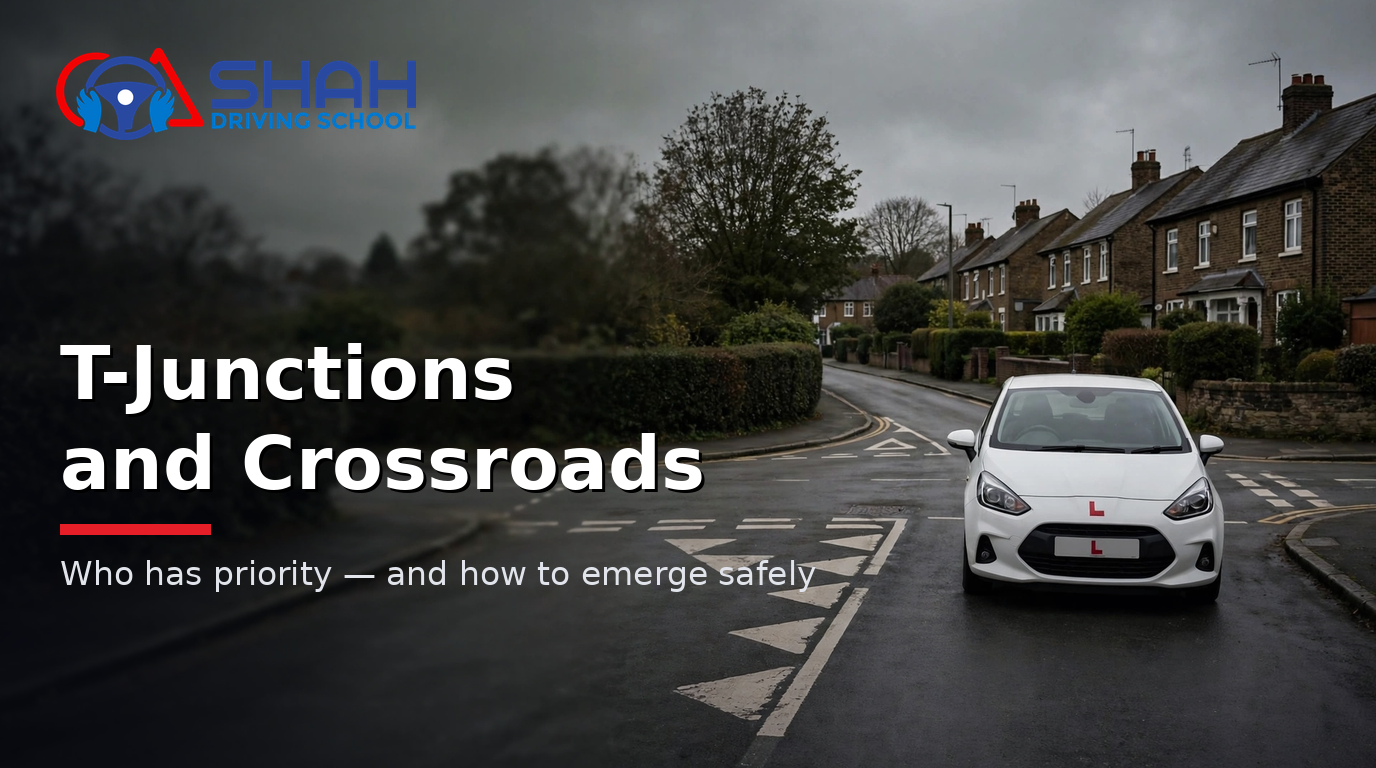

T-Junctions and Crossroads. Most UK junctions are T-junctions. A side road meets a main road, and somebody has to give way. Learners get this wrong more than almost anything else — not because the rule is complicated, but because every junction looks slightly different.
This guide explains both junction types you will meet on test day: the T-junction, where priority is clear, and the crossroads, where it is not. Learn who has priority, how to emerge safely, and the observation routine examiners expect. Our Bolton instructors practise these on real residential routes until reading a junction becomes second nature.
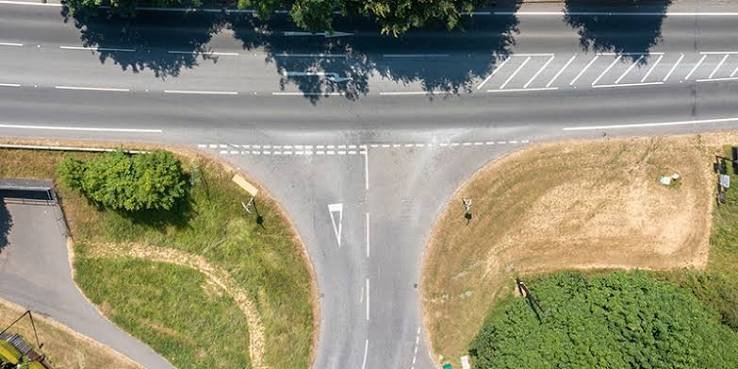
T junction by Shah Driving School
Picture the letter T. The top bar is the main road. The stem is the side road. Traffic on the main road has priority. Traffic emerging from the side road must give way.
The road markings tell you which one you are on:
Every safe emergence follows the same sequence. Drill it until it is automatic.
On approach, check your mirrors and signal your direction early. Position left for turning left, or just left of the centre of the road for turning right.
Ease off as you reach the give way lines. You do not have to stop if the road is clearly empty — but you must slow enough to judge the junction properly. At a STOP line, you must stop completely, even at 6 am on an empty road.
For a standard T-junction, traffic flows both ways on the main road. Look right first (the nearest danger), then left, then right again before moving. Keep looking as you emerge — the picture changes.
Emerging needs a gap large enough for you to join the road safely. Turning right needs a bigger gap because you cross the nearside lane of traffic to reach your side. Do not creep out hoping traffic will slow for you. If you are unsure, it is not a gap.
Move off positively into your lane — left lane for turning left, correct side for turning right — and build speed so you do not hold up the traffic behind you.
The simpler emerge. Position close to the left kerb, signal left, and slow at the lines. Your main check is to the right, where traffic approaches, but glance left too for cyclists and pedestrians on the pavement edge.
Pull out into the left lane of the main road without swinging wide. Watch for parked cars on the main road that might force you to adjust your line — our meeting traffic guide covers exactly that situation.
This is the harder emerge, and the one examiners watch most closely.
You need a safe gap in both directions because you cross one lane of traffic and join another. Position just left of the centre of the side road. Look right, left, right again — and remember vehicles may also be turning into your road from the right, which changes the picture.
The classic fault is creeping. The learner edges forward bit by bit, hoping a gap appears, and ends up blocking the main road while traffic brakes around them. Either the gap is there or it is not. If it is not, wait properly behind the lines. Patience here is a strength, not a fault — but once the gap comes, move off positively.
This move mirrors the right turn at traffic lights from our previous guide: mirror, signal right, position just left of the centre, give way to oncoming traffic, and keep your wheels straight while you wait.
Two extras apply at T-junctions. First, watch for traffic emerging from the side road you are turning into — a driver pulling out can surprise you mid-turn. Second, give way to any pedestrian crossing or waiting to cross the side road. The Highway Code is explicit: they have priority, so give way.
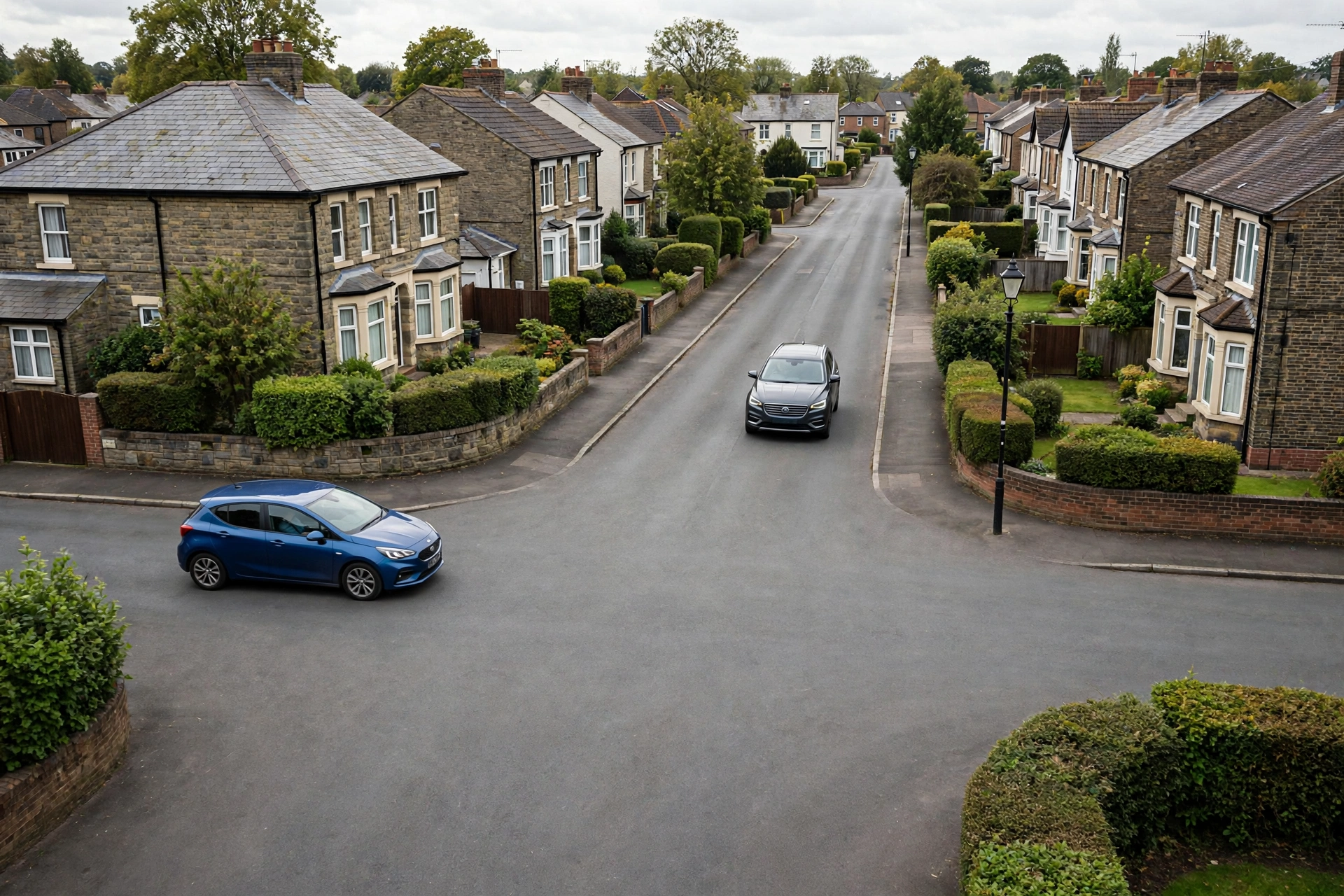
At an unmarked crossroads, nobody has priority — slow down, look everywhere, and be ready to give way.
A crossroads is where two roads cross. Some have clear markings — give way or stop lines on the minor arms, priority for the major road. Treat each arm like a T-junction and the rules above apply.
Unmarked crossroads are different. No one has priority. Every driver must slow right down, look all around, and be prepared to give way. This is where the Highway Code’s warning matters most: never assume another driver will do what their signal suggests. A car signalling left from your right may carry straight on.
On your test, the examiner wants to see caution, not confidence, at unmarked crossroads. Slow early, look in every direction, make eye contact where you can, and proceed only when you are sure. Hesitating briefly here is far better than assuming wrongly.
Staggered crossroads — two T-junctions slightly offset — deserve special care. Treat them as two separate junctions. Completing the first turn does not mean the second is clear. Look again, every time.
T-Junctions and Crossroads
At every junction, turning or emerging, the pedestrian rule applies: give way to pedestrians crossing or waiting to cross the road into which or from which you are turning. If they have started to cross, they have priority.
This catches learners because the pedestrian is not on the main road — they are on the side road, exactly where you are looking for cars. Make the side road part of every check. Scan the pavements, not just the tarmac.
Every one of these is fixed by the same routine: mirrors, signal, position, slow, look properly, decide once. Practise it during manual driving lessons and junctions stop feeling like a lottery.
No — unlike a STOP line, a give way line does not require a full stop. But you must slow enough to judge the junction and be ready to stop for traffic with priority. If the road is clearly empty, you may proceed at a safe speed.
No one has automatic priority. Slow down, look all around, and be prepared to give way. Proceed with caution only when you are sure the way is clear. Defensive driving wins here.
Edge forward very slowly — creep and peep — until you can see, without putting your bonnet into traffic. Never emerge blind. If you cannot get a safe view, wait until a gap in parked traffic or choose another route.
Yes. Position just left of the centre, keep your wheels straight, give way to oncoming traffic, and complete the turn when a safe gap appears. The same waiting discipline from our traffic lights guide applies.
Two T-junctions offset from each other, so you turn right then immediately left (or the reverse). The trap is treating them as one junction. They are two separate emerges — look and judge each one independently.
More questions? Read our frequently asked questions page.
T-junctions give you priority or take it away — the markings tell you which. Crossroads ask for caution from everyone. Both reward the same routine: approach with mirrors and signal, position correctly, look properly in every direction, and decide once.
Shah Driving School teaches manual and automatic lessons across Bolton, Horwich, Atherton and Farnworth. Our DVSA-approved instructors drill junctions on real Bolton roads, not just quiet test routes. Book your lessons today, or try an intensive driving course if your test is close. Let’s make every junction readable.
WhatsApp us