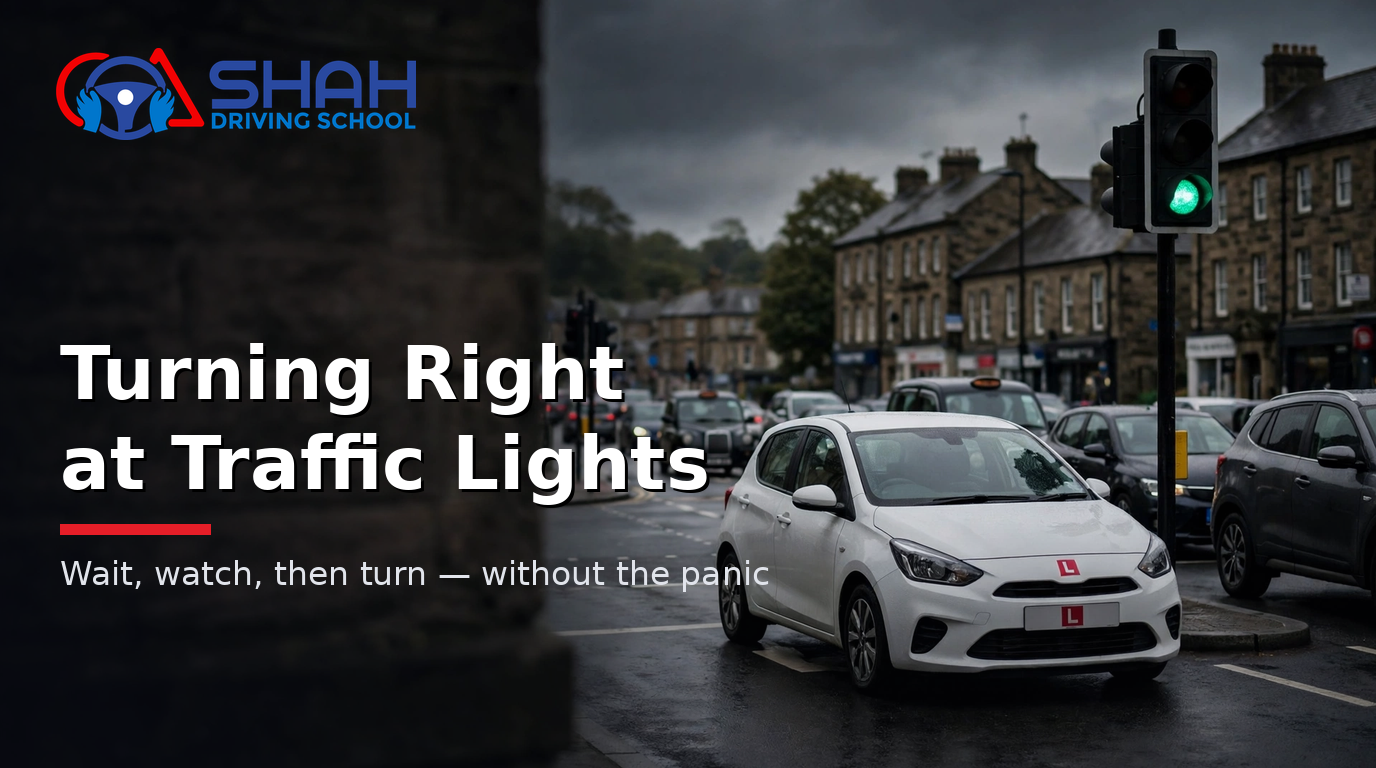

The light is green. Turning Right at Traffic Lights, Oncoming cars keep coming. You sit in the middle of the junction, heart racing, wondering whether to go, wait, or wish you had taken another route.
Turning right at traffic lights is the junction move learners fear most, and it is also one of the most tested. The good news: it is a sequence, not a gamble. Learn the light meanings, the waiting position and the filter arrow, and the whole move becomes calm and repeatable. Our Bolton instructors teach it on real signalised junctions until it feels ordinary.
UK traffic lights always follow the same order: red, red and amber, green, amber, red.
One rule ties everything together: do not enter a junction unless your exit is clear — except when turning right, where waiting in the middle of the junction is the correct move. That exception is the heart of this guide.
Check your mirrors early and signal right in good time. If the road is marked with lanes, use the right-hand lane for turning right, or the lane with the right-turn arrow. Approaching in the wrong lane is a fault before the turn even begins.
When the light turns green, move forward into the middle of the junction if the way ahead is clear enough to wait there safely. Do not sit behind the stop line for the whole green phase. You are allowed — expected — to wait inside the junction.
Position your car just left of the centre of the road, leaving room for traffic behind you to pass on your left. Keep your wheels straight. This matters more than learners realise: if a car hits you from behind while you wait, straight wheels keep you in place. Turned wheels would push you into oncoming traffic.
Your eyes have a job list: oncoming traffic, the lights, then the road you are turning into. Watch for pedestrians crossing that road too — they may have a green man while your light is green, and you must give way to them.
When a safe gap appears in oncoming traffic and the exit road is clear, steer smoothly into your lane. Do not cut the corner. Finish in the correct lane of the new road, cancel your signal, and build speed normally.
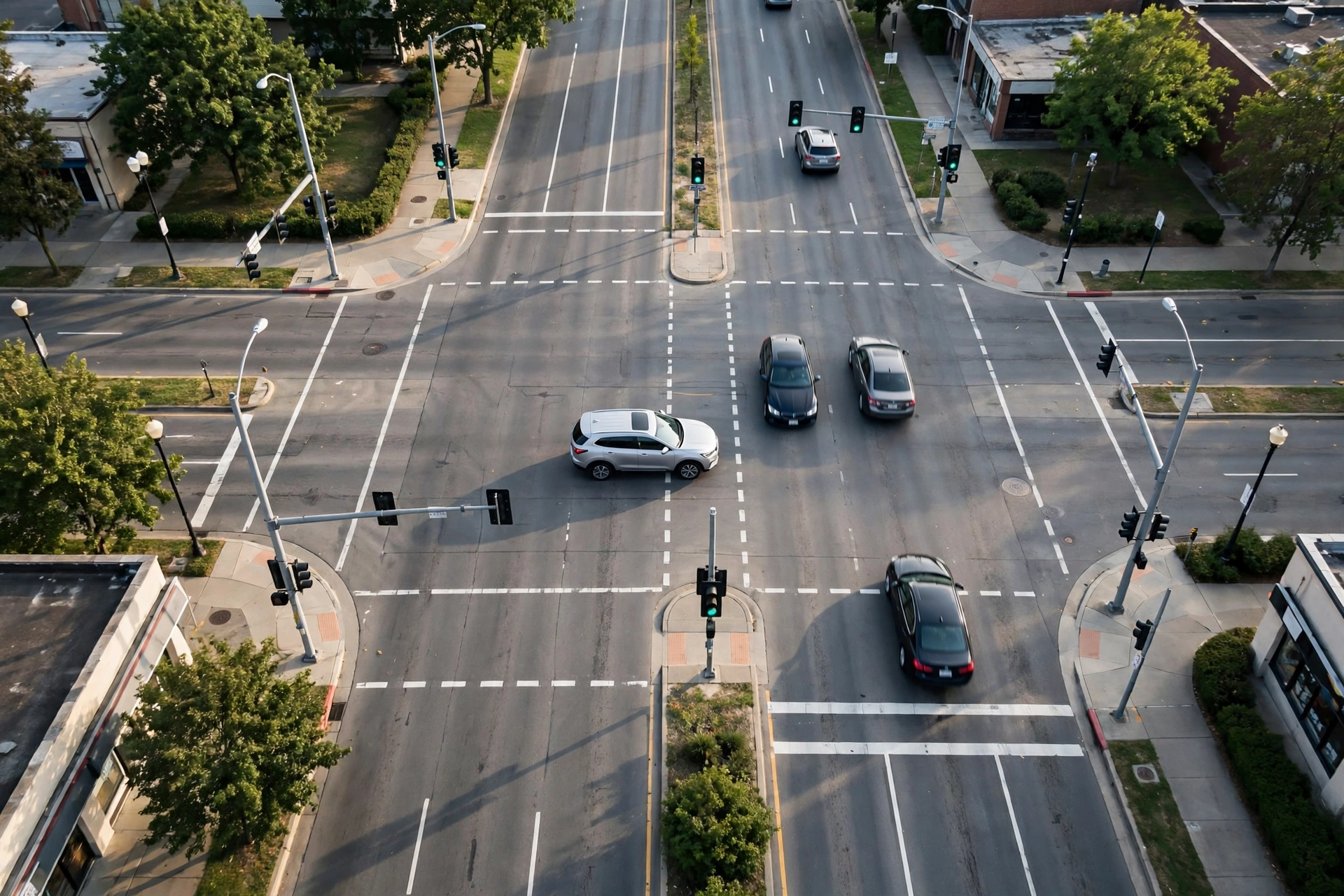
The waiting position: just left of centre, wheels straight, room for traffic to pass on your left.
This is the moment learners dread, and it is completely normal. If the lights change to amber and then red while you are waiting in the middle, complete your turn as soon as it is safe. Oncoming traffic stops at their red light, which creates your gap.
Do not stay sitting in the junction. Do not reverse back. Do not panic. Check that oncoming traffic has actually stopped — a late runner may still come through — then turn and clear the junction.
Usually only one car waits in the middle of the junction. If a car is already waiting there, stay behind the stop line and wait for the next green. Following a second car into the junction blocks cross-traffic when the lights change, and examiners mark it.
Some junctions add a green filter arrow beside the main light. It changes everything:
A filter arrow is not a free pass to ignore the road. Pedestrians may still be crossing, and a cyclist may be filtering past. Check, then go.
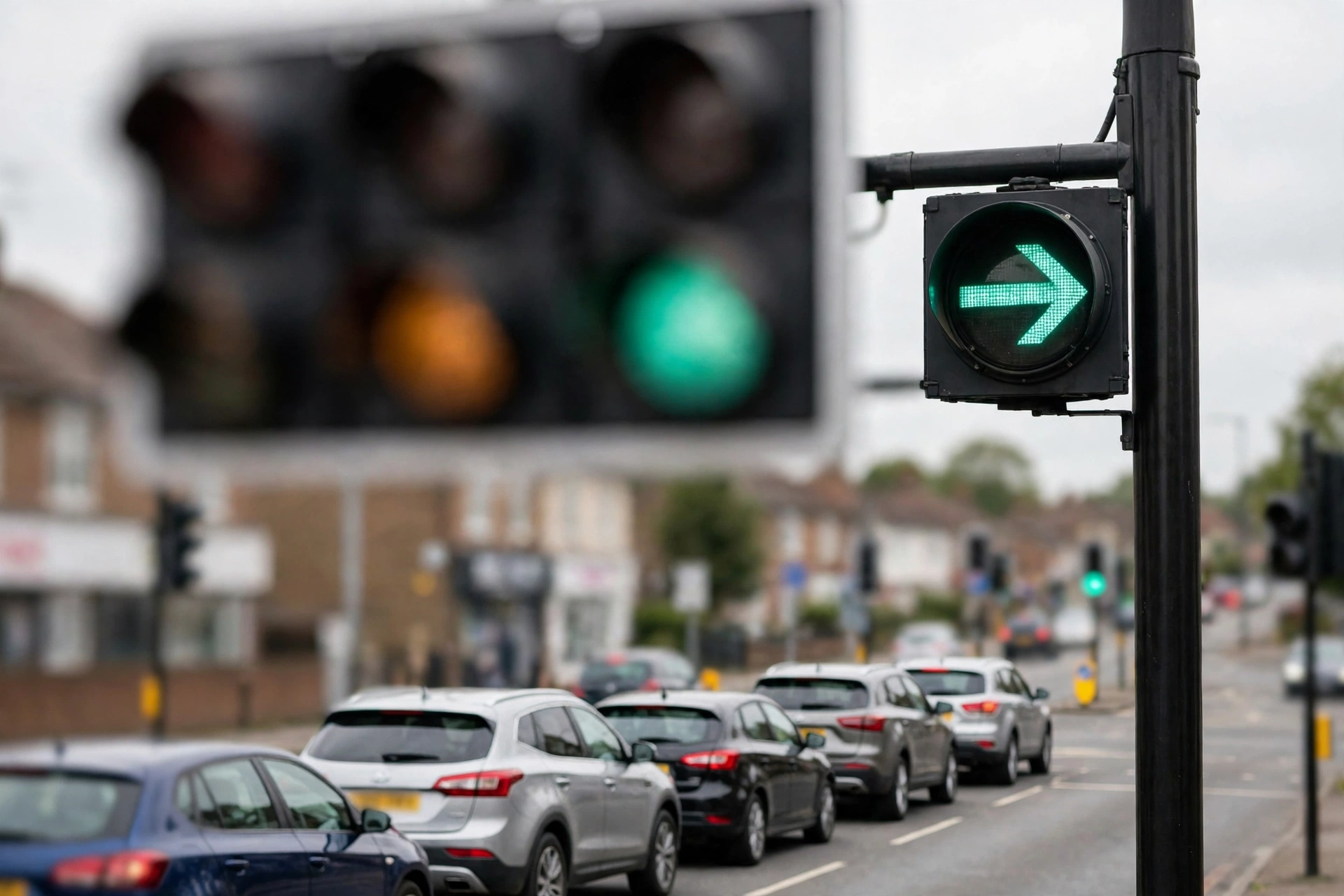
A green filter arrow gives you priority in that direction — but still check the junction is clear.
Green for you does not mean clear for you. When you turn right, you cross a pedestrian crossing point on the road you are entering. Pedestrians crossing there have priority, and their green man often runs at the same time as your green light.
Before you complete the turn, look into the road you are turning into. If someone is crossing, wait. Examiners watch this check closely, and missing it is a serious fault. The same awareness applies to cyclists: give them room and time, as our meeting traffic guide explains for narrow streets.
Every one of these is fixed by the same habit: slow down your thinking, speed up your observation. Practise the sequence during manual driving lessons and the move stops feeling like a test of courage.
Examiners mark this move under observation, positioning and judgement. They are not looking for bravery. They want to see you:
A calm, correct wait in the middle of the junction impresses an examiner far more than a rushed gap. If your test route includes Bolton’s busy signalised crossroads, your instructor will have practised them with you many times. Mock tests on our intensive driving courses include exactly these junctions.
Before your test, revise the light meanings with our UK traffic signs guide and check your speed awareness with our UK speed limits guide.
Yes. If you entered on green and are waiting in the middle, complete your turn as soon as it is safe once oncoming traffic stops. You are not running a red light — you entered legally and are clearing the junction.
Stay in the waiting position. When the lights change, oncoming traffic stops and your gap appears. Complete the turn then. This is the normal, expected way busy junctions work.
No. The arrow gives you priority over oncoming traffic, but you must still check the junction is clear and watch for pedestrians crossing the road you are turning into.
If another vehicle hits you from behind, turned wheels would push your car into oncoming traffic. Straight wheels keep you in place. It is a small detail with a serious safety reason.
Carry on and find another route. Never reverse at traffic lights, never change lanes suddenly, and never block the junction to correct a missed turn. Going around the block costs a minute; a dangerous correction can cost a test.
More questions? Read our frequently asked questions page.
Turning right at traffic lights rewards patience and observation, not speed. Position just left of centre, wheels straight, eyes on the oncoming traffic, the lights and the pedestrians — then turn promptly when your moment comes.
Shah Driving School teaches manual and automatic lessons across Bolton, Horwich, Atherton and Farnworth. Our DVSA-approved instructors practise signalised junctions on real Bolton routes until the move feels routine. Book your lessons today, and turn right at the lights without the panic.
WhatsApp us