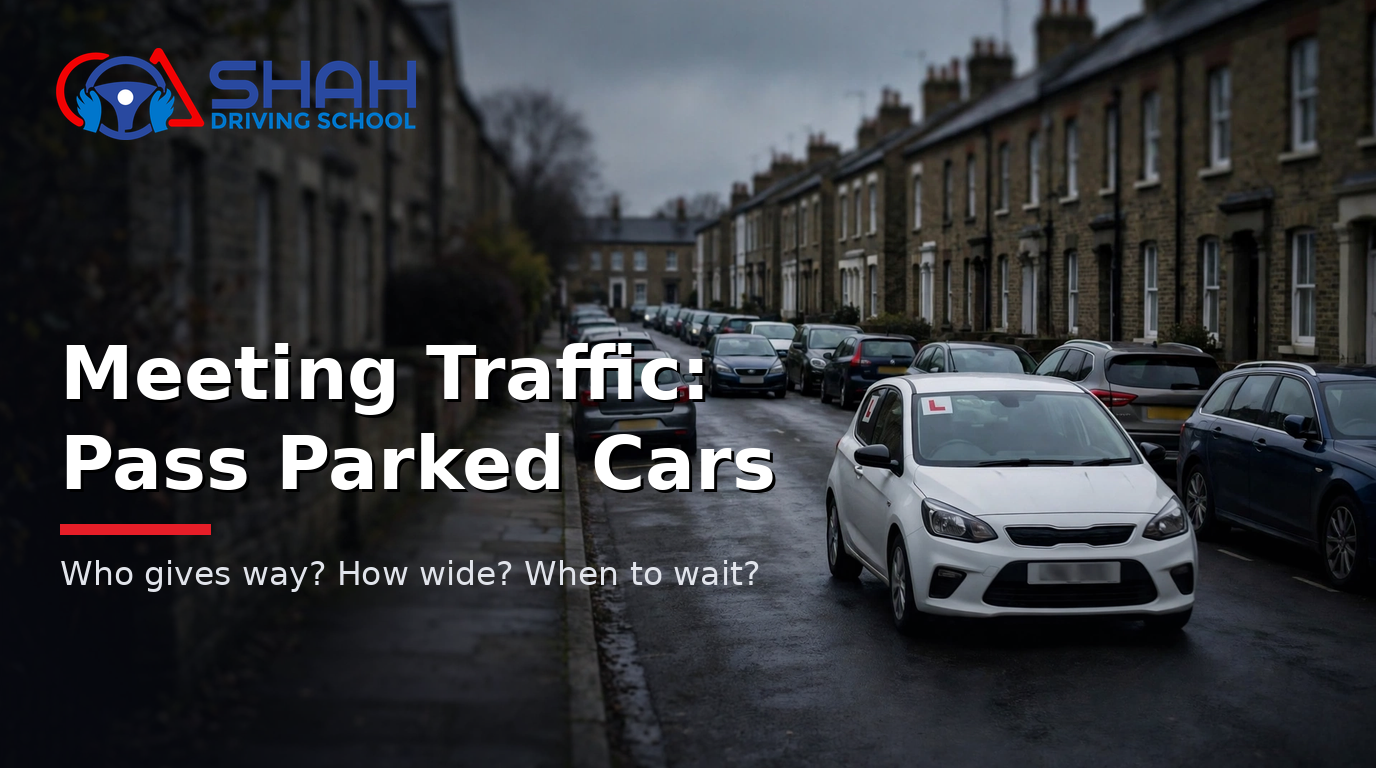

Parked cars line both sides of the street. A car approaches from the opposite direction. Somewhere in the middle, the road narrows to a single car’s width. Now what?
Meeting traffic is the skill learners practise least and use most. It is not a set manoeuvre like a bay park. It is judgement, repeated dozens of times on every Bolton drive: terraced streets, school runs, and quiet estates where parking fills both kerbs. This guide gives you the rules, the routine, and the confidence to meet traffic without guessing.
The Highway Code settles priority in a single sentence: give way to oncoming vehicles before passing parked vehicles or other obstructions on your side of the road.
Put simply:
Some narrow roads carry signs to settle it for you. A blue rectangular sign with a large white arrow pointing up means you have priority over oncoming vehicles. A red-bordered circular sign with a large black arrow pointing down means you must give way to oncoming vehicles. Learn both signs; they appear in our UK traffic signs guide.
Every pass follows the same routine. Practise it until it runs itself.
Look as far ahead as you can see. Spot parked cars, gaps between them, and anything approaching. Early scanning turns a surprise into a plan. Our UK speed limits guide covers why speed matters here: the slower you approach, the more time you have to judge.
If you are moving out around a parked car, check your mirrors, then signal right if another road user benefits from knowing. A signal costs nothing and prevents surprises, especially for cyclists behind you.
Pass parked cars with about a metre of clearance — a full door’s width. Doors open without warning, and a door swings wider than you expect. Slow down as you pass. Speed past a parked car is how mirrors get clipped and doors get hit.
Watch for clues that a parked car is about to move: brake lights glowing, indicators flashing, front wheels angled, exhaust vapour, or someone sitting inside. Any one of those means pause or widen your line.
Once you can see the parked car fully in your interior mirror, check your left mirror, signal left if needed, and ease back to your side. Never cut back sharply in front of traffic you just passed.
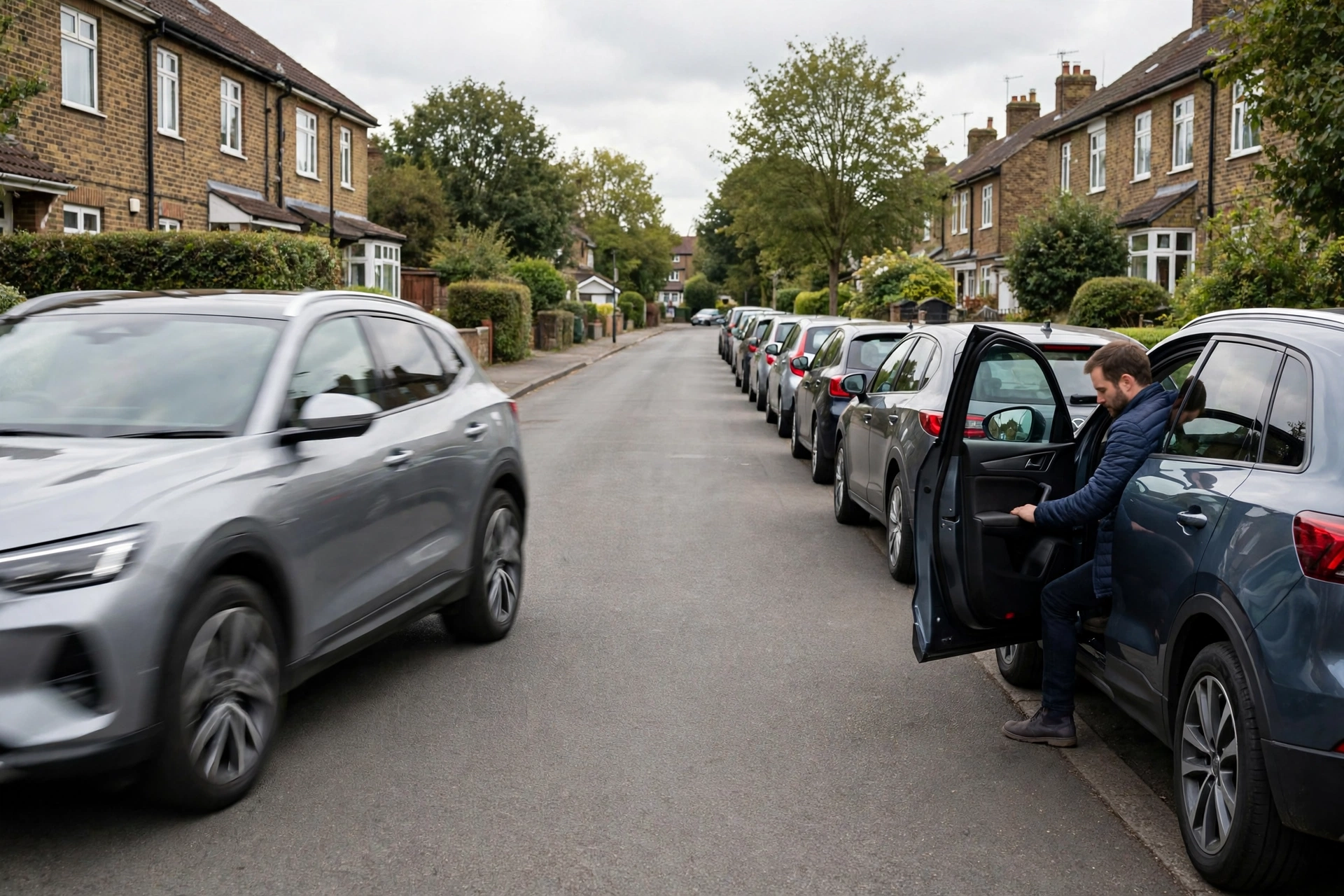
Leave a door’s width — about a metre — between your car and parked vehicles.
Parked cars hide people. That is the real danger, and examiners watch for it.
Slow, wide and watchful beats fast, close and lucky. Every time.
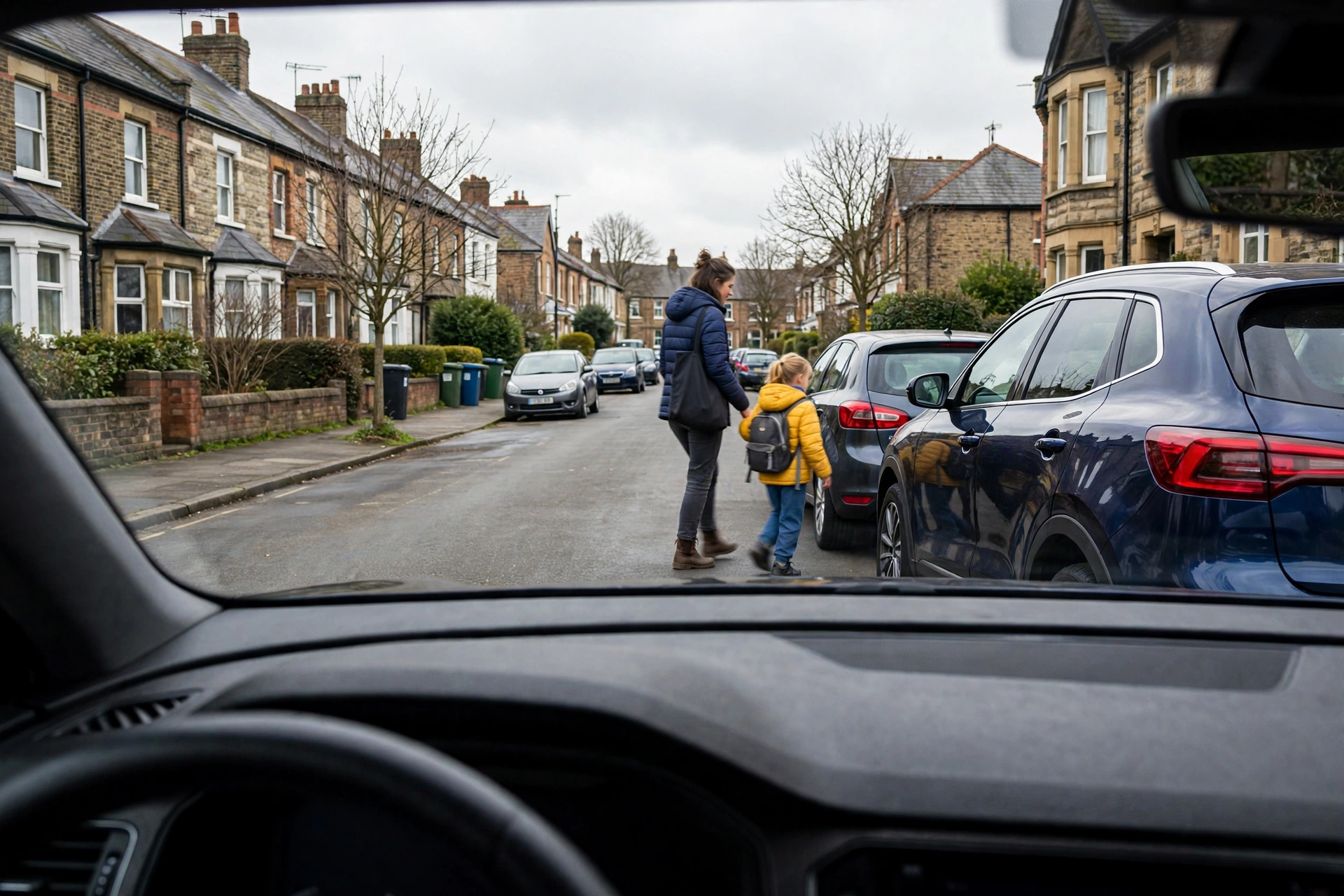
Parked cars hide people. Slow down and cover the brake wherever children may appear.
Waiting is not failing. Waiting badly is.
Wait before the obstruction, not during it. If you can see oncoming traffic approaching, pull into a gap on your side before you reach the parked cars. Stopping halfway through a narrow section blocks everyone and forces the other driver to reverse.
If the other driver is already committed, let them through. Even if you believe you had priority, a car already in the gap has nowhere to go. Reversing out of courtesy beats a standoff every time.
Never follow the car ahead blindly. The Highway Code warns that there may only be room for one vehicle to pass. Just because the car in front squeezed through does not mean you can. Judge the gap yourself.
If there is no gap, stop and wait patiently. Flashing headlights or edging forward does not create space. Patience is a driving skill, and examiners notice it.
Bolton’s terraced streets are the perfect classroom for meeting traffic. Cars park on both sides, the usable road shrinks, and buses, bin lorries and delivery vans share the same space.
On these streets, slow down early. Keep your car straight and centred in the space available, not hugging the parked cars. If two cars meet nose to nose with no gap nearby, one of you must reverse. Be the driver who does it first and does it calmly. Examiners never mark courtesy as a fault.
Never solve a squeeze by mounting the pavement. Pavements belong to pedestrians, and driving on them to pass is a serious fault on test and dangerous in real life.
Examiners mark meeting traffic under observation, positioning and judgement. The common faults are:
The balance examiners want is simple: confident but careful. Move when it is safe, wait when it is not, and show your thinking through mirrors, signals and speed. Regular practice during manual driving lessons on Bolton’s residential streets builds this balance faster than any theory page.
Remember that speed and space are linked. Our stopping distance guide shows why crawling past parked cars is not overcaution: at 20 mph you stop in 12 metres, at 30 mph you need 23. Those extra metres decide whether a child stepping out becomes a story or a statistic.
No one has automatic priority. The driver who can pull into a gap safely should give way, and the driver already committed to the gap should be allowed through. Signs, where present, settle it.
Signal when it benefits another road user — for example, when you move out into the path of following traffic or an approaching cyclist. On an empty street with no one behind, a signal adds nothing, but signalling unnecessarily is never a fault.
Let them through. Priority is a rule for normal flow, not a reason for a collision. Stop in a gap, stay calm, and carry on. Examiners mark safe decisions, not winning arguments.
No. Never use the pavement to pass parked cars or oncoming traffic. Wait for a gap, or reverse to one. Mounting the kerb is a serious fault on test.
Treat it like any other obstruction, with extra care for passengers stepping off. Pass wide and slowly, and watch for people crossing in front of the bus where you cannot see them.
More questions? Read our frequently asked questions page.
Meeting traffic rewards three qualities: scan early, leave room, and give way gracefully. Master those and the narrowest Bolton street becomes routine.
Shah Driving School teaches manual and automatic lessons across Bolton, Horwich, Atherton and Farnworth. Our DVSA-approved instructors practise meeting traffic on real residential routes, not just quiet test roads. Book your lessons today, or try an intensive driving course if your test is close. Let’s make parked cars boring.
WhatsApp us