
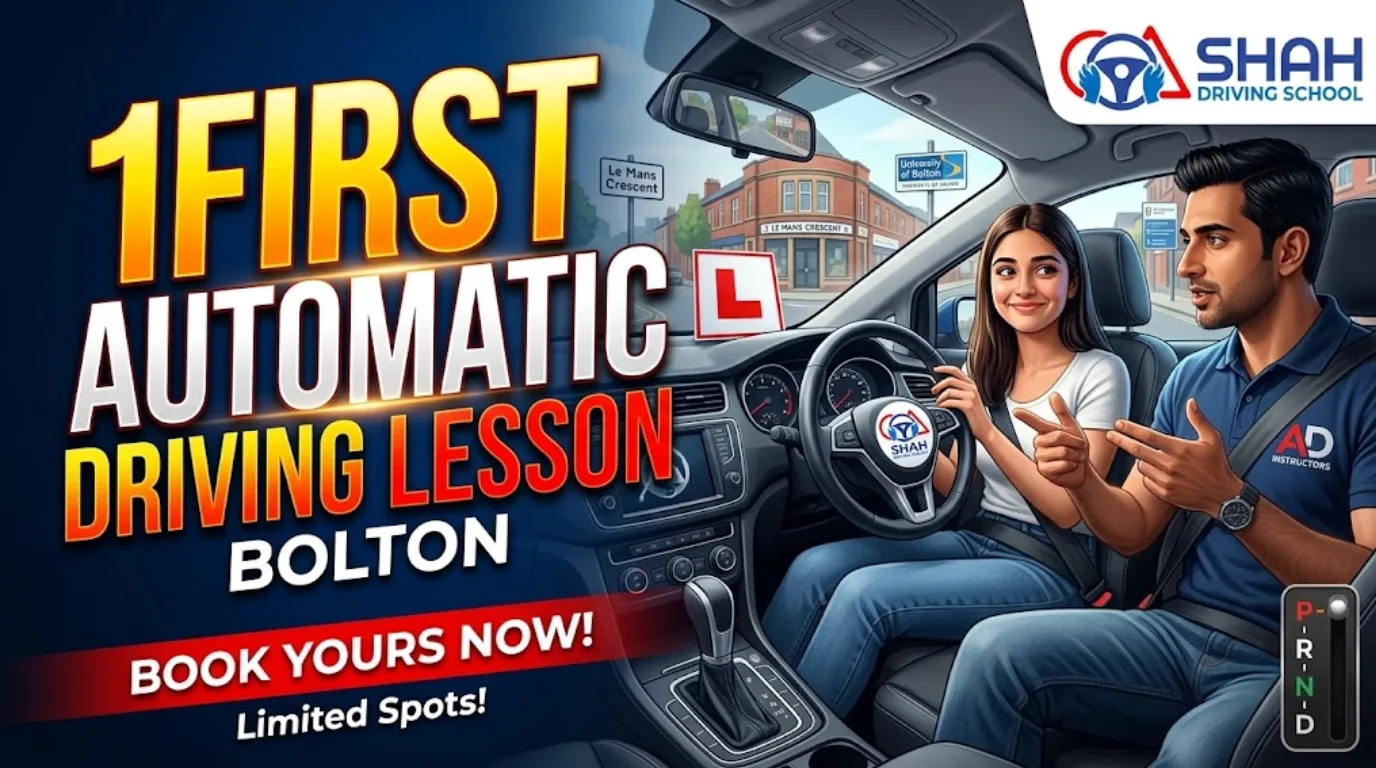
Starting your first automatic driving lesson in Bolton can feel exciting, but it can also be intimidating if you’ve never been behind the wheel before. The good news is that you are not expected to arrive knowing how to drive.
Your first lesson is about getting comfortable, understanding the vehicle and beginning to develop safe driving habits with professional guidance.
Whether you’re a complete beginner, switching from another instructor or choosing automatic driving because you want a simpler introduction to driving, knowing what to expect can make the experience much less stressful.
At Shah Driving School, learners can choose between automatic and manual tuition, with lessons available across Bolton and surrounding areas.
Your first lesson will depend on your experience, confidence and the instructor’s assessment of your current ability.
A complete beginner will normally spend time becoming familiar with the vehicle before moving into more demanding traffic situations.
You may cover:
The aim isn’t to cover everything in one session.
Learning to drive is progressive. Your instructor should introduce new skills at a suitable pace and help you understand why particular actions are important.
The Driver and Vehicle Standards Agency (DVSA) learning syllabus is designed around developing the knowledge, understanding and practical skills needed to become a safe and responsible driver.
No.
You don’t need previous driving experience before booking an automatic lesson.
In fact, professional instruction is a sensible starting point for a complete beginner because you can learn the correct techniques from the beginning rather than developing habits that later need correcting.
GOV.UK explains that learners need a provisional driving licence and must be supervised while learning to drive.
The DVSA’s Ready to Pass guidance also recommends starting with professional driving lessons and building private practice around the learner’s progress when their instructor considers them ready.
So if you’ve never driven before, don’t worry about being “good enough” for your first lesson.
The first lesson is where the learning begins.
Automatic cars can appeal to learners who don’t want to manage a clutch and manual gear changes while simultaneously learning observation, steering, road positioning and traffic awareness.
In an automatic, your attention can be focused more heavily on the road environment and making appropriate driving decisions.
However, automatic driving is not simply “easier driving”.
You still need to learn how to:
The DVSA syllabus specifically includes vehicle control, manoeuvring, observation and safe interaction with other road users as important elements of learning to drive.
An automatic removes some of the mechanical workload, but it does not remove the responsibility of being a safe driver.
Before moving onto the road, your instructor can help you understand the controls of the car.
You will generally encounter:
One important difference for a new learner is that an automatic normally has two pedals rather than the three pedals found in a manual.
Your instructor will explain how the particular vehicle works.
You should not assume every automatic car feels identical. Different vehicles can have different transmission systems and responses.
The DVSA syllabus includes understanding automatic and semi-automatic transmission systems as part of appropriate driver training.
There isn’t a long checklist of equipment you need.
The most important thing is that you have the appropriate provisional driving licence and arrive ready to learn.
It is also sensible to wear comfortable clothing and suitable footwear that allows you to operate the controls properly.
The Highway Code advises drivers to ensure that clothing and footwear do not interfere with proper control of the vehicle, and that seats and mirrors are adjusted correctly before driving.
Before your lesson, make sure you:
That final point is important.
Your instructor can’t support a concern they don’t know about.
Feeling nervous is extremely common.
You might worry about:
None of these concerns mean you aren’t capable of learning.
A professional lesson should give you the opportunity to learn in a controlled environment, with your instructor able to guide you through unfamiliar situations.
If you’re particularly nervous, say so at the beginning.
Your instructor can then understand your confidence level and introduce tasks appropriately.
One of the biggest mistakes beginners make is comparing their progress with friends, siblings or people they see online.
One learner might feel comfortable moving off quickly.
Another might need more time.
Someone else might struggle with steering but progress rapidly once they understand the basics.
There is no single timetable that guarantees every learner will progress at exactly the same speed.
GOV.UK confirms that there is no fixed minimum number of driving lessons or practice hours; the amount needed depends on how quickly an individual learns.
Your objective should be safe, consistent progress, not trying to beat someone else’s lesson count.
You don’t need to practise driving before your instructor teaches you.
However, there are useful things you can do before your first lesson.
The Highway Code isn’t only for the theory test.
It helps you understand the rules and guidance you’ll encounter while learning.
You can familiarise yourself with:
The DVSA’s learning syllabus makes clear that learners should understand and apply the Highway Code as part of becoming safe and responsible drivers.
When travelling as a passenger, pay attention to the road.
Ask yourself:
You don’t need to criticise the person driving.
Instead, use journeys as an opportunity to develop your awareness of the road environment.
If you’re unsure about something, ask.
Good questions could include:
“When should I start checking my mirrors?”
“How do I know when to slow down?”
“What should I look for at this junction?”
“When will I be ready to practise independently?”
Questions help turn a driving lesson into an active learning experience.
Learning locally can give you opportunities to experience a mixture of road environments.
Depending on your progress, your lessons may eventually involve:
Shah Driving School currently advertises tuition across Bolton and surrounding areas including Atherton, Horwich, Lostock and Farnworth.
However, learning to drive isn’t about memorising a small number of local routes.
A good learner should gradually develop the ability to respond to unfamiliar situations.
That’s why your instructor may deliberately expose you to different road layouts and traffic conditions as your skills improve.
first automatic driving lesson Bolton
Private practice can be useful when it is appropriate for your stage of learning.
However, it should be done legally and safely.
GOV.UK states that anyone supervising a learner without payment must meet specific requirements, including being at least 21, holding a full licence for the type of vehicle and having held it for at least three years.
Your instructor can also advise you about what skills are suitable for private practice.
For example, if you have only just learned basic vehicle control, there may be little benefit in immediately trying to tackle complicated roads.
Build progressively.
Practise what you have already been taught, reinforce good habits and ask your instructor what you should work on next.
Passing the practical test is an important goal.
But learning to drive should also prepare you for what happens after you receive your licence.
Eventually, you’ll need to drive without an instructor sitting beside you.
That means developing the ability to:
The DVSA describes its driving syllabus as developing the skills, knowledge and understanding needed to become a safe and responsible driver.
That is a much better long-term target than simply memorising what to do on test day.
Not every learner starting automatic lessons is a complete beginner.
You may have:
In these situations, your instructor can assess your current ability and identify what you already know versus what needs further development.
There is no reason to assume that every learner needs exactly the same programme.
If you’ve already had lessons, be honest about your experience.
It helps your instructor understand where to begin.
An automatic may be worth considering if you:
However, the decision is personal.
If you are unsure whether manual or automatic is better for your circumstances, discuss your options before committing to a course.
If you qualify to drive only automatic cars, GOV.UK explains that you can later upgrade to a manual licence by passing a manual driving test.
GOV.UK — Driving lessons and learning to drive
Choosing an instructor is an important part of learning to drive.
Shah Driving School offers manual and automatic tuition in Bolton, alongside intensive driving courses and other lesson options. Its current website also highlights experienced instructors, local knowledge and support for learners at different stages.
For a complete beginner, the priority should be finding tuition that helps you understand the car, develop safe habits and gradually become more independent.
If you’re nervous, tell your instructor.
If you’re progressing quickly, ask what you should work on next.
If you’ve had lessons before, explain what you’ve already covered.
The better your instructor understands your situation, the easier it becomes to create appropriate lessons.
An automatic removes clutch and manual gear changes, which can reduce the number of vehicle-control tasks you need to manage simultaneously. However, you still need to develop strong observation, judgement, positioning and hazard-awareness skills.
Yes. Complete beginners can start learning in an automatic with professional supervision, provided they have the appropriate provisional licence.
You don’t need to know everything before your first lesson, but becoming familiar with the Highway Code is useful and will support your practical learning.
There is no fixed number that applies to everyone. GOV.UK confirms that the amount of tuition required depends on how quickly an individual learner progresses.
Yes. Nervousness doesn’t prevent you from learning. Tell your instructor about your concerns so lessons can be approached at a suitable pace.
Your first automatic lesson doesn’t need to be perfect.
You don’t need to know every road sign, understand every junction or feel completely confident before you begin.
You simply need to be ready to learn.
With the right professional guidance, each lesson can build on the previous one — from basic vehicle control through to independent driving and practical test preparation.
If you’re looking for automatic driving lessons in Bolton, Shah Driving School can discuss your experience, goals and available lesson options with you.
Ready to start? Contact Shah Driving School to ask about current automatic driving lesson availability and find the right starting point for your driving journey.
Shah Driving School
8 Lancaster Walk
Bolton, BL1 3UF
Phone: 07490 662777
WhatsApp us