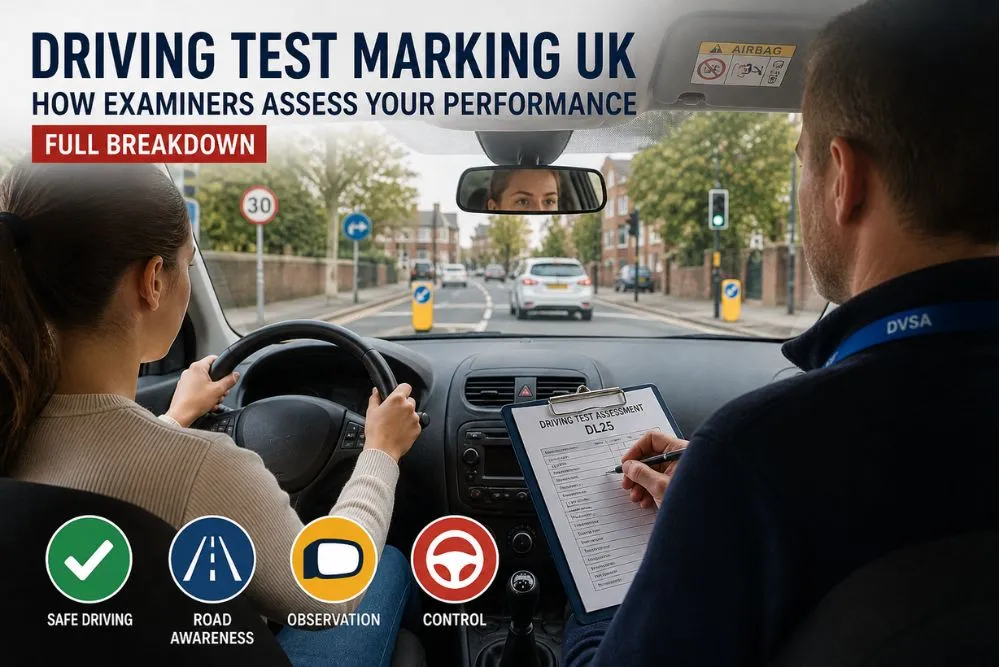
Understanding driving test marking in the UK is one of the most important things a learner driver can do before sitting their practical test. Many candidates walk into the test centre without a clear picture of how examiners actually score their driving and that uncertainty alone can cost them a pass. In this guide, we break down the entire marking system, explain what examiners are really looking for, and give you the practical knowledge to approach your test with genuine confidence.
What Is the Driving Test Marking System in the UK?
The DVSA (Driver and Vehicle Standards Agency) uses a structured fault-recording system during every practical driving test. Examiners don’t simply give you a pass or fail based on gut feeling. Every decision you make behind the wheel is observed against a defined standard, and any deviation from that standard is recorded as one of three types of fault.
Driving faults (also known as minors) are small mistakes that don’t pose an immediate danger. You’re allowed up to 15 driving faults and still pass however, accumulating too many in the same category can upgrade to a serious fault, which is an automatic failure.
Serious faults are mistakes that could have led to danger. One serious fault means an automatic test failure.
Dangerous faults involve actual danger to yourself, your examiner, another road user, or a member of the public. One dangerous fault means an automatic failure, and in some cases the examiner will take control of the vehicle.
This system is the backbone of every practical test in England, Scotland, and Wales.
How Examiners Assess Your Driving Test: The Examiner Mindset
To understand how examiners assess your driving test, you first need to understand how they think. An examiner isn’t hoping to catch you out. Their job is to assess whether you’re safe to drive independently on UK roads nothing more, nothing less.
From the moment you pull away from the test centre, the examiner is asking themselves one core question: “Would this driver be safe sharing the road with other people?”
They’re watching your:
- Observation are you checking mirrors before every manoeuvre?
- Road positioning are you in the correct lane and giving appropriate space?
- Speed management are you adapting to conditions, not just posted limits?
- Decision-making are your choices safe and appropriate at junctions, roundabouts, and crossings?
- Vehicle control are clutch, steering, and braking smooth and deliberate?
Examiners receive consistent, standardised training. They use a set of marking criteria from the DVSA’s Examiner’s Mark Sheet (DL25), which categorises driving into specific competencies. These include use of mirrors, signals, junctions, overtaking, pedestrian crossings, and more.
Also Read: How to Drive Safely Near Schools & Pedestrian Zones
The DL25 Mark Sheet: What’s Actually Being Recorded
The DL25 is the official document your examiner uses during your test. It lists every assessed driving competency in columns, and the examiner makes a mark in the appropriate fault column each time they observe an issue.
Key categories on the DL25 include:
- Eyesight check
- Highway Code knowledge (if asked)
- Controlled stop (emergency stop)
- Reverse manoeuvres
- Independent driving
- Use of mirrors (mirror-signal-manoeuvre routine)
- Signals
- Response to signs and road markings
- Use of speed
- Following distance
- Junctions (observation, turning, emerging)
- Overtaking, meeting, and crossing traffic
- Pedestrian crossings
- Position and lane discipline
- Awareness and planning
Each of these competencies has its own column. A driving fault gets a tick. A serious or dangerous fault gets a specific marker in the corresponding box. It’s clinical, precise, and completely standardised.
Common Areas Where Learners Fail: Real UK Scenarios
Junctions and Emerging Onto Busy Roads
From experience, many learners struggle most at junctions particularly emerging from side roads onto main roads. The most common error is what examiners call “hesitant emerging,” where a learner pulls forward slightly and stops repeatedly without committing to a safe gap.
This often leads to failure because it disrupts traffic flow and suggests the learner can’t read road situations effectively. On the flip side, pulling out without adequate observation especially at T-junctions on town centre roads is one of the fastest ways to collect a serious fault.
What the examiner wants to see: a clear, confident MSPSL (Mirror-Signal-Position-Speed-Look) routine, a definitive decision, and a smooth pull-away into the correct lane.
Roundabouts
UK roundabouts are a genuine challenge for learner drivers, and they account for a significant proportion of test failures. The most common errors include:
- Failing to give way to traffic already on the roundabout
- Poor lane selection at multi-lane roundabouts
- Not checking the right-hand mirror before exiting
- Cutting across lanes mid-roundabout
Examiners look for correct positioning throughout the approach and exit, timely signalling, and constant mirror checks. On a busy roundabout in a town centre think a Saturday morning school run managing speed and observation simultaneously is exactly what separates a pass from a fail.
Mirror Use: The Silent Test Killer
Neglecting mirrors is one of the most common reasons learners collect driving faults without realising it. The mirror-signal-manoeuvre (MSM) routine must be applied before every speed change, direction change, and lane change. Every single time.
Examiners notice when a learner brakes without checking the interior mirror first. They notice when a learner signals to turn but doesn’t glance at the door mirror. It might feel like a small detail, but poor mirror use across 40 minutes of driving can easily push you past 15 minors or produce a serious fault if something is genuinely missed.
Speed: Too Slow Is Also a Problem
Many learners assume that driving slowly is always the safe option. It isn’t. Driving significantly below the speed limit on a 60 mph A-road without a valid reason poor weather, hazards ahead can be marked as a serious fault for “undue hesitancy.”
Examiners assess whether your speed is appropriate to the conditions and the road. If you’re holding up traffic, making other drivers overtake unnecessarily, or approaching hazards at excessive speed, both extremes create problems on the mark sheet.
Also Read: Eco Driving UK Tips: Save Fuel While Learning to Drive | Complete Guide
What Examiners Are Really Judging Beyond the Basics
Independent Driving Judgement
Since 2017, independent driving has made up around 20 minutes of every practical test in the UK. During this section, you’ll either follow a sat nav or respond to road signs and markings without step-by-step instructions from the examiner.
Examiners during this phase are assessing your decision-making without prompts. If you take a wrong turn but do so safely, you won’t be marked down for the navigation error only for any driving faults that occur as a result. What they’re looking for is consistent observation, appropriate speed, and safe responses to junctions and traffic.
Responding to Other Road Users
UK roads aren’t controlled environments. During your test, you’ll encounter cyclists, pedestrians stepping out unexpectedly, buses pulling out, and drivers who don’t always behave predictably. The examiner is watching how you respond.
Do you slow early when a pedestrian approaches a zebra crossing? Do you give cyclists sufficient space when overtaking? Do you read the body language of parked vehicles to anticipate a door opening?
These “anticipation and planning” skills are explicitly assessed and reflect real driving experience. Learners who pass tend to drive proactively rather than reactively.
Practical “Do This” Section: Apply These Before Your Test
Here’s what you can start doing immediately in your lessons to align with examiner expectations:
- Narrate your mirrors. As you drive, say out loud “interior, left mirror” before each speed change. It reinforces the habit until it’s automatic.
- Give yourself time at junctions. Don’t rush. A two-second wait to make sure a gap is genuinely safe is far better than an emergency stop from an examiner.
- Treat every 30 mph road as a 30 mph road. Many learners drift to 28 or 25 mph in built-up areas without realising. Match the limit appropriately and check for variable limits near schools and roadworks.
- Practice roundabouts in real conditions. Ask your instructor to take you to the roundabouts nearest to your test centre. Familiarity with the layout is a genuine advantage.
- Use a full commentary drive. A commentary drive where you describe everything you see and plan to do is one of the most effective preparation tools. It forces you to think like an examiner.
Quick Pre-Test Checklist
- Check interior mirror before every speed change
- Check appropriate door mirror before every direction change
- Apply MSM routine at every junction, roundabout, and lane change
- Signal in good time not too early, not too late
- Match speed to conditions, not just to the posted limit
- Give cyclists and pedestrians generous space
- Approach roundabouts in the correct lane well in advance
- During independent driving, maintain all standards even without prompts
- Stay calm if you make a minor error keep driving safely
- Complete the eyesight check confidently at the start
Also Read: Driving Test in Bad Weather UK: How Weather Conditions Affect Your Performance
People Also Ask
How many minors can you get on a UK driving test? You can receive up to 15 driving faults (minors) and still pass. However, one serious or dangerous fault results in automatic failure regardless of how many minors you have.
What is a serious fault on a driving test? A serious fault is a mistake that could have potentially caused danger for example, emerging from a junction without adequate observation when another vehicle is approaching. One serious fault means a failed test.
Does the examiner tell you how many faults you got? Yes. At the end of the test, the examiner will explain the result and go through any faults recorded. You’ll also receive a copy of your mark sheet showing every fault and where it occurred.
Can you fail for going too slowly? Yes. Driving significantly below the speed limit without good reason can result in a serious fault for undue hesitancy, as it may cause unnecessary disruption to other road users.
What happens if you make a mistake during independent driving? If you take a wrong turn during the independent driving section, you won’t be penalised for the navigation error itself only for any faults that occur as a result of the mistake. Stay calm and continue driving safely.
A Real-Life Scenario: The Town Centre Junction
Imagine you’re on test in a busy town centre on a Tuesday afternoon. You approach a T-junction to emerge right onto a main road. There are parked cars partially obscuring your view to the right.
You stop at the line, check left and right, and identify that your view is limited. So you creep forward slowly to improve your view exactly as you’ve been taught. You check again. There’s a van approaching from the right at some distance. You judge it to be far enough away and pull out smoothly, accelerating into the correct lane.
The examiner records nothing. Why? Because every element of that decision was safe: you identified the restricted view, improved your position, reassessed, made a confident and correct judgement, and executed it cleanly.
Now imagine a learner who reaches the same junction, glances briefly, and pulls out in front of the approaching van which has to slow. That’s a serious fault at minimum, and possibly dangerous. The difference isn’t just skill. It’s understanding what the examiner is actually looking for: safe, deliberate, well-observed decisions.
DVSA Approach and Latest Developments
The DVSA regularly reviews its testing standards to reflect modern roads and driving conditions. In recent years, there has been an increased emphasis on:
- Sat nav use during independent driving (reflecting real-world driving habits)
- Eco-safe driving awareness, including smooth acceleration and appropriate gear use
- Anticipation around vulnerable road users cyclists, motorcyclists, and pedestrians
The DVSA also publishes an annual report of the most common reasons for test failure, which consistently highlights junctions, mirrors, and moving off as the top three. This data comes directly from the examiner marking system and reflects real patterns across thousands of tests every year.
You can view the latest DVSA statistics at gov.uk/government/statistical-data-sets/driving-test-statistics-drt, which offers a transparent breakdown of failure reasons by test centre.
Also Read: Lane Discipline for Beginners UK – Simple Tips That Really Help
Conclusion: Know the System, Pass With Confidence
Understanding driving test marking in the UK removes a significant amount of test-day uncertainty. When you know that examiners are assessing observation, decision-making, speed management, and vehicle control against a consistent, structured standard you can prepare for those specific things deliberately and effectively.
The marking system is not designed to trip you up. It’s designed to confirm that you’re ready to drive safely and independently on UK roads. Every minor, every serious fault, every assessment category exists for a reason: to protect you and everyone else sharing the road with you.
The learners who pass aren’t always the most naturally gifted drivers. They’re the ones who understand what’s expected of them, practise with purpose, and walk into the test centre knowing exactly what an examiner needs to see. Now you’re one of those learners.
FAQs
- How long does a UK practical driving test last?
The test lasts approximately 40 minutes, including around 20 minutes of independent driving.
- Can you see your examiner’s mark sheet after the test?
Yes. Win or lose, the examiner walks you through every fault recorded and you receive a copy of the DL25 mark sheet.
- Is the marking system the same across all UK test centres?
Yes. All DVSA examiners are trained to use the same standardised marking criteria, though road conditions and routes naturally vary by location.
- What counts as a dangerous fault?
A dangerous fault occurs when the examiner or another road user is put in actual danger for example, pulling out in front of an oncoming vehicle. The examiner may intervene physically.
- Do examiners mark differently in busier areas?
No. The marking standard is consistent. However, test routes in busier areas naturally present more complex situations, which is why familiarity with your local roads and test centre area is so valuable.