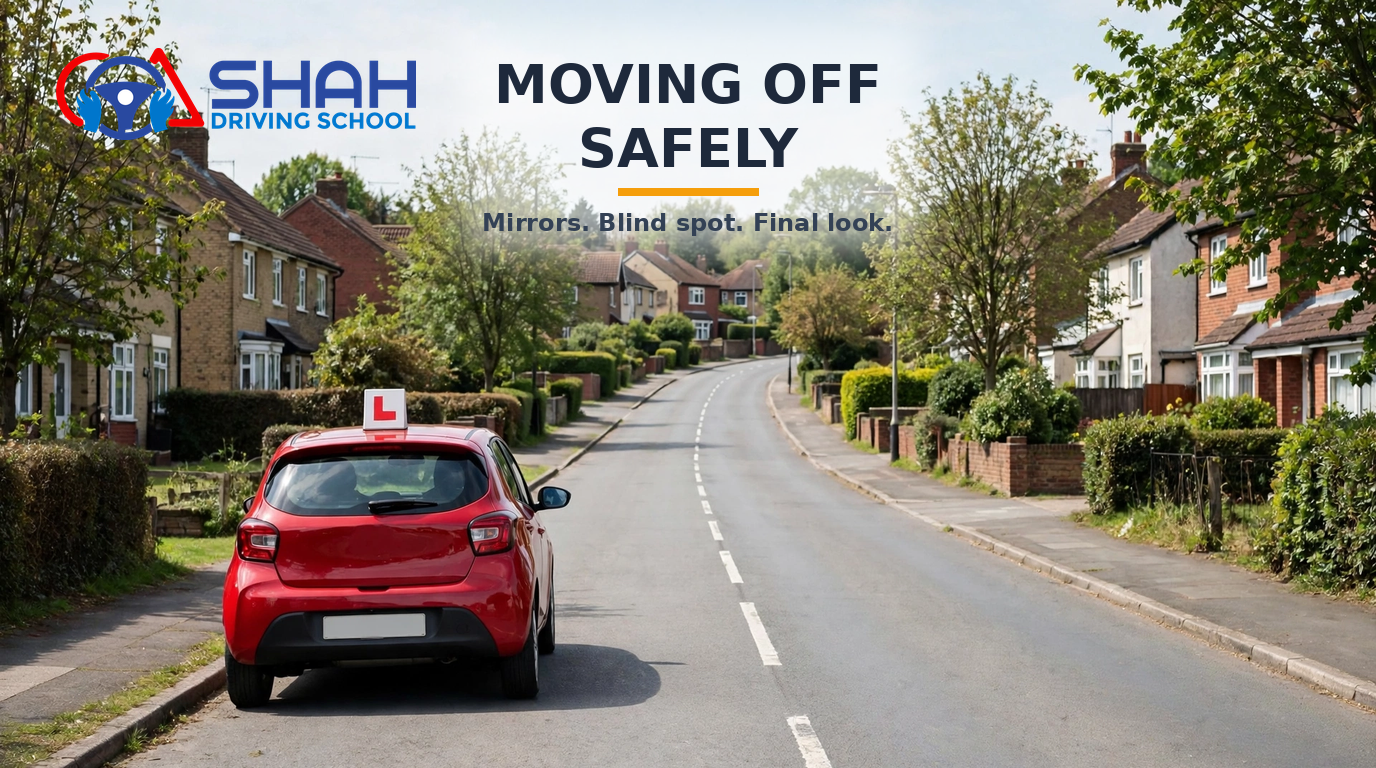

Moving off safely means this: check all your mirrors, look round for the blind spots, signal if you need to, take one final look, and move off only when it is safe. That short routine is marked again and again on your test.
It sounds too basic to fail anyone. Yet moving off safely sits in DVSA’s top ten reasons for failing the driving test. The reason is repetition. You move off at the start, after every pull-up, after the manoeuvre, and at junction after junction. Each one is a fresh chance to miss a blind-spot check. This guide walks through those moments the way your examiner sees them. It is written by the Shah Driving School instructor team.
Highway Code Rule 159 sets the sequence. Before moving off, use all mirrors to check the road is clear. Look round to check the blind spots, the areas the mirrors cannot show. Signal if necessary before moving out. Then look round for a final check. Move off only when it is safe to do so.
Rule 161 explains why the look round matters. Mirrors do not cover all areas, and there will be blind spots. You need to look round and check. The same rule gives the routine its short form: Mirrors, Signal, Manoeuvre. Moving off safely is that routine with one extra step: the final look, taken just before the car moves.
Notice the order. Mirrors first, then the blind-spot look, then the signal, then the final look. Learners often signal first and check afterwards. That tells other road users you are coming before you know whether you should. Examiners notice the order because it shows whether the decision came before the movement.
GOV.UK’s guide to your test result says you must move off safely and under control throughout the test. It names four settings: from the side of the road, on a slope or hill, from behind a parked vehicle, and at junctions. The routine stays the same in all four. What changes is what can go wrong.
From the side of the road. This is the test start and every normal pull-up. The risk is traffic approaching from behind, including cyclists filtering past. Mirrors show the road behind. The blind-spot look covers the space beside the car.
From behind a parked vehicle. Here you move off at an angle, into the road. Your view ahead is blocked by the vehicle in front. The final look matters most, because the gap you need is the one you cannot fully see until you start to move.
On a slope or hill. Observation still comes first, but control joins it. The car must not roll back, and repeated stalling is a fault. Our guide to how to do a hill start covers the control side in full.
At junctions. Moving off here blends into emerging. The checks are the same, but the decision is bigger: you are joining traffic, not just leaving the kerb. A safe gap, judged properly, is part of moving off safely.
Examiners mark moving off on two things: control and safety. GOV.UK lists the common faults plainly. Trying to move off without appropriate control and rolling back. Not properly checking blind spots. Moving off into the path of an oncoming vehicle. Repeatedly stalling when moving off.
Read that list again and notice what is missing. Nobody fails for moving off slowly and carefully. The faults are about missing checks and losing control. A learner who takes two extra seconds to look round properly is doing exactly what the examiner wants to see.
The opposite error also exists, though it is marked elsewhere. Sitting at a clear junction long after it is safe to go becomes a progress fault. Our guide to driving too slowly on your driving test covers that balance. Moving off safely and moving off promptly are partners, not rivals.
Most moving-off faults come back to one missed look. Mirrors show a lot, but they leave gaps beside the rear of the car. A cyclist filtering through slow traffic can sit in exactly that gap. Rule 160 warns drivers to be aware of cycles and motorcycles filtering through traffic, because they are harder to see and their riders are vulnerable.
That is why the blind-spot check is a physical look, not a glance at the mirror. Turn your head. Look over your shoulder. The examiner can see that movement from the passenger seat, and it is the clearest evidence that the check happened.
From the passenger seat, we see the same pattern in lessons. The learner checks mirrors, signals, and pulls away in one smooth motion. It looks confident. It is also how a cyclist gets missed. Moving off safely feels slower than that smooth motion. It is meant to. The pause for the final look is the skill.
The routine only protects you if it runs every time, without thinking. Three habits build that.
Same sequence, every stop. Mirrors, blind-spot look, signal if needed, final look. Use it at every junction and every pull-up in lessons, not just at the test start. Repetition is what makes it survive test-day nerves.
Prepare the car before the checks. Find the biting point and settle the car first. Then do your observation. Learners who juggle clutch control and mirror checks at the same time drop one of them. Usually the look round goes first.
Let the final look decide. Treat the final look as a real decision, not a ritual. If something is coming, wait. Then start the sequence again. A fresh check after a wait is not wasted time. It is moving off safely, done properly.
Once moving, keep left unless signs or markings say otherwise, and build your speed to match the road. That second half is progress, and it is where independent practice helps. Our guide to independent driving and sat nav on your test shows how making your own decisions in lessons builds the same calm judgement.
Moving off safely is a small routine with a long reach. It is marked at the start, at junctions, on hills and after every stop. Learn the sequence, respect the blind spot, and let the final look make the decision. If move-off faults are showing up in your lessons, compare our manual driving lessons and automatic driving lessons, or ask us a question through the contact page. Call 0749 0662 777 to talk through your test preparation.
WhatsApp us