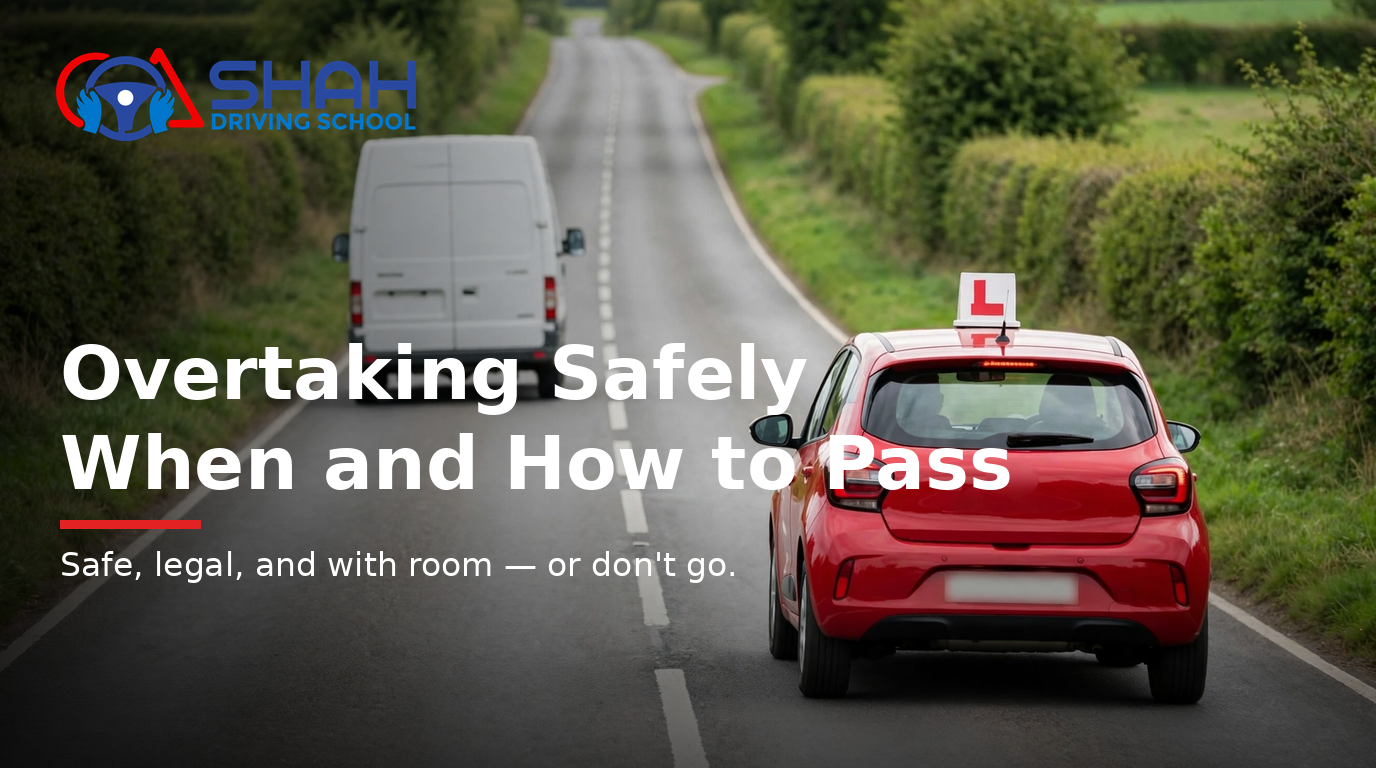

Overtaking Safely: When and How to Pass | Shah Driving School. Overtaking safely is a decision, not a reflex. The question is never “can I get past?” — it is “is it safe, is it legal, and is there room to finish?” If any of those three answers is no, you wait. This guide covers the full framework from Highway Code Rules 162 to 169. The three checks before you go, the gaps the Code expects for vulnerable road users, the places where you must not overtake at all, and what to do when someone overtakes you.
Before overtaking, Rule 162 says to make sure of three things:
If any of the three is missing, the overtake is off. Waiting is not a failure. It is the correct answer, and on your driving test it is what the examiner wants to see.
Overtake only when it is safe and legal to do so. When you have decided to go, the sequence is the one you already know:
Once you have started, move quickly past the vehicle you are overtaking. Allow plenty of room. Move back to the left as soon as you can, but do not cut in. Wait until you can see the whole vehicle in your interior mirror before pulling back in.
Three habits to unlearn:
Give motorcyclists, cyclists, horse riders, horse-drawn vehicles and pedestrians at least as much room as you would a car. The Code gives these clearances as a guide:
If it is unsafe or not possible to meet these clearances, wait behind and do not overtake. That single sentence is the whole point of the rule — the gap comes first, the overtake second. For the full picture of driving near bikes, read our Sharing the Road with Cyclists guide.
Some situations are not judgment calls. Rule 165 says you MUST NOT overtake:
These are legal requirements, backed by the Road Traffic Act 1988 — not advice.
Double white lines come in two forms. Where the line nearer to you is broken, you may cross the lines to overtake if it is safe. But you must be able to complete the manoeuvre before reaching a solid white line on your side. White direction arrows on the road tell you to get back onto your side.
Where the line nearer to you is solid, you must not cross or straddle it — unless it is safe and you need to enter adjoining premises or a side road. You may also cross the line if necessary, provided the road is clear. That covers passing a stationary vehicle, or overtaking a pedal cycle, horse or road maintenance vehicle travelling at 10 mph or less.
Beyond the legal bans, the Code lists situations where overtaking is simply not safe. Rule 166 is the headline: if there is any doubt, or you cannot see far enough ahead to be sure it is safe, do not overtake. That covers approaching a corner or bend, a hump bridge, and the brow of a hill — anywhere the road ahead is hidden from you.
Rule 167 adds the places where you might come into conflict with other road users:
Read that list once more. Every item on it is a place where something is about to happen — a turn, a stop, a pedestrian, a narrowing — and overtaking removes your ability to react to it.
Overtaking a large vehicle is more difficult, and the Code treats it separately:
The same discipline applies on the A666 St Peter’s Way dual carriageway and on the single-carriageway lanes around Rivington: the bigger the vehicle, the longer the gap you need. On a dual carriageway, the mechanics are different. Stay in the left-hand lane, use the right-hand lane to overtake, and move back left when safe. Our dual carriageway guide covers them in full.
Overtaking is a two-way street. If a driver is trying to overtake you:
And if you are the slow vehicle — especially a large or slow-moving one — do not hold up a long queue of traffic. Check your mirrors frequently, and if necessary, pull in where it is safe and let traffic pass. On narrow Bolton and Atherton roads, that courtesy keeps everyone moving and keeps tempers down.
Overtaking rarely dominates a driving test, but when it comes up, the faults are consistent:
The habit that passes is the habit that keeps you safe: decide early, check properly, commit cleanly, and return to the left without rushing. If the gap is not there, wait — and do not let the driver behind you rush your decision.
Only in limited cases. You may overtake on the left if the vehicle in front is signalling to turn right and there is room to do so. In slow-moving queues, stay in your lane — but if the queue on your right is moving more slowly than you are, you may pass on the left. Overtaking on the left anywhere else is not allowed.
At least 1.5 metres at speeds up to 30 mph, and more space at higher speeds. If you cannot meet the clearance, wait behind the cyclist until you can.
Not between the kerb and the bus — Rule 167 says do not overtake there. Pass on the offside when it is safe, watching for passengers stepping off and crossing the road in front of the bus.
Wait. Rule 167 says do not overtake when a road user is indicating right, even if you believe the signal should have been cancelled. Do not take a risk — wait for the signal to be cancelled.
Yes — that is what the right-hand lane is for. Stay in the left-hand lane, use the right-hand lane to overtake or turn right, and move back to the left when it is safe to do so. Never overtake on the left except in the queue cases described above.
More questions? Read our frequently asked questions page.
Overtaking safely comes down to three questions: is it safe, is it legal, and is there room to finish? Answer all three honestly, every time, and the rest of the framework falls into place. The gaps, the bans and the blind spots are all there to protect the moment you commit.
If you are learning to drive in Bolton or Atherton, we will practise overtaking on real roads. The dual carriageway on St Peter’s Way, the single-carriageway lanes around Rivington, and the test routes around the Bolton test centre on Weston Street. Book manual driving lessons with Shah Driving School. Call us on 0749 0662 777, or visit our contact page to book your first lesson. The safest overtake is the one you were sure about before you started.
Highway Code rules: Using the road, Rules 159 to 203 (GOV.UK) — Rules 162–169; General rules, techniques and advice for all drivers and riders, Rules 103 to 158 (GOV.UK) — Rules 128–129 and 137–138.
WhatsApp us