
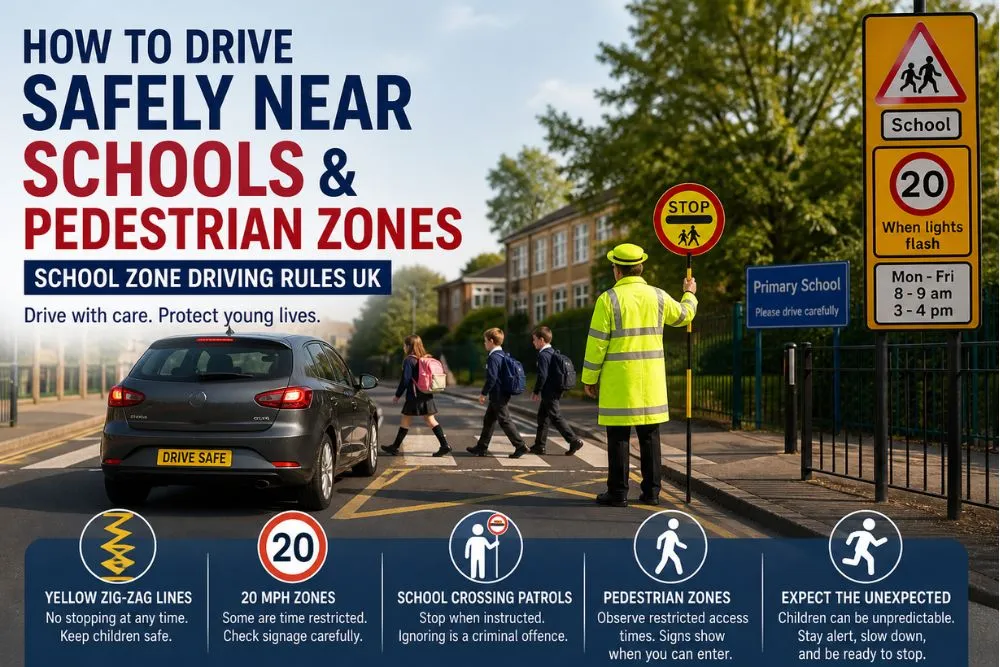
Understanding school zone driving rules UK is one of the most important and most tested skills any driver needs to master. Whether you’re a learner preparing for your practical test or a qualified driver navigating a busy school run, the rules around schools and pedestrian zones are non-negotiable. Get them wrong and you risk not only a test failure, but more critically, the safety of the most vulnerable road users: children.
From experience, many learners underestimate just how much attention examiners pay during routes that pass schools, zebra crossings, and pedestrian zones. These areas separate careful, observant drivers from those who are simply going through the motions.
This guide breaks down everything you need to know from legal requirements and DVSA standards to real-world scenarios and examiner expectations.
In the UK, there is no single designated “school zone” system with fixed speed limits as seen in some other countries. However, a combination of laws, signage, and road markings create a robust framework for protecting pedestrians near schools.
Key elements include:
The law underpinning much of this sits within the Highway Code and Road Traffic Act 1988. However, the DVSA’s practical test standards go further examiners assess not just whether you followed the law, but whether your driving demonstrated genuine awareness and responsibility.
Also Read: Eco Driving UK Tips: Save Fuel While Learning to Drive | Complete Guide
Pedestrian safety driving UK is a topic that sits at the heart of responsible motoring. Near schools, the risk profile is entirely different from a standard road.
Children are unpredictable. They run between parked cars. They cross without looking. They assume drivers have seen them when they haven’t. A responsible driver accounts for all of this not just the rules on a sign.
Moreover, pedestrian zones in UK town centres, shopping areas, and near schools often have restricted access times. Entering a pedestrian zone during restricted hours is a traffic offence. Some zones are enforced by cameras, and fixed penalty notices can follow.
For learners, failing to demonstrate awareness in these environments is one of the most common reasons for a driving test failure. It’s not always about breaking a rule sometimes it’s about failing to anticipate what might happen next.
When your test route passes a school, the examiner is not simply checking whether you slowed down. They’re evaluating a chain of driving behaviours that demonstrate genuine hazard perception and pedestrian awareness.
Examiners look for:
This often leads to failure because learners focus so hard on their speed that they forget to demonstrate why they’re slowing down the scanning, the anticipation, the readiness to stop. The examiner needs to see a thinking driver, not just a slower one.
Also Read: Driving Test in Bad Weather UK: How Weather Conditions Affect Your Performance
This is surprisingly common. A learner sees a crossing ahead, spots pedestrians, and stops right on the zig-zags. This is both illegal and dangerous. It blocks sightlines for pedestrians and other drivers. On a test, this typically results in a serious fault.
A lollipop person stepping towards the road is a legal instruction to stop not a suggestion. Many learners hesitate or slow gradually rather than stopping promptly and confidently. Examiners treat this as a failure to respond to an authoritative road signal.
Pedestrians have absolute priority at zebra crossings once they step onto the crossing. Creeping forward even slowly while someone is crossing sends the wrong signal and can cause panic. It also tells the examiner that you haven’t fully understood the rule.
Slamming on the brakes as you reach a 20 mph zone sign demonstrates a lack of planning. The DVSA expects you to read the road ahead and begin slowing in good time. From experience, many learners wait too long because they’re still watching their mirrors or managing other controls.
Parked vehicles near schools create pinch points and blind spots. Learners often either swing too wide into oncoming traffic or pass too close, not accounting for car doors opening or children stepping out. Neither approach impresses an examiner.
Imagine you’re on a test in a typical UK market town. Your route takes you along a residential road at 8:45 am. There are parked cars on both sides, a lollipop person ahead on the left, and children on the pavement with parents.
Here’s what a failing candidate does: approaches at 28 mph, checks mirrors once, brakes sharply when they notice the lollipop person, stops on the zig-zags because there’s a queue, and then edges forward while a child is still on the crossing.
Here’s what a passing candidate does: notices the school environment well in advance, checks mirrors early, reduces speed progressively to around 15 mph, positions the car correctly to allow safe passage near parked vehicles, stops well before the zig-zags when the lollipop person signals, and waits patiently with the handbrake applied if stationary for more than a few seconds.
Same road. Same situation. Completely different outcome.
Also Read: Lane Discipline for Beginners UK – Simple Tips That Really Help
What are the rules for driving near a school in the UK? In the UK, drivers must observe any posted speed limits (often 20 mph near schools), never stop on yellow zig-zag lines outside school gates, and give immediate way to school crossing patrols. The Highway Code and Road Traffic Act 1988 underpin these requirements.
Can you stop outside a school on zig-zag lines? No. Stopping or parking on yellow zig-zag lines outside a school is illegal at any time, regardless of whether school is in session. These markings exist to protect visibility for children and drivers approaching the crossing.
What is the speed limit near schools in the UK? There is no single universal speed limit for all schools, but many school zones operate 20 mph limits, particularly during school hours. Always follow posted signage. In some areas, temporary 20 mph signs are used during drop-off and pick-up times only.
Do you have to stop for a lollipop person? Yes, absolutely. A school crossing patrol operative displaying their sign and stepping towards the road is a legal instruction to stop. Failing to do so is a traffic offence and will result in an immediate serious fault on a driving test.
What happens if you drive through a pedestrian zone in the UK? Entering a pedestrian zone during restricted hours is a traffic offence. Many zones are enforced by cameras or signage with time restrictions. Fixed penalty notices may be issued. Always check signage carefully before entering any restricted zone.
The DVSA has consistently emphasised hazard perception and anticipation as core competencies in UK driving standards. The updated Highway Code, particularly changes introduced in 2022, reinforced the hierarchy of road users placing pedestrians and cyclists at the top of priority consideration.
In practical test terms, this means examiners are now paying even closer attention to how candidates respond to vulnerable road users in complex environments like school zones. It’s no longer sufficient to simply not hit anyone. The DVSA expects drivers to demonstrate active, proactive awareness slowing before they have to, scanning continuously, and responding to cues rather than waiting for an emergency.
For newly qualified drivers, this mindset should extend well beyond the test itself. Pedestrian safety driving UK is an ongoing responsibility, not a box ticked on test day.
Also Read: Night Driving Tips for Beginners UK – Essential Guide for New Drivers
Mastering school zone driving rules UK is about far more than memorising the Highway Code. It’s about developing a genuine instinct for the unexpected the child who steps out from behind a parked van, the parent pushing a pram without looking, the lollipop person who steps out just as the lights change elsewhere.
Examiners see this instinct or the lack of it clearly. The candidates who pass cleanly through school zones are the ones who’ve already thought three or four steps ahead before they even reach the zig-zags.
Take the time to practise these routes during school hours. Ask your instructor to include school zones in your lessons. And remember: the habits you build as a learner become the driver you are for life. Drive like you’d want someone to drive past your own child’s school.
They indicate a no-stopping zone at all times. Parking or stopping here even briefly is illegal and obstructs visibility for children and drivers.
Not always. Some are fixed limits, while others operate only during school hours. Check roadside signage carefully for time-restricted notices.
They cannot issue fines, but police can act on reports. Failing to stop for a patrol operative is a criminal traffic offence.
Yes. Delivery drivers must observe restricted access times in pedestrian zones just like any other driver. Time restrictions are usually displayed clearly on signs at zone entry points.
React calmly brake progressively, sound your horn if necessary, and avoid swerving into oncoming traffic. Practising hazard perception regularly will improve your ability to anticipate such situations before they become emergencies.
WhatsApp us