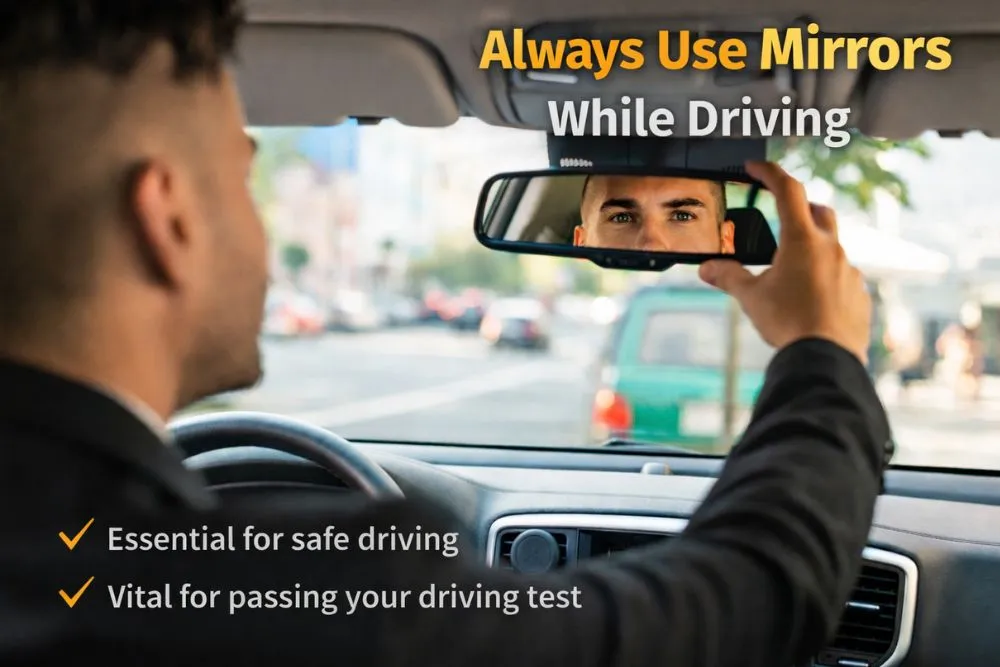
Mirror checks during your driving test UK examiners assess are one of the most frequently cited reasons learners lose marks or fail outright. Yet despite being one of the most teachable skills in driving, many pupils underestimate just how much attention the examiner pays to their eyes and head movement throughout the test.
This guide breaks down everything you need to know about mirror checks why they matter, how to do them correctly, and the common mistakes that catch learners off guard on test day.
What Are Mirror Checks and Why Do They Matter?
Mirror checks are the deliberate act of observing your surroundings using your vehicle’s mirrors before changing speed, direction, or road position. They form a core part of what the Driver and Vehicle Standards Agency (DVSA) evaluates during every practical driving test in the UK.
The DVSA’s marking sheet assesses your “use of mirrors” as a standalone category. Failing to check mirrors at the right time can result in a driving fault, and repeated errors in the same category can lead to a serious or dangerous fault both of which mean an automatic test failure.
Beyond the test itself, proper mirror use is a genuine road safety habit. According to the Highway Code, drivers must use mirrors effectively before signalling, before changing direction, and before changing speed. These are not suggestions they are fundamental expectations of safe driving.
The MSM Routine: Mirror, Signal, Manoeuvre
One of the first structured techniques you will learn is the MSM routine. This stands for Mirror, Signal, Manoeuvre, and it underpins almost every decision you make at the wheel.
Before you signal, you check your mirrors. Before you manoeuvre whether that means turning, overtaking, or pulling away you check your mirrors again. The sequence matters because acting before checking can lead to dangerous situations you simply could not have anticipated.
Your instructor will likely drill this into you early on, and rightly so. Making it second nature before your test day is the goal.
Also Read: Best Places to Practise Driving in Bolton | Quiet Areas for Beginners
Which Mirrors Should You Check and When?
Centre Mirror and Door Mirrors: Understanding the Difference
Your centre rear-view mirror gives you a clear view of what is directly behind you. Your door mirrors, however, show you the areas to the sides and slightly behind critical for lane changes, overtaking, and manoeuvres like parallel parking.
As a general rule, you should check the centre mirror first, followed by the relevant door mirror depending on which direction you are moving. For example, if you are turning left, you check centre then left mirror. If you are moving out to the right, check centre then right mirror.
When Exactly Should You Be Checking?
There are specific moments during any drive where mirror checks are not optional they are expected:
Before moving off from a stationary position, you should check all mirrors and look over your shoulder for a blind spot check. Before signalling to turn or change lanes, centre and door mirrors must be observed. Before slowing down or braking, particularly on a busy road, a centre mirror check ensures no vehicle is following too closely. Before increasing your speed, checking mirrors helps you assess whether it is safe to do so. At regular intervals during normal driving roughly every five to eight seconds you should glance in your centre mirror to maintain awareness of the traffic situation behind you.
How Examiners Assess Your Mirror Checks
The examiner sits beside you and watches your head and eye movements closely. They are specifically looking for what the DVSA calls “effective use of mirrors” meaning you do not just glance at them momentarily, but that you actively respond to what you see.
For example, if you check your centre mirror before braking and there is a car close behind, the examiner expects you to brake more gently to avoid a rear-end collision. That reaction is the proof that your mirror check was genuinely effective, not simply performed for show.
Many learners make the mistake of moving their head in an exaggerated way without actually absorbing the information. Examiners are trained to spot this. Conversely, some learners check mirrors with only their eyes, with no visible head movement and this can also be marked as insufficient.
A natural, deliberate movement of the head toward the mirror, followed by visible adjustment to your driving if needed, is what you are aiming for.
Common Mirror Check Mistakes Learners Make
Not checking mirrors before moving off is one of the most common errors seen on test day. Another frequent issue is checking mirrors after signalling, rather than before which reverses the MSM sequence entirely.
Forgetting to check the left door mirror before turning left is a mistake that catches many learners out, particularly when cycling lanes are present. Similarly, failing to use mirrors before slowing for a hazard, such as a pedestrian stepping out or traffic lights changing to red, is regularly marked as a fault.
Some learners also check mirrors far too infrequently during general driving, creating long stretches where they have no idea what is happening behind them. This is especially noticeable on dual carriageways or when joining a motorway during a test that includes those road types.
Do You Need to Check Blind Spots Too?
Yes and this is a separate action from checking your mirrors. Blind spot checks involve physically looking over your shoulder to cover the area that mirrors cannot show you.
You should perform a blind spot check when moving off from the side of the road, when changing lanes, and when emerging from a junction in some situations. Learners sometimes confuse mirror checks with blind spot checks, but both are required and both are assessed.
The Highway Code rule 159 specifically addresses the need to check blind spots before moving off, and the DVSA practical test marking reflects this expectation.
Also Read: Provisional Licence to Full UK Licence: The Complete Timeline and Costs Breakdown
Practical Tips to Improve Your Mirror Checks Before Test Day
Start building a habit during every lesson, not just when you remember. Ask your instructor to give you a verbal prompt every time you miss a mirror check, so you gradually internalise when they are required.
Practice saying the MSM routine in your head as you drive. This internal narration keeps you focused and ensures you do not skip steps under pressure. Many learners find that test-day nerves cause them to rush and mirror checks are often the first thing to go when someone feels anxious.
Also, make sure your mirrors are properly adjusted before you start every drive. If your door mirrors are angled incorrectly, you may be looking at the wrong thing entirely without realising it. A properly adjusted centre mirror should show the full rear window, and each door mirror should show a small sliver of your own vehicle’s side for reference.
People Also Ask: Mirror Check Questions Answered
Does not checking mirrors always result in a test failure?
Not necessarily. A single missed mirror check may result in a driving fault. However, repeated errors or a mirror-related serious fault such as failing to check mirrors before a significant manoeuvre will result in a test failure.
How often should you check mirrors during normal driving?
The general guidance is to check your centre mirror every five to eight seconds during normal driving, and always before changing speed or direction.
Do you need to check mirrors before every gear change?
Not specifically for gear changes themselves, but you should check mirrors before actions that lead to gear changes such as slowing down or accelerating. The gear change is secondary to the decision that triggers it.
Can you fail your test for not using door mirrors?
Yes. Failing to use door mirrors at appropriate moments, particularly before turning or changing lanes, is assessed on the DVSA marking sheet and can contribute to a serious or dangerous fault.
What is the difference between a serious and a dangerous fault on a driving test?
A serious fault is a significant error that could have led to danger. A dangerous fault is one where actual danger was created and intervention was required. Either results in an automatic test failure.
Read More: How to Improve Driving Lessons Faster: Tips to Progress and Save Money
Conclusion
Improving your mirror checks while driving is not about performing a mechanical action for an examiner’s benefit it is about developing the situational awareness that keeps you and everyone around you safe. The DVSA’s assessment criteria exist because mirrors are genuinely life-saving tools when used correctly.
Build the MSM routine into every journey you take during your lessons. Be deliberate, be consistent, and make sure your mirror checks actually inform how you drive. That combination of habit and responsiveness is exactly what your examiner wants to see and exactly what will serve you well for years after you pass.
Frequently Asked Questions
- What do examiners look for during mirror checks on a driving test?
Examiners look for deliberate, visible head movement toward mirrors at appropriate times, followed by a driving response that shows the information was acted upon.
- How many mirrors should I check before turning?
You should check at least two the centre mirror and the door mirror on the side you are turning toward as part of the MSM routine.
- Is it true that examiners can tell if you are faking mirror checks?
Yes. DVSA examiners are trained to distinguish genuine checks from performed ones by observing head movement, eye direction, and whether driving behaviour adjusts accordingly.
- Should I check my mirrors at traffic lights?
Yes. Checking your centre mirror while stationary at lights, particularly before moving off or when the lights are about to change, is good practice and supports your overall mirror routine.
- How can I make mirror checks feel natural rather than forced?
Consistent practice during every lesson is the key. Over time, the routine becomes automatic the same way experienced drivers check mirrors without consciously thinking about it.