
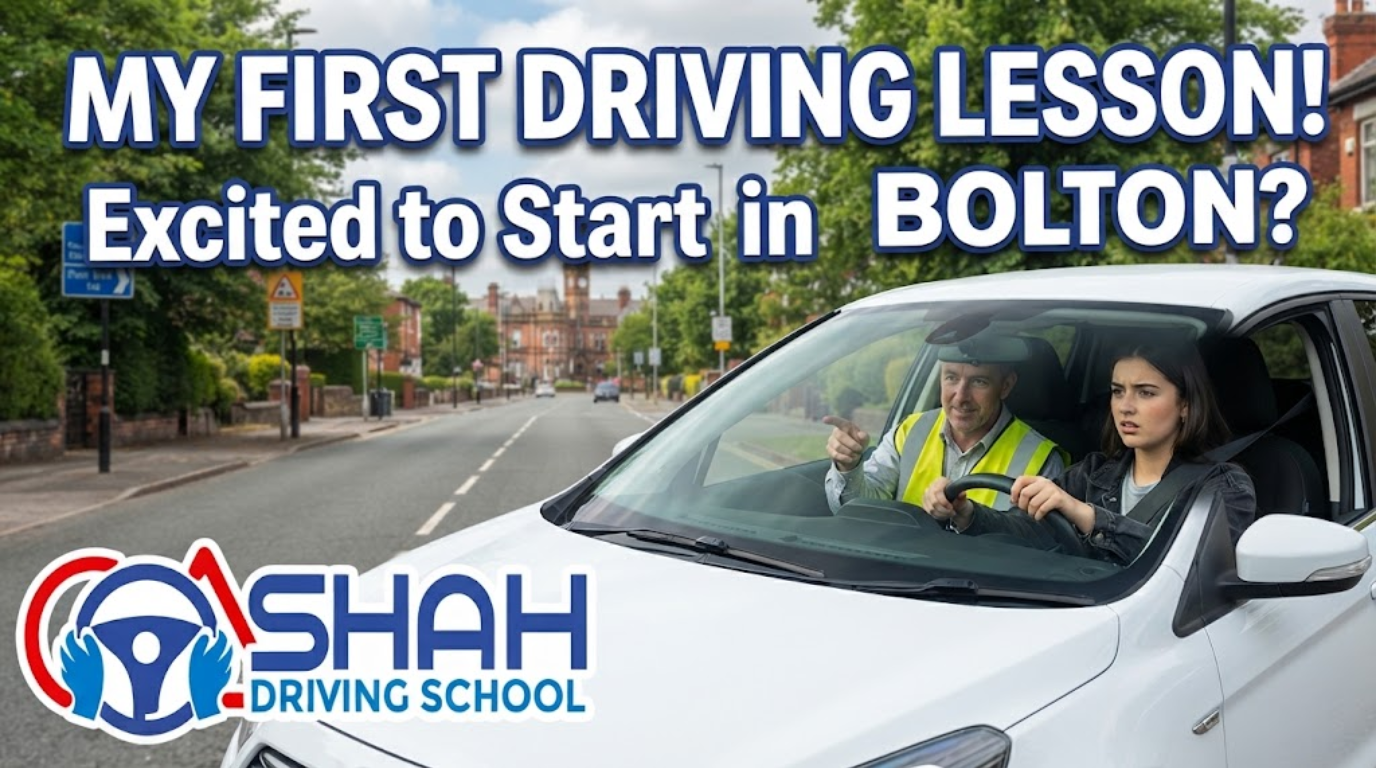
Your first driving lesson in Bolton is a big moment. For some learners, the excitement of finally getting behind the wheel is mixed with a lot of questions:
Will I actually drive on my first lesson? What if I stall? Do I need to know anything beforehand? What should I bring? What if I’m nervous?
The good news is that you are not expected to be a confident driver on your first lesson. That’s what the lessons are for.
A good first lesson is about understanding your starting point, becoming comfortable with the car and beginning to develop safe driving habits—not proving that you already know how to drive.
If you’re starting your driving journey in Bolton, here’s what you can realistically expect from your first lesson.
There isn’t a long list of things you need to master before meeting your instructor.
The most important requirement is having a valid provisional driving licence. GOV.UK confirms that you need a provisional licence to take driving lessons or practise driving.
It’s also worth checking your eyesight before your lesson.
You must be able to read a number plate from 20 metres away to meet the required eyesight standard for driving. You can use glasses or contact lenses if you need them for driving.
Bring:
You don’t need to memorise every road sign or learn every manoeuvre before you arrive.
Your instructor will teach you progressively.
There isn’t one rigid lesson plan that every learner must follow.
Your instructor should adapt the lesson according to your experience, confidence and ability.
A complete beginner will obviously need a different starting point from someone who has previously had 20 lessons and is returning after a break.
At Shah Driving School, the first session can be used to understand your starting level and establish a suitable learning plan. The school’s current booking information says instructors consider factors such as the learner’s location, manual or automatic preference, instructor preferences and anxiety level when matching learners.
Here’s what the experience may look like.
The first few minutes aren’t about immediately throwing you into traffic.
You’ll meet your instructor, discuss your experience and get comfortable with the car.
If you’ve never driven before, tell your instructor.
There’s absolutely no advantage to pretending you have experience that you don’t have.
Your instructor needs to know your starting point so they can teach you safely.
You might discuss:
This conversation can make the rest of the lesson much easier.
Before driving, your instructor needs to establish that you’re legally able to learn and that you meet the relevant eyesight requirement.
GOV.UK states that learners need a provisional driving licence and must meet the minimum eyesight standards.
The number-plate eyesight requirement is particularly important: you must be able to read a number plate from 20 metres away.
If you normally wear glasses or contact lenses for driving, bring them.
Before the car moves, you’ll need to understand the basic controls.
This can include:
This stage can feel surprisingly important.
You don’t want to be trying to find the indicator while simultaneously worrying about steering.
The goal is to start making the car feel familiar.
Your instructor will explain the checks you need to make before moving.
Depending on the car and teaching approach, this may include the familiar cockpit drill and checking that you’re properly positioned and ready to drive.
You’ll start learning that safe driving isn’t simply:
“Look ahead and turn the steering wheel.”
Instead, you’ll gradually develop habits involving:
Observation → planning → positioning → speed → control
These habits will become increasingly important as you progress toward your Bolton driving test.
Possibly—and often the goal is to start driving when it is safe and appropriate.
But don’t compare your first lesson with someone else’s.
One learner might move off and stop during their first session.
Another might need more time becoming comfortable with the controls.
Neither situation means that one learner is “better.”
Your instructor should choose an appropriate environment for your current ability.
For a complete beginner, that may mean starting in a quieter area before gradually introducing more complex traffic situations.
The important thing is progress without unnecessary pressure.
For many beginners, this is the moment they’ve been waiting for.
You’ll begin learning how to:
You’ll also begin learning how the:
work together.
You may stall.
And that’s completely normal.
Stalling on your first driving lesson doesn’t mean you’re a bad driver.
You’re learning a mechanical process that initially requires coordination. With practice, it becomes much more natural.
You won’t need to coordinate a clutch and manual gear changes, but you’ll still need to develop:
Automatic doesn’t mean you have less to learn—it means the car handles some of the mechanical workload differently.
This is where your instructor’s local knowledge becomes valuable.
You shouldn’t expect your first lesson to involve the most complicated roads around Bolton simply because they’re close to the test centre.
Your starting area should suit your current ability.
As your confidence and control improve, your lessons can progress toward:
quiet residential roads
↓
normal local traffic
↓
junctions
↓
roundabouts
↓
busier roads
↓
more complex traffic situations
↓
test-standard driving
This progression is much more useful than simply taking a learner straight onto difficult roads and expecting them to cope.
If you’re nervous before your first driving lesson, tell your instructor before you start.
You don’t need to hide it.
Nervousness is particularly common when everything is unfamiliar:
The instructor’s job is to teach you—not judge you for being a beginner.
If you need something explained again, ask.
If you’re unsure about a control, ask.
If you’re confused about an instruction, ask.
A question during a lesson is much better than silently guessing.
You don’t need to arrive knowing:
❌ How to parallel park perfectly
❌ How to perform every manoeuvre
❌ How to handle a busy roundabout
❌ How to change gears smoothly
❌ How to drive around Bolton independently
❌ How to pass the practical test
❌ Every rule in the Highway Code from memory
Those are things you develop throughout your training.
However, becoming familiar with the Highway Code alongside your practical lessons is a very good idea. GOV.UK’s learner-driver process specifically includes the Highway Code as part of learning to drive.
Choose clothing that allows you to move comfortably.
Your footwear is particularly important.
You need to be able to feel and operate the pedals accurately, so avoid footwear that makes pedal control difficult.
For example, very thick soles or uncomfortable footwear can make it harder for a beginner to develop good pedal control.
Keep it simple:
comfortable clothes + suitable flat footwear + glasses if required.
Yes, because the experience of controlling the vehicle is different.
You’ll learn to coordinate:
You’ll focus more heavily on:
If you’re unsure which transmission is right for you, discuss your circumstances with an instructor before booking a longer programme.
The best choice isn’t necessarily the one your friend chose.
This is something new learners sometimes misunderstand.
Your first lesson is not a miniature driving test.
Your instructor isn’t expecting you to:
Instead, the first lesson begins establishing the foundation you’ll build on throughout your training.
The official GOV.UK guidance confirms that there is no minimum number of lessons or hours of practice required before taking a driving test. Your learning requirement depends on your individual progress.
That’s why a good instructor should assess your progress rather than promising that every learner will need exactly the same number of lessons. First Driving Lesson in Bolton
The end of your first lesson is a good time to ask:
Your instructor should be able to explain:
At Shah Driving School, the current booking guide describes the first session as an assessment of the learner’s current standard, followed by a recommendation based on that learner’s progress rather than a fixed number of hours.
That’s the approach I’d recommend learners look for generally: progress-based instruction rather than arbitrary promises. First Driving Lesson in Bolton
If your first lesson is coming up, don’t spend the night trying to become a driving expert.
Instead:
Make sure you have what your instructor needs.
Make sure you meet the legal eyesight requirement.
You’ll be using your feet constantly.
You don’t need to memorise it.
Concentration matters.
Arrive ready to learn.
And most importantly:
Don’t be embarrassed about being a beginner. First Driving Lesson in Bolton
Before finishing, ask:
These questions can turn your first lesson into the beginning of an actual learning plan rather than simply a one-off driving session.
Not on your first lesson.
Your priority initially should be building safe, controlled driving skills.
As your skills develop, your instructor can gradually introduce more demanding situations and eventually test-standard practice.
GOV.UK explains that the practical car test covers areas including an eyesight check, vehicle safety questions, general driving ability—including independent driving—and reversing.
That gives you an idea of how broad the final standard is.
Your first lesson is simply step one.
Your first driving lesson doesn’t need to be perfect.
You don’t need to impress your instructor.
You don’t need to know how to drive before you start.
You simply need to arrive prepared, be honest about your experience and be willing to learn.
If you’re looking for manual or automatic driving lessons in Bolton, Shah Driving School can help you start from your current level and build your skills progressively.
Ready to book your first lesson?
📞 Call or WhatsApp Shah Driving School: 0749 0662 777
WhatsApp us