
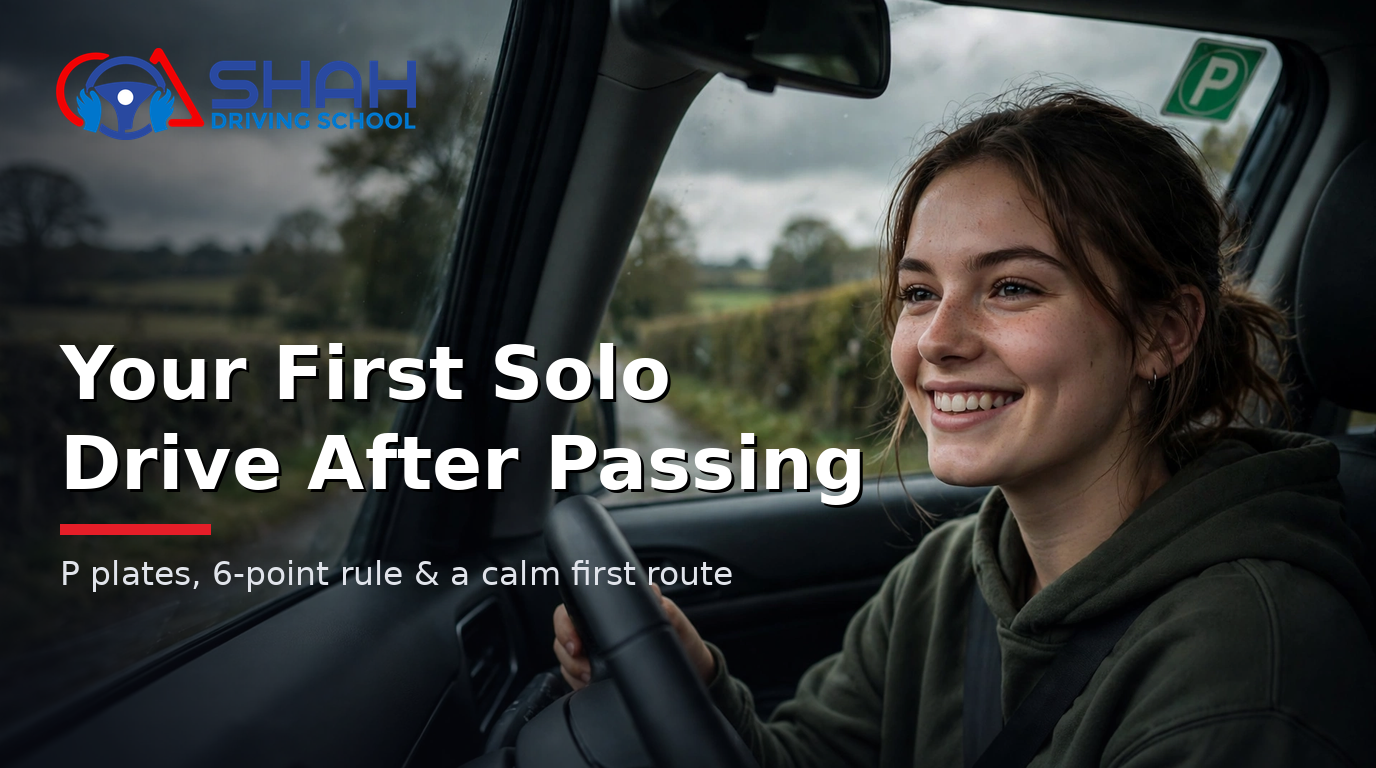
You passed. The examiner shook your hand, the L plates came off, and suddenly the passenger seat is empty. Your first solo drive is one of the best feelings in driving — and one of the strangest. No instructor beside you, no one to prompt you, just you and the road.
It is also the moment the rules change. Passing your test does not mean the learning is over, and it does not mean the consequences disappear. For the next two years, your licence hangs on a much thinner thread than most new drivers realise. This guide covers the pass-day facts, the 6-point rule, P plates, motorways, and a calm plan for that first drive.
Under the Road Traffic (New Drivers) Act 1995, any driver who accumulates 6 or more penalty points within 2 years of passing their first test has their licence revoked. The DVLA revokes it automatically — there is no discretion, no warning, no appeal to the DVLA.
Revocation is not a ban. It means your licence is cancelled. To drive again, you must apply for a new provisional licence and pass both the theory and practical tests again. Points you earned on your provisional licence carry over — if you had 3 points as a learner, you start your full licence with 3 points already on it, and only 3 more will end it. The points stay on your record for four years from the offence date.
One detail new drivers often miss: after you pass the retest, you do not enter a new two-year probation. The Act applies to the first two years from your first pass only.
Six points sounds like a lot. It is not. Here is how quickly it happens:
The pattern is clear: the offences that end new licences are the ordinary ones — the phone, the speed, the insurance. None of them feels like a big deal in the moment. All of them are, for the first two years.
Our speed limits guide covers the limits themselves — worth a re-read now that the points are yours alone.
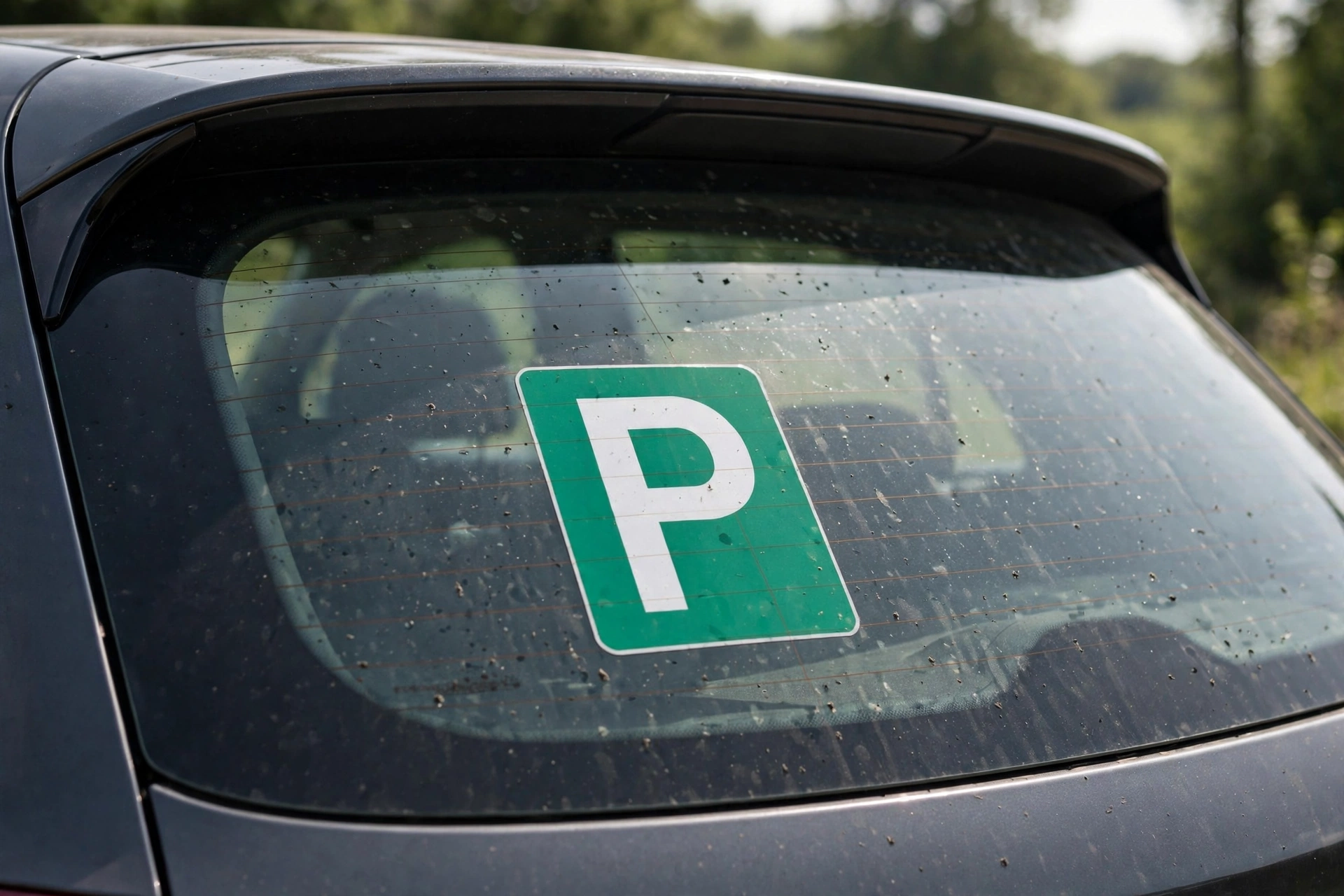
Green P plates are voluntary — not legally required in England, Scotland or Wales.
Green P plates (for “probationary” or “passed”) are the new driver’s equivalent of L plates — with one big difference: they are not legally required in England, Scotland or Wales. You may display them, or not. There is no time limit and no extra restriction either way.
So why bother? Because they tell other drivers you are newly qualified, and most drivers respond by giving you more space and more patience — at roundabouts, at junctions, when you hesitate. For the first few weeks, that extra patience is worth a lot. Take them off whenever you feel ready. There is no rule about when.
As a learner, you could only drive on a motorway with an approved instructor in a dual-control car — never with a family supervisor. Once you hold a full licence, motorways are open to you. There is no waiting period and no extra test.
That does not mean your first solo drive should be the M61. Build up to it:
Keep the first solo drive short, familiar and calm:
Pass Plus is the DVSA’s optional scheme for new drivers — a minimum of 6 hours with a registered ADI, covering six modules (town driving, all-weather driving, rural roads, night driving, dual carriageways and motorways). There is no test; your instructor assesses you throughout.
It can genuinely help — motorway and night driving are the two things lessons barely cover, and Pass Plus covers both properly. It may also reduce your insurance, but that is not guaranteed. Check with your insurer first, before you pay. Typical costs are reported around £150–£300 — treat that as a range to check, not a fixed price.
Yes. Your pass certificate is proof you have passed, and you can drive on your own immediately — as long as you are insured as a full licence holder and the car is taxed.
No. P plates are entirely voluntary in England, Scotland and Wales. They simply signal to other drivers that you are newly qualified.
Yes — legally you may. Build up to it rather than making the motorway your first solo drive, and consider a Pass Plus session first.
Your licence is revoked automatically. You must apply for a new provisional licence and pass the theory and practical tests again.
No. Some insurers offer a discount, some do not. Check with your insurer before booking a course.
More questions? Read our frequently asked questions page.
Passing your driving test proves you can drive to the standard. Your first two years prove you can keep driving to it — alone, unsupervised, with your phone in your pocket and nobody watching. The drivers who pass their probation are not the most talented. They are the most careful: phone away, speed respected, insurance sorted, and no rush to prove anything.
Shah Driving School teaches manual driving lessons and automatic lessons across Bolton, Horwich, Atherton and Farnworth — and if you want motorway or night-driving confidence after passing, ask us about Pass Plus. Book your lessons today, or consider an intensive driving course for someone you know who is still learning. And if you supervised a learner, our supervising guide explains what comes next for them.
WhatsApp us