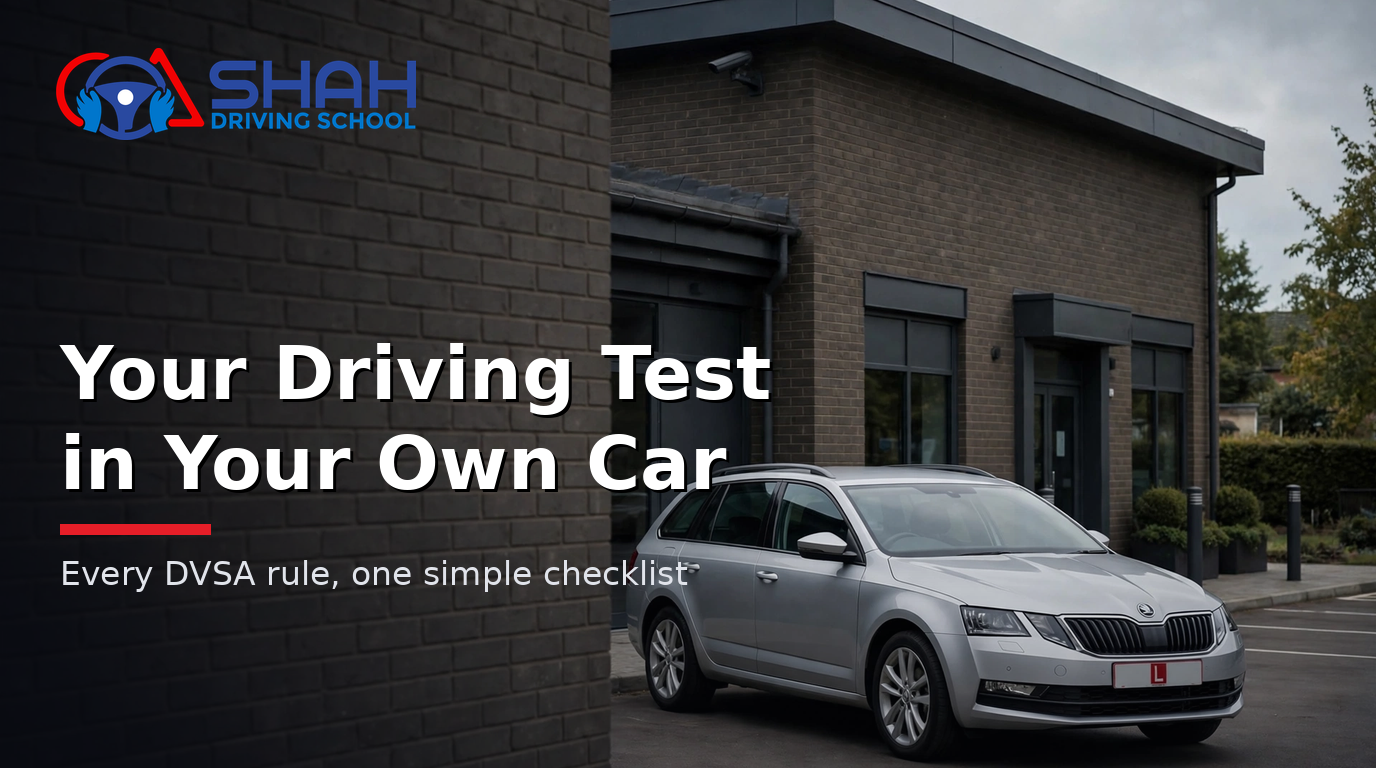

The car you know best is the car you drive best. Familiar clutch, familiar mirrors, familiar blind spots — on test day, that comfort is worth a lot. That is why many learners take their driving test in their own car instead of their instructor’s.
But comfort comes with rules. The DVSA sets strict requirements for any car used on the test, and the penalty for missing one is brutal: your test is cancelled on the spot, and you do not get a refund. This guide is the complete checklist — paperwork, car setup and test-day tips — so you arrive knowing your car will pass its own inspection.
Yes. You can take the UK car driving test in your own car, a family member’s car, or any car that meets the DVSA’s rules. You do not need dual controls fitted.
There are two catches. First, some vehicles are banned outright because they do not give the examiner adequate all-round vision — certain vans and heavily modified cars fall here. If in doubt, check with the DVSA before booking. Second, every rule below must be met on the day. The examiner checks the car before the test begins, and there are no second chances.
Before anything else, three documents must be in order:
Bring your photocard provisional driving licence to the test centre. Without it, there is no test — and no refund.
Go through every item below the week before your test, not the morning of it.
Fit L plates (or D plates in Wales) securely to the front and rear of the car. They must be clearly visible and must not block your view or the examiner’s. Magnetic plates that fall off on the drive over are a classic test-day disaster — check them before you leave.
You must fit a second interior rear-view mirror so the examiner can see behind. These cost a few pounds and clip onto the windscreen or existing mirror. Buy one early and practise driving with it fitted — it changes the reflections you are used to.
The front passenger seat needs a working seatbelt and a proper fixed head restraint for the examiner. Slip-on head restraints are not allowed. If your car’s head restraints are removable, make sure one is fitted and secure.
No warning lights showing a safety issue may be lit — the airbag light is the famous example. Even a tyre pressure warning can cause problems. If a light is on, get it diagnosed and fixed before test day. An examiner will not debate what a light means.
Every tyre must have the legal minimum tread depth of 1.6 mm across the central three-quarters, with no cuts, bulges or other damage. You must not have a space-saver spare wheel fitted. Check all four tyres — and the spare is not a substitute.
The car must be able to reach at least 62 mph and must have an officially fitted speedometer reading in mph. A phone app or an add-on display does not count.
The car must have four wheels and a maximum authorised mass of no more than 3,500 kg. It should be clean inside and out, with the passenger seat clear for the examiner. A smoke-free car matters too — arrive in a car that smells of cigarettes and you start the test on the wrong foot.
The examiner runs through this checklist before you drive a metre. Any failure means the test does not go ahead, the fee is lost, and you book and pay again. The most common cancellation reasons are:
Every one of these is preventable. That is what makes them so painful.
Your own car gives you familiar controls, familiar visibility and one less new thing on a stressful day. If you have done most of your private practice in it, the muscle memory is real.
Your instructor’s car is already test-ready: examiner mirror fitted, correct insurance, L plates secure, dual controls as a safety net, and an instructor who knows the test routes and will warm you up beforehand.
Many learners split the difference: lessons and mock tests in the instructor’s car, then the test itself in whichever car they drive most confidently. Talk to your instructor — a good one will tell you honestly which car gives you the better chance. Our manual driving lessons include test-day preparation either way.
No. Dual controls are not required for the test. They are a feature of instructor cars, not a DVSA rule for candidates.
Yes, as long as it meets every rule above and the insurance covers a driving test with the examiner. Hire companies and owners often exclude test use, so confirm in writing before you rely on it.
Treat any warning light as a test-canceller until proven otherwise. Get it checked and cleared by a garage before your test. Do not hope the examiner will overlook it — they will not.
Usually, yes. You can ask for your instructor or supervising driver to accompany you. Discuss it beforehand so everyone knows the plan.
Not valeted, but clean and tidy inside and out, with a clear passenger seat and a smoke-free interior. The examiner spends 40 minutes in your car — make it pleasant.
More questions? Read our frequently asked questions page.
Your own car can absolutely be the right choice for test day. Just remember the test has two candidates: you, and your car. Prepare both with the same care.
Shah Driving School teaches manual and automatic lessons across Bolton, Horwich, Atherton and Farnworth, including test-day preparation in your own car or ours. Book your lessons today, or consider an intensive driving course if your test date is approaching. Let’s make test day feel familiar.
WhatsApp us