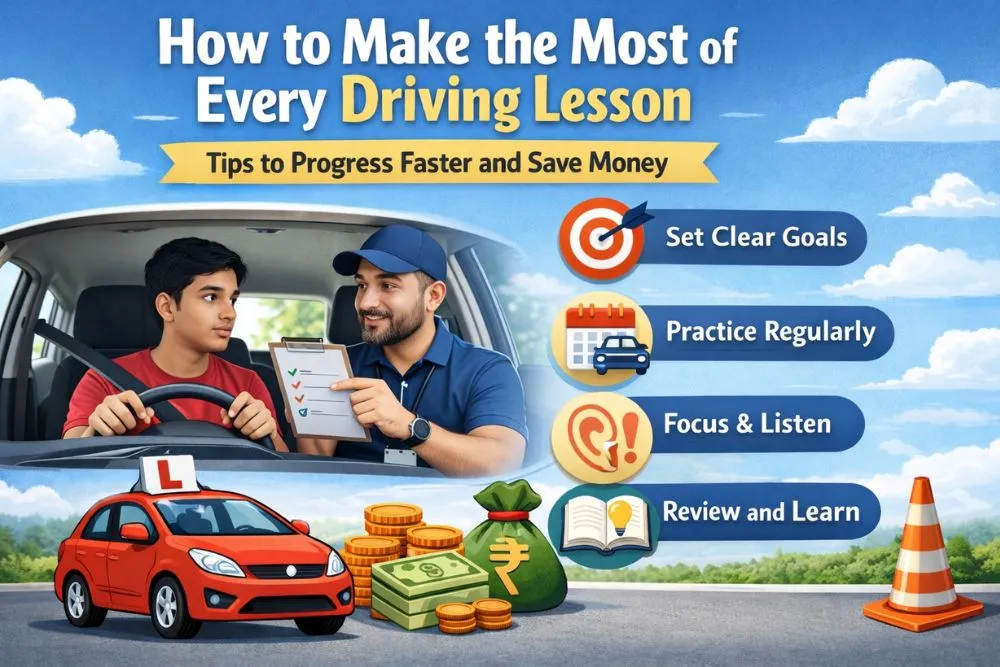

If you’re searching for ways to improve driving lessons faster, you’re already thinking like a smart learner. Driving lessons aren’t cheap, and every minute behind the wheel should count. With the right approach, you can cut down the number of lessons you need, build genuine confidence, and pass your test sooner than you might expect.
The average learner driver in the UK takes around 45 hours of professional tuition alongside 22 hours of private practice, according to the DVSA. That adds up quickly when lessons typically cost between £30 and £40 per hour. Getting more from each session isn’t just about skill it’s also about saving real money.
Many learners turn up to each lesson without a clear focus. They sit in the car, wait for instructions, and react to whatever their instructor throws at them. This passive approach is one of the biggest reasons progress slows down.
Learning to drive is a skill, and like any skill, it improves fastest when you’re actively engaged. The more mental effort you put in before, during, and after each lesson, the faster you’ll move through the DVSA’s national standard for driver and rider training.
Preparing before each lesson is one of the most overlooked ways to accelerate progress. Your instructor has a limited amount of time with you, so arriving ready to learn means you spend less time catching up.
Review what you covered in your last lesson the night before. Think about what felt difficult, what felt comfortable, and what questions came up. Write them down if that helps. This small habit alone can shave several lessons off your overall learning journey.
Also, get enough sleep the night before. Fatigue genuinely impairs your ability to concentrate and process new information, which directly affects how much you retain behind the wheel.
Before your instructor even starts the engine, tell them what you want to focus on. Whether it’s improving your mirror checks, getting more comfortable at roundabouts, or working on your parallel park, having a specific goal keeps the session productive.
Your instructor will appreciate this. It also helps them tailor the lesson to your actual needs rather than following a default progression. This kind of targeted practice is far more effective than covering the same general ground repeatedly.
Staying mentally present during a lesson sounds obvious, but it’s surprisingly easy to drift. You might be on a familiar road and switch to autopilot, or you might feel so nervous that your brain shuts down rather than absorbs.
Talk through what you’re doing. This technique, often called commentary driving, involves narrating your observations and decisions out loud. For example: “Checking mirrors, speed limit changing, pedestrian stepping off the kerb.” It forces your brain to stay active and helps your instructor identify gaps in your hazard perception far more quickly.
Also Read: What Happens If You Fail Your UK Driving Test? Retake Rules Explained
If a manoeuvre doesn’t feel right, ask to do it again immediately. Repetition while the experience is fresh is far more valuable than moving on and hoping it clicks next time. Most instructors will be happy to circle back it’s your lesson and your money.
Also, ask why, not just how. Understanding the reason behind a technique such as why you use the MSM (Mirror, Signal, Manoeuvre) routine helps it stick in a way that pure instruction does not.
Private practice with a parent or trusted adult is one of the most effective ways to accelerate progress, but only if it’s done correctly. The DVSA recommends that private practice supervisors are over 21, have held a full UK driving licence for at least three years, and that the car has appropriate insurance.
Use private practice to consolidate what you’ve already learned in lessons, not to introduce new skills you haven’t been taught. Practising the wrong technique repeatedly can create bad habits that take extra lessons to undo.
What People Ask About Learning to Drive Faster
Can I pass my driving test with fewer than 45 hours of lessons?
Yes, some learners pass with fewer hours particularly those who supplement professional lessons with regular, high-quality private practice. However, the DVSA average exists because most people genuinely need that amount of time to reach test standard. Quality matters more than quantity.
Does taking lessons more frequently help you pass faster?
Generally, yes. Taking two or three lessons per week, rather than one every fortnight, helps skills embed more effectively because there’s less time for them to fade. Consistency is key, especially in the early stages of learning.
What should I do if I feel like I’m not progressing?
Speak to your instructor honestly. A good instructor will reassess their teaching approach and may suggest different routes, times of day, or methods. If progress genuinely stalls, a second opinion from a different DVSA-approved instructor can sometimes unlock a breakthrough.
What you do in the hours after a lesson has a significant impact on how much of it you retain. Research in cognitive science consistently shows that reviewing new information shortly after learning it strengthens memory consolidation.
Spend five to ten minutes reflecting immediately after your lesson. What went well? What felt uncomfortable? Were there any moments where you weren’t sure of the correct action? Write these down and bring them to your next session.
Watching hazard perception clips on the official DVSA practice resources can also sharpen your awareness between lessons, and it double counts as preparation for the theory test.
Knowing what examiners actually look for puts your progress in context. The DVSA uses a marking system that records driving faults as either minor, serious, or dangerous. You’re allowed up to 15 minor faults on your practical test, but a single serious or dangerous fault means an immediate fail.
Understanding this helps you prioritise. For example, consistently failing to check mirrors before manoeuvring will accumulate minor faults quickly and could tip you over the limit. Knowing this means you and your instructor can address it directly rather than treating all mistakes as equally important.
Also Read: How Independent Driving Works in the UK Practical Driving Test
A structured lesson plan agreed with your instructor at the start of your learning journey can save you significant money. Without a plan, it’s easy to meander through topics without a clear sense of when you’ll be ready to test.
Ask your instructor for an honest assessment after your first few lessons. How many sessions do they estimate you’ll need before test standard? What are the weak areas to focus on? This transparency helps you budget and set realistic expectations.
Block booking lessons is another way many learners reduce cost, as some instructors offer a small discount for booking multiple sessions in advance. However, only do this once you’re confident you’re happy with your instructor and their teaching style.
Your instructor’s teaching style has a direct effect on how quickly you progress. A DVSA-approved driving instructor (ADI) with a Grade A or B check test result from the DVSA is a reliable sign of teaching quality. You can ask your instructor for their ADI badge, which they’re required to display in the car.
Some learners benefit from a more relaxed and conversational instructor; others prefer structured and methodical teaching. There’s no single right answer, but finding a good match early saves both time and money in the long run.
Anxiety is one of the most common reasons progress stalls. Nerves make you hesitant, which in turn makes manoeuvres feel harder than they are, which increases anxiety further. Breaking this cycle is essential.
Try to reframe mistakes as data rather than failures. Every error you make in a lesson is one you’re far less likely to make on test day. Your lessons are literally the safest place to get things wrong.
Breathing techniques before and during lessons can also help. Slow, controlled breathing reduces cortisol and helps your brain stay in a learning-ready state. It sounds simple, but it genuinely works.
Read More: Are Intensive Crash Courses in Bolton Worth It? A 1-Week Guide to Passing
Knowing how to improve driving lessons faster comes down to one core idea: treat every lesson as an investment. Prepare before you get in the car, stay actively engaged during it, and review what you’ve learned afterwards. Supplement your professional lessons with smart private practice, communicate openly with your instructor, and don’t lose sight of the financial logic fewer wasted lessons means more money in your pocket.
The learners who progress fastest aren’t always the most naturally talented. They’re the ones who show up prepared, ask good questions, and take ownership of their own learning journey. That’s entirely within your control from your very first lesson.
How many driving lessons does the average person need in the UK?
According to the DVSA, the average learner takes around 45 hours of professional lessons alongside 22 hours of private practice before passing their test.
Is it better to have longer or shorter driving lessons?
Two-hour lessons are often more cost-effective and allow more time to consolidate skills in a single session, though this depends on your concentration and stamina.
Can I use a dashcam to review my driving lessons?
Yes, with your instructor’s permission, reviewing dashcam footage can be an excellent way to identify recurring mistakes and self-correct between lessons.
What is the pass rate for the UK driving test?
The overall practical test pass rate in the UK sits at roughly 47–48%, according to DVSA statistics, which highlights just how much preparation matters.
Does the type of car I learn in affect my progress?
It can do. Learning in a modern car with good visibility, light steering, and responsive brakes generally makes the experience easier, especially in the early stages.
WhatsApp us