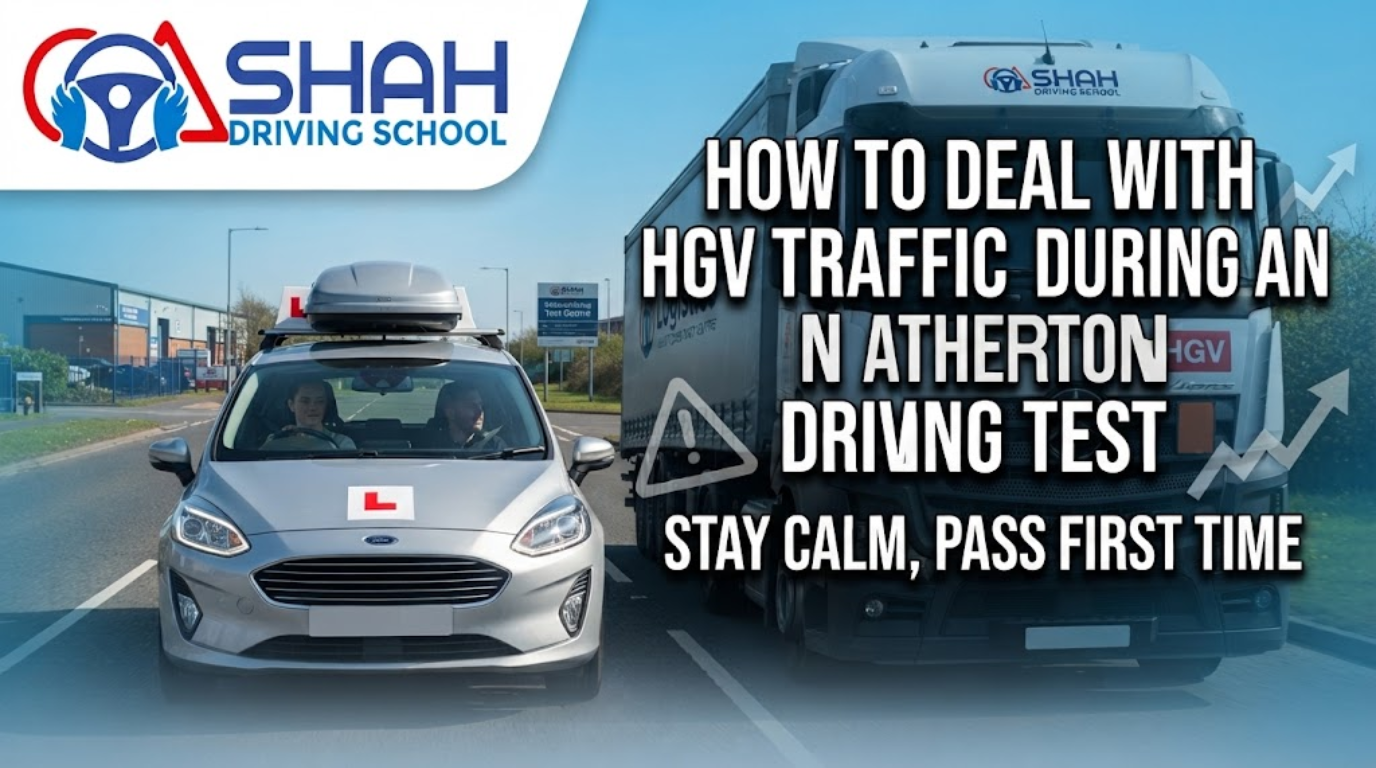
One of the most common causes of hesitation faults at Atherton Gibfield Park test centre has nothing to do with roundabouts, junctions, or lane discipline. It is something far bigger — literally. Heavy goods vehicles (HGVs) on Atherton’s industrial estate approach roads cause more unnecessary hesitation, missed gaps, and examiner interventions among learner drivers than almost any other single hazard on the test route.
If you are preparing for your practical driving test at Atherton Gibfield Park Avenue and the sight of a lorry in front of you — or beside you — makes your hands tighten on the wheel, this guide is written specifically for you. We will cover exactly where HGVs appear on the Atherton test routes, why they behave the way they do, and precisely what you need to do to deal with them confidently and safely under examination conditions.
Why Atherton’s Test Routes Have More HGV Traffic Than Most
Before we look at technique, it helps to understand why Atherton Gibfield Park generates more HGV encounters than test centres in purely residential areas like Bolton Weston Street.
The answer is geography. Gibfield Park itself is an industrial and business estate. The access roads surrounding the test centre are shared with delivery lorries, articulated vehicles, skip trucks, and trade vans serving the surrounding businesses throughout the day.
The moment you pull out of the Gibfield Park Avenue test centre car park, you are on roads that HGVs use regularly. This is not unusual or unlucky — it is a consistent feature of every Atherton test, at every time of day.
The specific roads where you are most likely to encounter HGV traffic during your Atherton practical test include:
- Gibfield Park Avenue itself — delivery and commercial vehicles serving the estate
- The A579 Atherleigh Way — a major arterial route carrying consistent commercial traffic between Leigh, Atherton, and the wider Greater Manchester network
- The industrial estate approach roads connecting Gibfield Park to the surrounding road network
- Hindsford and Howe Bridge residential approaches — where delivery vehicles service local businesses throughout the day
Shah Driving School’s instructors prepare every Atherton learner specifically for these roads — which is why we build the Gibfield Park approach network into lesson programmes from early in your training, not just in final pre-test sessions.
🔗 GOV.UK — Rules for Drivers and Motorcyclists: Large Vehicles and Road Position
Why New Learners Hesitate Around HGVs — And Why It Creates Faults
Understanding why you hesitate around large vehicles is the first step to eliminating the hesitation.
Most learner drivers have not spent much time driving near lorries before they started lessons. Everything about an HGV is larger, louder, and harder to read than a standard car:
- They are physically enormous — up to 16.5 metres long and 4.2 metres tall
- They move more slowly but carry far more momentum when they do move
- They take up more of the road — particularly on bends and at roundabout exits
- They generate a wind buffet when passing at speed that newer drivers find startling
- Their braking distances are significantly longer than a car’s, even at the same speed
- Their wide turning paths at junctions look unpredictable if you have never seen one negotiate a corner before
The problem is not that learners are physically unable to deal with HGVs. The problem is that without specific preparation, the presence of a lorry triggers a freeze response — and freezing during a driving test is recorded as hesitation, which can be marked as a serious fault if it causes delay or creates a hazard for other road users.
The solution is not bravery. It is knowledge, preparation, and the repeatable techniques that Shah Driving School builds into every Atherton lesson programme.
The Key Rules HGV Drivers Follow — And Why They Matter to You
You cannot deal confidently with HGV traffic if you do not understand how lorry drivers operate and what their vehicles are legally required to do. Here is what every Atherton learner needs to know.
HGVs Have Enormous Blind Spots
A large goods vehicle has blind spots that are far bigger than most learners realise:
- Directly in front of the cab — approximately 2 metres that the driver cannot see at all
- The full left side of the vehicle — especially the nearside rear quarter
- Directly behind the trailer — the driver cannot see you if you are following within 10 metres
- The right side — reduced but still significant compared to a car
The practical rule for Atherton test routes: if you cannot see the lorry driver’s face in their mirror, they cannot see you. Keep your distance and position accordingly.
HGVs Swing Wide on Left Turns
This is the behaviour that surprises learner drivers most often on Atherton’s industrial estate junctions. When an articulated lorry turns left, it first moves slightly right before sweeping left with the trailer following an entirely different path to the cab.
If you are positioned alongside an HGV at a junction and it turns left, the trailer will sweep into your space. This is not a driving error by the lorry driver — it is the physical geometry of a long vehicle making a tight turn. It is your responsibility to leave space for this movement.
The correct approach at any junction where an HGV is in front of you and turning left: hold back, give plenty of room, and wait until the entire vehicle — cab and trailer — has cleared the junction before proceeding.
HGVs Accelerate and Decelerate Slowly
A loaded articulated lorry can take significantly longer to accelerate from rest than any car you have driven. On the A579 Atherleigh Way, if an HGV pulls away from traffic lights ahead of you, do not expect it to reach the speed limit in the same timeframe a car would. Maintain your following distance and allow it the space and time it needs.
Conversely, an HGV that needs to stop requires a much longer stopping distance than a car. If you are following a lorry and you close the gap, you reduce the time available to react if it brakes. The two-second rule — at minimum — applies to following any vehicle. Behind an HGV on a faster road like the A579, four seconds is more appropriate.
Specific HGV Scenarios on the Atherton Test Route — And Exactly What to Do
Scenario 1 — An HGV Is Ahead of You When You Pull Out of Gibfield Park
This happens frequently. You pull out of the test centre car park onto Gibfield Park Avenue and there is an articulated delivery lorry ahead of you.
What to do:
- Maintain a minimum four-second following distance — you cannot see the road ahead, so you need time to react to anything the lorry reacts to
- Do not attempt to overtake on the approach roads within the estate — the roads are not suitable for overtaking and your examiner will not expect you to do so
- Stay centred in your lane — do not drift left toward the kerb or right toward oncoming lanes
- Keep your observations going: look beyond the HGV to the sides of the road, not just at the back of the lorry
Your examiner is not assessing how quickly you can get past the lorry. They are assessing whether you handle the following position safely and maintain appropriate distance and observation throughout.
Scenario 2 — An HGV Is Approaching You on a Narrow Section
Some of the industrial estate roads around Gibfield Park are not wide enough for two large vehicles to pass side by side comfortably. When an HGV approaches from the opposite direction on a narrower section, learner drivers often panic.
What to do:
- Identify the situation early — do not wait until the lorry is close to decide what to do
- Move smoothly to the left within your lane, maintaining safe distance from the kerb
- Reduce your speed to give both you and the lorry driver more time and space
- Do not stop unnecessarily unless the road is genuinely too narrow — stopping in the path of an oncoming HGV creates its own hazard
- Maintain a steady course — sudden swerving is more dangerous than a controlled, steady passage
The golden principle: slow, smooth, predictable. HGV drivers are professional, experienced, and accustomed to sharing narrow roads. They need you to be predictable, not to disappear.
Scenario 3 — An HGV Is on the A579 Atherleigh Way Beside You
The A579 carries HGVs at 40mph alongside learner drivers throughout the day. Being next to a lorry on a faster road is one of the most intimidating experiences a new learner faces on the Atherton test.
What to do:
- Maintain your lane position — do not drift away from the lorry. Drifting right into oncoming traffic or left into the kerb while passing a lorry is a far greater hazard than the lorry itself
- Expect wind buffet — when you pass an HGV, or an HGV passes you, you will feel a push from the displaced air. Hold the wheel firmly, maintain your course, and do not over-correct
- Maintain your speed — slowing down suddenly next to an HGV creates a hazard for the traffic behind you. Keep pace with the traffic flow unless your road position or hazard assessment requires you to slow
- Keep observations ahead — do not stare at the lorry. Your job is to look ahead and maintain your position
What examiners record as faults in this scenario:
- Drifting out of lane under wind buffet — positioning fault
- Excessive speed reduction without reason — unnecessary hesitation
- Steering over-correction after buffet — control fault
Scenario 4 — An HGV Is Waiting at a Junction You Are Approaching
If an HGV is waiting to emerge from a side road as you approach on the main road, allow extra passing clearance.
What to do:
- Move slightly to the right within your lane to increase the gap between your vehicle and the lorry’s front end
- Reduce your speed on the approach to give yourself more reaction time
- Watch the cab — if the driver is looking in your direction, that is a good sign. If they are looking the other way and edging forward, be ready to react
- Do not assume they have seen you — maintain observations and speed management that assumes they might pull out
Scenario 5 — An HGV Is on the Roundabout at Atherton Test Centre Approaches
Roundabouts near Gibfield Park and on the A579 corridor see HGV traffic. The key challenge is the wide swept path an HGV traces through a roundabout — which looks like it is drifting into adjacent lanes from behind but is deliberate and unavoidable.
What to do:
- Never position alongside an HGV on a roundabout — if the lorry drifts left on exit, your car has nowhere to go
- Hang back at the give way line if an HGV is already on the roundabout — give it time and space to clear the junction completely before you enter
- Watch the trailer, not just the cab — the cab exits before the trailer does. The roundabout is not clear until the entire vehicle has left it
The Wind Buffet Effect — What It Is and How to Handle It
Wind buffet is the one HGV effect that genuinely surprises learner drivers who have never experienced it before. When a lorry passes you — or you pass one — at 30mph or above, the displaced air hits your vehicle suddenly and pushes it sideways.
First time drivers often gasp, grip the wheel tightly, or make a sudden steering correction that takes them out of their lane. In a practical test, that steering correction is recorded as a loss of vehicle control.
The correct technique:
- Anticipate the buffet before it arrives — you can see the lorry coming
- Grip the wheel firmly but not rigidly
- When the buffet hits, hold your steering position — resist the natural urge to steer away from the lorry
- The push lasts approximately one second at typical test route speeds
- After it passes, make a smooth, minor correction if needed — not a sharp one
Shah Driving School’s instructors introduce wind buffet experience on the A579 corridor during lessons specifically — at an appropriate stage of your training — so that it is a familiar sensation before test day, not a shock.
What Your Examiner Is Actually Assessing
When an HGV appears on your Atherton driving test, your examiner is not testing whether you are comfortable around large vehicles. They are assessing whether you demonstrate:
- Appropriate following distance behind an HGV
- Correct positioning when passing or being passed
- No unnecessary hesitation at junctions or on approach roads where an HGV is visible
- Correct gap judgement — emerging when it is safe, not refusing a safe gap because an HGV is visible in the distance
- Steady vehicle control through wind buffet and passing movements
- Consistent observation — not fixating on the lorry and ignoring the rest of the road
The examiner is looking for a calm, systematic, well-prepared response — not a performance of confidence. Calm competence is what passes driving tests.
How Shah Driving School Prepares Atherton Learners for HGV Traffic
Every Shah Driving School learner preparing for Atherton Gibfield Park test centre drives the industrial estate approach roads, the A579 Atherleigh Way, and the Hindsford residential network in lessons — in real traffic conditions, including real HGV encounters.
We do not introduce these roads as a final pre-test exercise. We build them into your lesson programme progressively, so that by the time you sit in the examiner’s seat, the sight of a lorry on Gibfield Park Avenue feels like Tuesday morning, not a threat.
Our mock driving test programme at Atherton runs on real test routes — including the industrial estate approach roads where HGV traffic is a consistent feature. Every learner completes at least one full mock test before their actual examination day.
For learners who want to reach Atherton test-ready standard as efficiently as possible, our intensive driving courses in Bolton include the specific HGV encounter scenarios listed in this guide as mandatory preparation content.
For the fastest structured route from learner to Atherton pass certificate, read our complete guide on how to pass fast with Shah Driving School.
🔗 GOV.UK — Book Your Official Practical Driving Test at Atherton
Key Takeaway: The One Thing to Remember When You See a Lorry on Test Day
When an HGV appears during your Atherton driving test, remind yourself of this:
Every professional lorry driver on that road is also trying to keep it safe. Slow down, stay predictable, give space, and keep looking ahead.
The lorry is not a threat. Your hesitation is the only real hazard.
Frequently Asked Questions: HGV Traffic on the Atherton Driving Test
1. Will I definitely encounter HGV lorries on my Atherton driving test?
Almost certainly yes. Gibfield Park is an active industrial and business estate. HGVs and commercial vehicles are a consistent feature of the approach roads around the test centre and on the A579 Atherleigh Way. Shah Driving School builds HGV encounter preparation into every Atherton lesson programme for this reason.
2. Can I fail my Atherton driving test just because I hesitated near a lorry?
Yes — if the hesitation involves waiting unnecessarily at a junction when a safe gap was available, an examiner will record it as a hesitation fault. If the hesitation persists, causes another road user to brake or react, or involves multiple instances, it can be recorded as a serious fault. The solution is specific preparation on real Atherton roads where HGVs are present, so the hesitation response is replaced with a practised, confident technique.
3. What should I do if an HGV overtakes me while I am driving on my Atherton test?
Stay in your lane, hold your steering position, maintain your speed, and expect the wind buffet. Grip the wheel firmly and hold your course through the buffet — do not steer away from the lorry. After the lorry has passed, make a smooth minor correction if needed. Do not brake suddenly or deviate from your lane position.
4. Is the A579 Atherleigh Way always on the Atherton driving test?
The A579 corridor appears on many Atherton Gibfield Park test routes and is one of the most consistently used roads in the test route network. Learners should always be prepared for it, regardless of which specific route their examiner chooses on the day.
5. My instructor says I hesitate too much near lorries. What is the most effective way to fix this before my test?
The most effective fix is specific, progressive exposure on real roads where HGVs are present — not discussion in a car park or a quiet residential street. Shah Driving School’s Atherton preparation lessons drive the industrial estate approach roads, the A579, and the Gibfield Park access network in real traffic conditions including real lorry encounters. Call 07456 772 714 to arrange targeted HGV preparation sessions before your test date.
All Highway Code references are accurate as of September 2026. Shah Driving School is a DVSA-registered driving school serving Atherton, Bolton, Leigh, Tyldesley, Westhoughton, and the wider Greater Manchester area. All instructors hold current ADI certification.