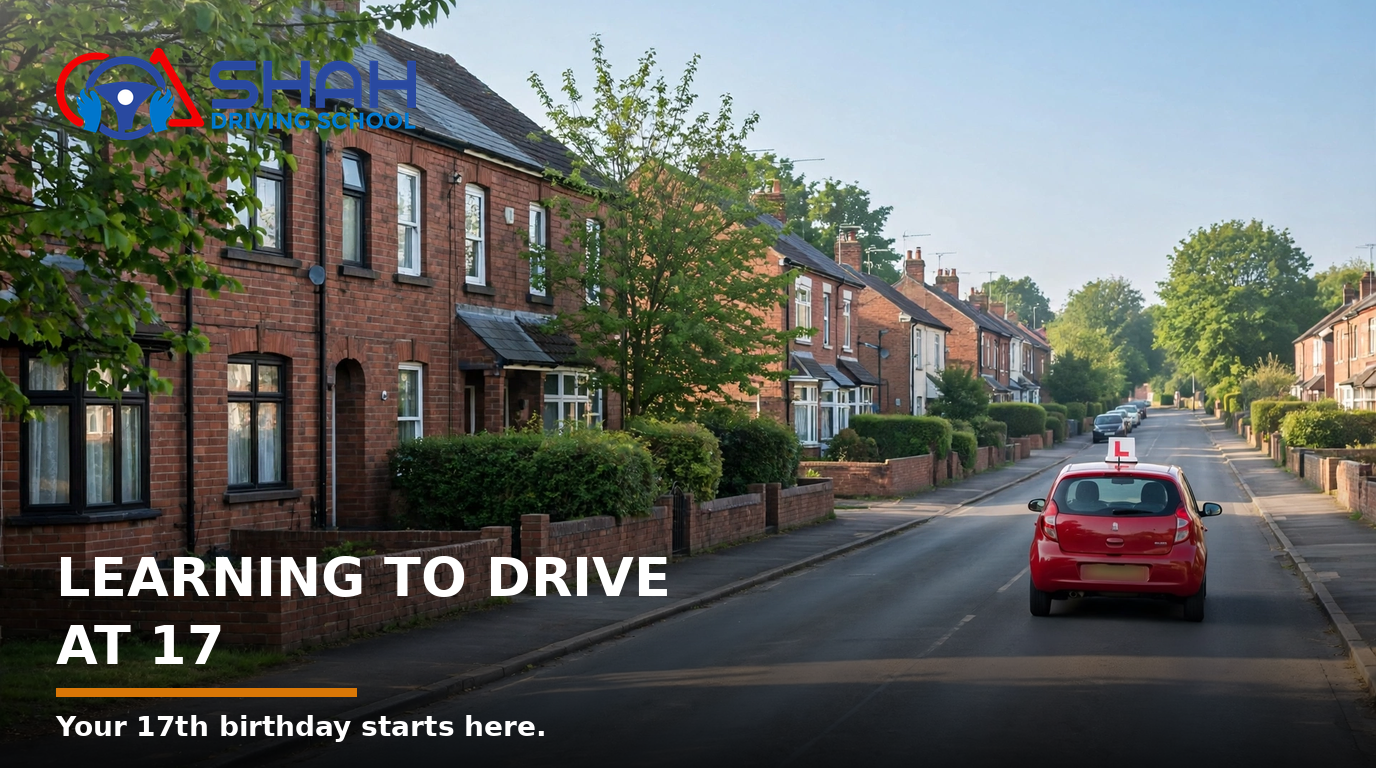

Yes — you can start learning to drive at 17. Your 17th birthday is the day everything opens. You can take your theory test from that morning, and sit in the driver’s seat for your first lesson that same afternoon.
The work starts earlier than that. You can apply for your provisional licence when you are 15 years and 9 months old. You can start revising for the theory test at 16. The teenagers who pass on the first time are rarely the ones who started on their birthday. They are the ones who arrived on their birthday already prepared.
This guide is written by the Shah Driving School instructor team in Bolton, from teaching 17-year-olds every week. It is written for both of you — the teenager and the parent paying for it.
Apply for your provisional licence. You can apply when you are 15 years and 9 months old. It costs £34 online, or £43 by post with a D1 form from the Post Office. Apply online, and it usually arrives within a week. Without it, you cannot book a theory test or take a lesson. Do this first and get it out of the way.
Start revising for the theory test. You cannot take the test until your 17th birthday, but nothing stops you from learning the material at 16. The test has 50 multiple-choice questions in 57 minutes. You need 43 correct. The hazard perception part has 14 video clips, where you need 44 out of 75. The questions come from three books: The Highway Code, Know Your Traffic Signs, and Driving — the essential skills. The official DVSA Theory Test Kit app covers both parts. It is the revision tool our instructors recommend most. A few minutes a day from age 16 beats a panicked month at 17.
If you are learning to drive at 17, choose your instructor now, not on your birthday. Good instructors in Bolton book up weeks ahead, especially around school holidays. Ask around, read reviews, and check the badge in the windscreen. Green means a fully qualified approved driving instructor. Pink means a trainee. Anyone you pay to teach you must be one of the two. Book your first lesson for the week of your birthday. Then the waiting feels like part of the plan instead of a delay.
Nobody expects you to drive away in your first lesson. Here is what a first lesson at Shah Driving School actually looks like.
Your instructor picks you up and checks your provisional licence. Then you spend a few minutes on the controls while the car is parked: pedals, gears, handbrake, mirrors, indicators. Then you move off — slowly, on a quiet street, with the instructor talking you through every step. You will stall. Almost everyone does. It is not a fail, it is not embarrassing, and it is not a sign of anything. It is a first lesson.
By the end of the hour, you will usually have moved off and stopped several times. You will have steered around a corner or two, and done your first proper mirror check. That is a good first lesson. The second lesson builds on it, and the third, and by the tenth you will be doing things that felt impossible in the first.
Two lessons a week is the rhythm that works best when learning to drive at 17. One a week is fine if that is what your budget allows, but progress is slower — each lesson starts with re-learning the last one. And if you can practise with a parent between lessons, do it. The DVSA’s average is around 45 hours of professional lessons plus 22 hours of private practice. The private hours are what turn a learner into a driver.
Nobody likes surprises, so here is the honest maths. These are the official fees plus our lesson prices, worked out on the DVSA average of 45 hours. Your total will be different. Fewer hours if you practise a lot, more if you need extra time. But this is a realistic starting point.
The biggest number is the lessons, and it is the one you can control. Block booking brings our price down to £30 an hour, which would cut £225 off that total. Our guide to block booking vs pay-as-you-go explains the difference. A fail costs a full retest fee — £62 for a weekday practical. So the cheapest test is usually the one you take when you are genuinely ready, not the earliest one you can book. The full cost of the driving test is £23 for theory and £62 for a weekday practical, or £75 in the evening, at weekends and on bank holidays.
One cost parents forget: learner insurance for private practice. If you practise in the family car, you need your own learner cover. It sits on top of the owner’s insurance and is designed not to affect their no-claims bonus. And remember that learner cover ends the moment you pass. You will need a full policy before your first solo drive.
You can supervise your teenager’s private practice when they are learning to drive at 17, and you should — those 22 hours of private practice are where the learning sticks. But the rules are strict, and breaking them is expensive.
You must be 21 or over, and you must have held a full licence for at least three years. You must sit in the front passenger seat for the whole session. You must never be paid — not even fuel money. You must not use your phone, tablet or sat nav while supervising. And you cannot take a learner on the motorway — that is only allowed with an approved instructor in a dual-control car. Get any of this wrong and your teenager can be fined up to £1,000. They can also get up to six points on a licence they have barely held.
The rules are the easy part. The hard part is how you sit there. Here is what our instructors tell parents, every week.
Say less. The instructor’s job is to teach. Your job in the passenger seat is to be a calm pair of eyes. If you comment on every gear change, your teenager stops listening to the road and starts listening to you. One instruction at a time, and only when it matters.
Practise what the instructor set, not what you think is next. If the lesson was junctions, practise junctions. If you jump ahead to roundabouts because they look more impressive, you practise a skill nobody has taught yet. And you teach the wrong version of it.
Keep it short. Thirty to forty-five minutes of practice is plenty. An hour of tense silence in a car helps nobody. The last fifteen minutes of a long session are usually where the mistakes happen.
Our full guide to supervising a learner driver covers the rules in detail. Read it before your first practice session, not after.
We teach teenagers learning to drive at 17 every week, and the same three mistakes show up in almost every first month. Knowing them in advance is half the fix.
Rushing junctions. The most common one. A new driver sees a gap, panics about holding traffic up, and goes before they have properly looked. The fix is boring and it works: stop, look, decide, then go. Nobody behind you matters. The examiner will fail you for going too soon, and will never fail you for waiting.
Forgetting mirrors. New drivers look where they are going, which is the road ahead. They forget to check what is behind them before they signal, change lanes or slow down. The fix is a habit, not a talent: mirror, signal, manoeuvre — in that order, every time, until it is automatic. Say it out loud in your first lessons if it helps. It does.
Speeding up to keep up. A 17-year-old in a queue of traffic feels the pressure to match everyone else’s speed. So they do — into a 30 limit at 40, or through a bend too fast. The fix is the simplest rule in driving. The speed limit is a maximum, not a target, and your speed is your decision. The cars behind you can wait.
None of these is a reason to worry. They are the normal mistakes of a new driver, and they are exactly what lessons are for.
Passing is the start, not the end. For the first two years you are on probation. Six or more points and your licence is revoked, and you would have to retake both tests. One phone offence — six points and a £200 fine — is enough to lose it on its own. Take the L plates off, and put P plates on if you like. They are voluntary, and they tell other drivers you have just passed. Read our guide to your first solo drive after passing before you go out alone.
Pass Plus is worth considering in your first year. It is a minimum of six hours of extra training: motorways, night driving, country roads, all-weather driving. The insurance discount is not guaranteed, but the experience is real. It costs roughly £150 to £300. It covers the driving you will actually do but never practised for your test.
Learning to drive at 17 is the best age to do it, by the numbers. 17-year-olds have the highest pass rate of any age, at 63.5% in 2025-26. But the number is not the point. The point is that you start prepared, you practise properly, and you take the test when you are ready. If that is the plan, our manual driving lessons and automatic driving lessons run in Bolton and Atherton. Book through our contact page or call 0749 0662 777 — and if your 17th birthday is coming up, book the first lesson now.
WhatsApp us