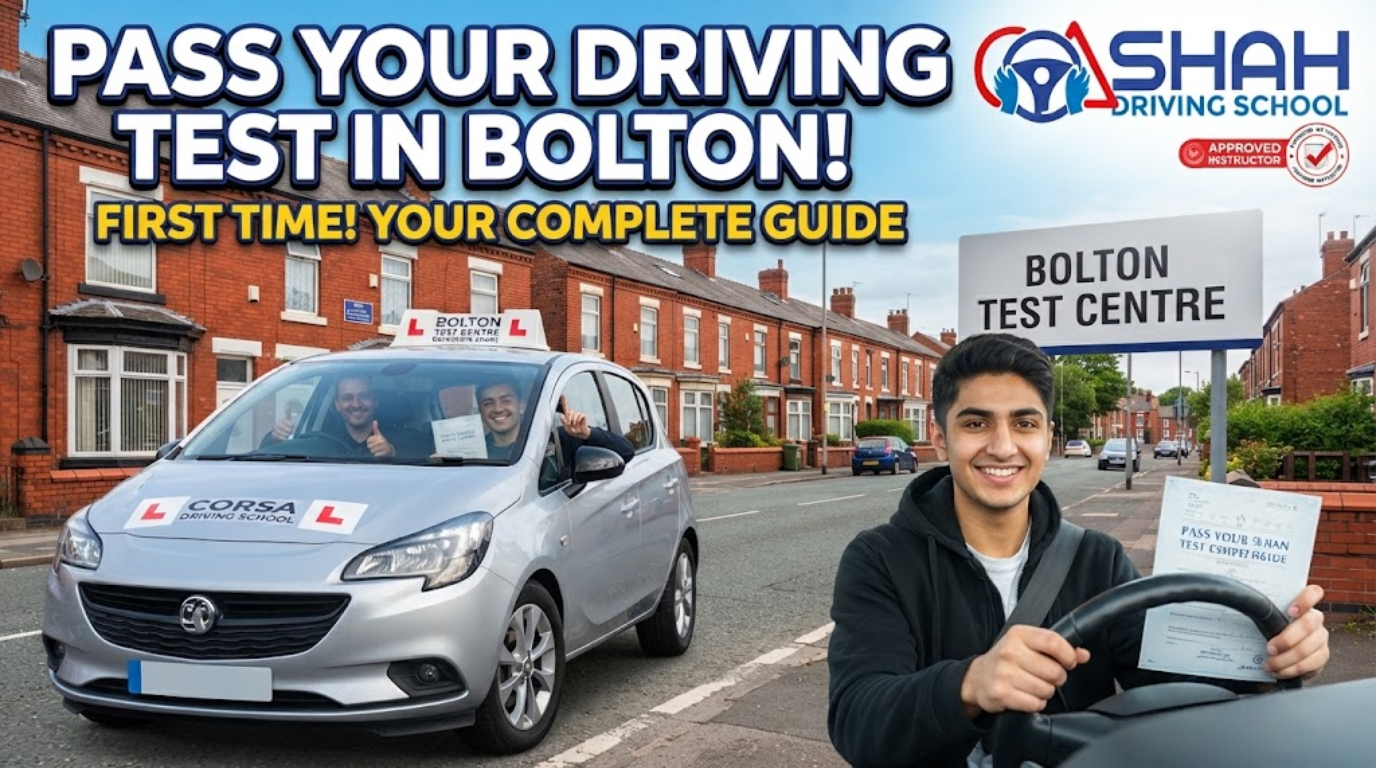

If you want to pass your driving test in Bolton, you are already in a stronger position than most learner drivers across Greater Manchester. Bolton Weston Street test centre holds the highest pass rate of any test centre in Greater Manchester — and with the right preparation, the right instructor, and the right knowledge of the specific roads your examiner will use, that statistical advantage translates directly into your result.
This is Shah Driving School’s complete 2026 guide — built around years of preparing Bolton learners for Weston Street examinations. Everything in it is locally specific, practically focused, and grounded in what actually makes the difference between a first-time pass and a retest booking.
The pass rate data published by the DVSA each year tells a clear story about Bolton.
Bolton (Manchester) Weston Street test centre recorded an overall pass rate of 51.8% for 2025/2026 — 3.1 percentage points above the national average of 48.7%. The first-attempt pass rate was even stronger at 52.8%, making Bolton one of the most encouraging test environments in the entire region. veygoveygo
Bolton has the highest pass rate of any test centre in Greater Manchester for 2025/2026. In 2024/2025, Bolton’s pass rate was 58.6%, meaning learners were 55% more likely to pass their practical driving test in Bolton than in Bury. veygomancunianmatters
The full 2025/2026 Bolton Weston Street breakdown:
| Metric | Bolton 2025/2026 |
|---|---|
| Overall pass rate | 51.8% |
| First-attempt pass rate | 52.8% |
| Manual pass rate | 54.7% |
| Automatic pass rate | 46.7% |
| Tests conducted | 11,570 |
| National average | 48.7% |
This data is meaningful — but it is not guaranteed. The Bolton pass rate advantage reflects the test route environment and the quality of local preparation. Learners who arrive at Weston Street without specific preparation on Bolton test routes do not benefit from the statistical advantage. Learners who have specifically trained on Bradford Road, the A666, Lever Edge Lane, and Bury Road arrive with a genuine familiarity advantage that shows directly in results.
You cannot book your practical driving test at Bolton Weston Street without a valid theory test pass certificate. Letting your practical lessons run ahead of your theory preparation is one of the most common and most costly mistakes Bolton learners make.
The theory test consists of two parts — 50 multiple choice questions (43 correct required to pass) and a hazard perception section (44 out of 75 required). Both must be passed in the same sitting at a DVSA theory test centre.
Following this sequence means your theory pass certificate and practical readiness align without gaps. Learners who reverse the order — completing their full practical course before passing the theory — sometimes face a fresh wait for test slots that causes skill regression before they can even book.
🔗 GOV.UK — Book Your Theory Test
Address: Weston Street, Great Lever, Bolton, BL3 2AW
Location: The test centre sits in Great Lever — the same BL3 postcode. This means the roads surrounding the test centre are the test routes. For learners based in Great Lever, Daubhill, Little Lever, and the wider BL3 area, the test routes are your local roads.
Facilities:
What to bring on test day:
Test fees in 2026:
£62 on weekdays | £75 on evenings, weekends, and bank holidays
🔗 GOV.UK — Official DVSA Practical Driving Test — Bolton Weston Street
Understanding the exact structure of your practical examination before test day eliminates the format-shock that causes unnecessary anxiety and faults in underprepared candidates.
Before any driving, your examiner asks you to read a number plate at the required legal distance in the car park. Fail this and the test ends immediately — no refund, no continuation. If you wear glasses or contact lenses for driving, wear them. Always.
Before moving off, your examiner asks one Tell Me question — answered verbally, car stationary. There are 19 possible Tell Me questions on the current DVSA list. Preparing all 19 takes approximately 30 minutes and removes this element as any source of anxiety entirely.
Examples of Tell Me questions at Bolton:
The core of your Bolton test. Your examiner gives directions and you drive for approximately 40 minutes across the road types detailed below. This section includes:
General road driving — assessing every element of your driving technique continuously throughout the route.
One manoeuvre — selected by your examiner from:
Emergency stop — approximately one in three Bolton tests includes an emergency stop. Your examiner raises a hand and says “stop” — brake firmly and under control as quickly as possible.
Independent driving section — approximately 20 minutes of following either a sat-nav to a programmed destination or road signs to a named location without your examiner providing directions. Missing a turn is not recorded as a fault. Reacting to a missed turn dangerously is.
During the drive, your examiner asks one Show Me question — a vehicle safety demonstration while the car is moving. Common examples: demonstrating the rear demister, adjusting temperature controls, washing the rear windscreen.
The critical rule: answer the question without taking your eyes off the road for more than a brief, controlled glance. Your hands should remain on the wheel except for the brief demonstration moment.
At the end of the test your examiner delivers your result. A pass means you receive a pass certificate. A fail means you receive a detailed fault sheet identifying every fault recorded during the test — your most valuable preparation resource for a resit.
Passing your driving test in Bolton requires specific knowledge of the roads Weston Street examiners actually use. This is not information you can generalise from other areas — it is locally specific knowledge that only comes from training on these roads repeatedly under the guidance of an instructor who teaches them daily.
The A666 runs alongside the Weston Street test centre and appears on a significant proportion of Bolton test routes. It is the road most commonly cited by candidates who failed their first attempt as “not what I expected.”
The A666 carries traffic at 50mph on its dual carriageway sections. Joining from slip roads requires smooth acceleration, correct mirror sequencing, and a confident merge without hesitation when a safe gap is available. Candidates who have not practised specifically on this road frequently either hesitate at the merge point — recording a hesitation fault — or join at insufficient speed — recording a positioning fault.
What examiners assess on the A666:
In automatic training, joining the A666 is significantly more manageable — full acceleration without simultaneous gear changes means complete focus on the merge timing and positioning that examiners assess.
Bradford Road is one of Great Lever’s busiest arterial routes and a consistent feature of Weston Street test routes in multiple directions.
What you will face on Bradford Road:
Shah Driving School’s instructors use Bradford Road throughout lesson programmes — not just in final pre-test sessions. By your test day, every bus stop, every crossing, and every junction along it has been navigated many times.
The residential streets surrounding Weston Street test centre — Lever Edge Lane, Sunning Hill Road, Deane Road, and the wider BL3 estate roads — feature on the majority of test routes heading away from the test centre.
These streets are where observation at junctions faults are most frequently recorded at Weston Street. Restricted visibility at residential junctions, parked vehicles limiting sightlines, and the density of side roads all create continuous observation demands that underprepared candidates fail to manage consistently.
The Peep and Creep technique must be instinctive on these streets — inching forward to gain a sightline before emerging from any restricted-visibility junction. Never guessing. Never assuming. Always confirming before committing.
Bury Road connects Weston Street northward toward Breightmet and Tonge Moor and features on test routes heading northeast from BL3. Speed limit transitions, roundabout approaches, and pedestrian crossings throughout its length are all covered in Shah Driving School’s Weston Street preparation.
Deane Road connects westward from Bolton town centre toward Deane and beyond, appearing on test routes heading west from Weston Street. The western route directions also incorporate sections of the Wigan Road corridor and the approaches toward the Daubhill and Deane residential networks.
The DVSA publishes annual data on the most common practical test failure reasons nationally. Combined with Shah Driving School’s direct experience at Weston Street Bolton, these are the fault categories that account for the majority of Bolton test failures.
The national number one failure reason — and the most common serious fault at Weston Street. Emerging from junctions without sufficient observation, not checking both directions, or pulling out when oncoming traffic is too close.
The Lever Edge Lane and Daubhill residential networks generate the highest concentration of observation-at-junction faults at Bolton due to their restricted-visibility junction density.
The fix: Peep and Creep executed correctly at every restricted-visibility junction — instinctively and consistently, not selectively.
Incomplete mirror checks before any change in speed, direction, or road position. This fault accumulates across an entire test route — every incomplete MSM on Bradford Road, every missed blind spot check before a lane change on the A666, every unsignalled turn through the Daubhill residential network adds to the count.
The fix: MSM routine drilled until completely automatic — not consciously constructed, but instinctive. Shah Driving School’s instructors assess MSM quality continuously throughout lessons, not only at specific manoeuvre points.
Waiting unnecessarily at junctions or roundabouts when a safe gap is clearly available. Common at the A666 merge points and the Bradford Road junction network.
The fix: Accurate gap judgement through repeated practice on the specific roads where hesitation occurs. Understanding that a vehicle approaching at 50mph covers approximately 22 metres per second — and that a gap which looks marginal is often genuinely safe — replaces uncertainty with calculated confidence.
Drifting out of lane, late lane selection on approach to multi-lane junctions, or cutting across lanes on roundabout exits.
The fix: Read road markings from 100 metres back, not at the junction. Lane selection made before the give way line — not at it.
Either exceeding the limit on the A666 or residential 20mph zones, or travelling significantly below the limit without a hazard reason.
The fix: Active speedometer awareness throughout every road type — combined with early sign recognition for speed limit transitions between zones.
For Bolton (Manchester) in 2025/2026, the manual pass rate was 54.7% compared with 46.7% for automatic tests — a difference of 8 percentage points. veygo
This gap deserves an honest explanation rather than a simple recommendation.
The majority of learners sitting manual tests have typically taken more lessons and trained over a longer period than automatic learners — partly because manual training takes longer and partly because many automatic learners are those who switched after struggling with manual.
If your primary goal is earning a full manual licence — for career reasons, for vehicle flexibility, or for long-term driving needs — manual training at Bolton produces the strongest statistical results. Shah Driving School’s manual instructors build clutch control, gear management, and junction technique progressively on Bolton’s real test roads.
If your primary goal is qualifying as efficiently as possible — and there is no specific need for a manual licence — automatic training removes the clutch and gear demands from a test environment that already requires continuous observation, positioning, and hazard management. For nervous learners, returning drivers, and those who previously stalled repeatedly, automatic training in Bolton consistently delivers faster progress to test readiness.
The right choice depends on your individual situation. Shah Driving School’s instructors give you an honest recommendation after your first assessment session — without agenda and without defaulting to whichever option suits the lesson schedule.
These are the ten preparation and test-day actions that Shah Driving School’s instructors consistently identify as the difference between a first-time pass and a retest booking at Weston Street.
1. Pass your theory test before your practical test preparation peaks
Holding a valid theory certificate means you can book your practical test the moment your instructor confirms you are ready — no delay, no skill regression during a wait.
2. Train specifically on Bolton test route roads — not just residential streets
Bradford Road, the A666, Lever Edge Lane, and Bury Road must feature in your lessons regularly — not as a final pre-test tour, but as standard lesson content throughout your programme.
3. Complete at least one full mock test before your real examination
A mock test conducted in examiner format, on real Weston Street routes, with examiner-style silence — debriefed with specific fault-by-fault feedback — is the single most effective preparation step available before your test day. Shah Driving School’s mock driving test Bolton programme is structured specifically around Weston Street routes.
4. Only book your test when your instructor says you are ready
Under the 2026 DVSA booking rules, you have only two permitted changes per test booking. Booking speculatively and rearranging repeatedly is no longer possible. Book when you are genuinely ready — not when you have reached a lesson count or a specific date.
5. Drill the Peep and Creep technique at every blind junction in your lessons
Observation at junctions is the number one failure reason at Weston Street. Every restricted-visibility junction in the BL3 residential network needs to feel instinctively managed before test day.
6. Practise the A666 specifically — from the actual slip road approaches
The dual carriageway merge is the element most likely to generate a hesitation fault for learners who have not specifically practised it. Your instructor should include multiple A666 joining and exiting sequences in your lesson programme before test day.
7. Know all 19 Tell Me questions
Thirty minutes of focused revision eliminates this element entirely as a source of test-day anxiety. There is no excuse for not knowing all 19 — the complete list is freely available on GOV.UK.
8. Arrive at Weston Street 15 minutes early — not five minutes late
Rushing into the test centre breathless and flustered elevates cortisol, impairs fine motor control, and sets your first impression with the examiner under the worst possible conditions. Arrive early, sit quietly, breathe.
9. If something goes wrong during the test, reset immediately
You can record up to 15 minor faults and still pass. A single mistake is not a test failure. Reset your focus to the next junction, the next observation, the next correct decision — and keep driving to the standard you prepared for.
10. Use the instructor’s car for your test — never an unfamiliar private vehicle
Sitting your test in Shah Driving School’s tuition vehicle — the same car you have trained in throughout your programme — means consistent, familiar controls, dual brakes for safety, and the muscle memory that transfers directly from your lessons to your test.
Shah Driving School does not operate a generic lesson programme adapted to Bolton roads. Every lesson programme for Weston Street candidates is built specifically around the roads and junctions on the Bolton test route network — from the first lesson to the mock test.
✅ A first-session honest assessment establishing exactly how many hours are genuinely needed — not a standard package regardless of starting level
✅ Progressive introduction to Bradford Road, the A666, Lever Edge Lane, and the BL3 residential network as standard lesson content — not a final pre-test addition
✅ Specific Peep and Creep technique instruction at every significant blind junction on the Weston Street route network
✅ A666 dual carriageway preparation including slip road joining technique, lane discipline, and exit sequencing
✅ At least one full mock test conducted in examiner format on real Weston Street test routes — included as standard, not charged as an extra
✅ Honest readiness confirmation before any test booking — so you book once and pass
✅ Female instructor option — always accommodated without additional process
✅ Bilingual instruction in Urdu and Punjabi — available across the Bolton BL postcode area
Our intensive driving courses in Bolton are the fastest structured route from current ability to Weston Street pass certificate — covering every required element on real test routes with daily consecutive sessions that build skills without regression between sessions.
For semi-experienced learners who want the most efficient structured option, our 15-hour automatic intensive course delivers fifteen focused daily hours on real Bolton test routes, concluding with a full mock test before your actual examination day.
For the complete picture of how to fast-track your entire Bolton driving journey from first lesson to pass certificate, read our guide on how to pass fast with Shah Driving School.
The most recently published DVSA data for Bolton (Manchester) Weston Street driving test centre shows an overall pass rate of 51.8% for 2025/2026 — 3.1 percentage points above the national average of 48.7% and the highest pass rate of any test centre in Greater Manchester. The first-attempt pass rate is even stronger at 52.8%. The manual pass rate is 54.7% and the automatic pass rate is 46.7%.
The DVSA recommends an average of 45 hours of professional tuition for a typical learner. In practice, this varies significantly. Shah Driving School’s structured, route-specific approach means many Bolton learners reach test-ready standard in 28 to 35 hours for semi-experienced candidates, or 38 to 45 hours for complete beginners. Your instructor provides a precise, honest estimate after your first assessment session — based on your actual demonstrated ability, not a standard package figure.
Based on DVSA national data and Shah Driving School’s direct experience at Weston Street, the most common serious fault categories at Bolton are: observation at junctions — particularly on the BL3 residential network around Lever Edge Lane; incomplete MSM (Mirror — Signal — Manoeuvre) routine across the test route; hesitation at junction and merge points; and speed management errors on the A666 St Peter’s Way. All are directly addressable through specific, route-based preparation on the actual roads where they occur.
For learners based in Bolton’s BL postcodes, Weston Street is the statistically stronger choice — its 51.8% pass rate compares favourably to Atherton’s 44.3% for 2025/2026. For learners in Leigh, Atherton, Tyldesley, and Westhoughton, Atherton is more geographically logical and the test routes align more naturally with the local road network those learners train on. Shah Driving School prepares pupils for both centres — call us on 0749 0662 777 and we will advise on the most suitable option based on your specific location and training.
Under the 2026 DVSA booking rules, only you — the learner driver — can book your practical test. Book directly through the official GOV.UK booking service. You will need your provisional driving licence number, your theory test pass certificate number, and your instructor’s personal reference number (PRN). The current fee is £62 on weekdays and £75 on evenings, weekends, and bank holidays. Shah Driving School provides every learner with their instructor’s PRN as soon as their course begins. Never book through a third-party reselling service — the official GOV.UK booking is free to use and is the only legitimate route.
All pass rate data is sourced from published DVSA statistics for 2025/2026. Test fees accurate as of September 2026. Shah Driving School is a DVSA-registered driving school serving Bolton, Great Lever, Halliwell, Deane, Farnworth, Westhoughton, Horwich, Leigh, Atherton, and the wider Greater Manchester area. All instructors hold current ADI certification.
WhatsApp us