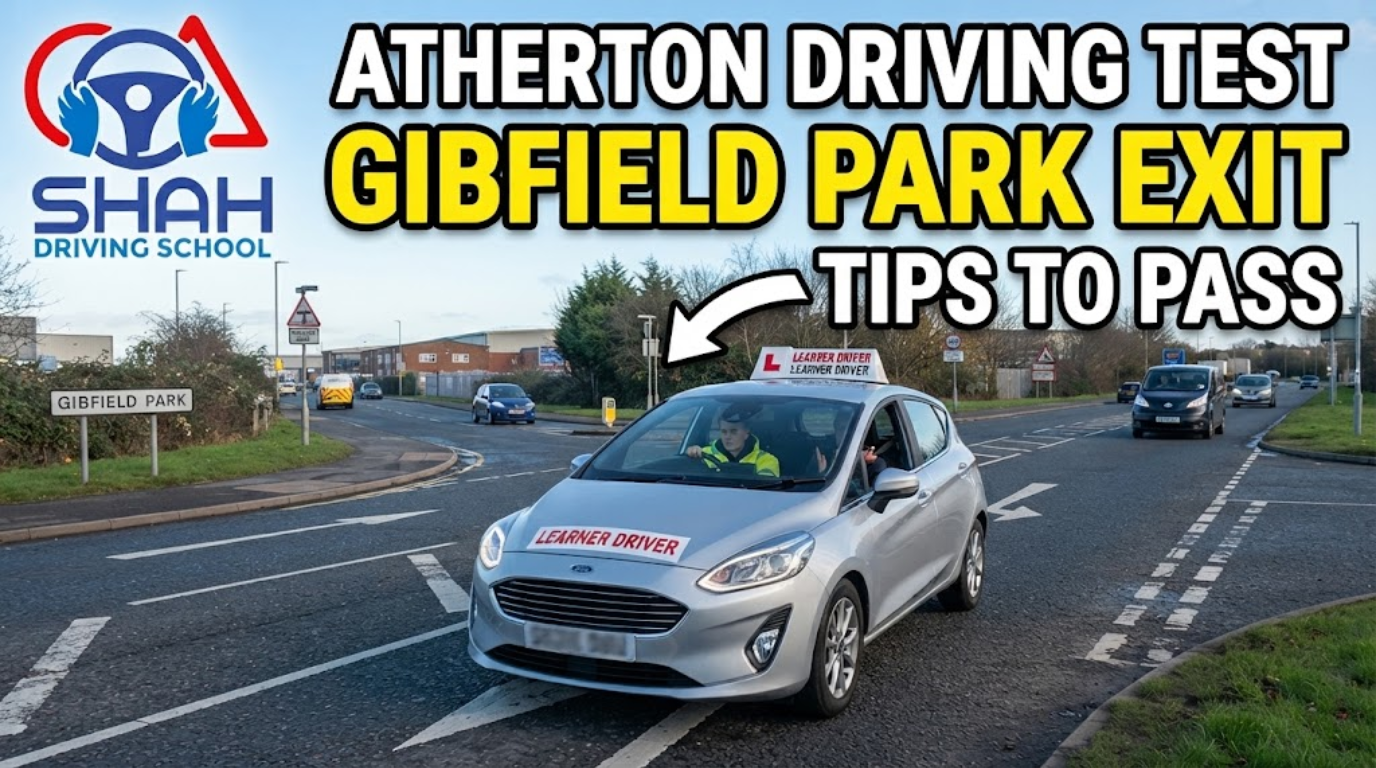
When it comes to your Atherton driving test Gibfield Park exit, most learner drivers make the same mistake — they spend weeks preparing for junctions, roundabouts, and the A579 Atherleigh Way, and give almost no thought to the very first seconds of their test. The moment they pull out of the Gibfield Park Avenue car park with an examiner beside them, everything they planned goes out of the window because the road is nothing like the residential streets they trained on.
Shah Driving School prepares learners specifically for the Gibfield Park test centre environment — not just the routes beyond it, but the exit itself, the immediate approach roads within the estate, and the junction decisions that happen before most learners have even adjusted to the examination pressure. This guide gives you the complete picture.
Why the Gibfield Park Exit Catches Learner Drivers Off Guard
Atherton Gibfield Park test centre sits within an active industrial and business estate on the southwestern edge of Atherton. This is fundamentally different from the environment surrounding Bolton Weston Street test centre, which exits into a residential road network that many learners are already familiar with.
At Gibfield Park, the very first road you drive on after leaving the test centre car park is an industrial estate access road. It carries delivery lorries, vans, trade vehicles, and commercial traffic throughout the day. The road markings, junction types, and traffic behaviour are all distinctly different from the residential streets where most learners spend the majority of their lesson time.
Learner drivers can still initially book a test at any centre — but changes made after 9 June 2026 will be limited to the same test centre or one of the three closest alternatives. This means if you have booked Atherton Gibfield Park, preparing specifically for its exit conditions is not optional — it is essential. Blackcircles.com
The specific challenges of the Gibfield Park exit include:
- Limited visibility on initial exit from the car park itself
- Industrial estate road surface and markings that differ from residential streets
- Immediate junction decisions within the first 200 metres of pulling away
- HGV and commercial vehicle presence from the very first seconds of the test
- No gentle warm-up period — the examiner’s assessment begins from the moment you start the engine
Before You Leave the Car Park — The Pre-Drive Checks
The examiner’s assessment at Atherton Gibfield Park begins inside the car park, not on the road. The first formal elements of your test happen before you have moved an inch.
The Eyesight Check
Your examiner will ask you to read a number plate at the required distance in the car park itself. This is not a formality — failing the eyesight check ends the test immediately. If you normally wear glasses or contact lenses for driving, wear them. Every time. Without exception.
The Tell Me Question
Before moving off, your examiner will ask one Tell Me question — a vehicle safety question answered verbally without demonstrating anything. Common Tell Me questions include how you would check that the brakes are working before starting a journey, how to check the power-assisted steering is working, or how to check the horn is working.
Prepare all Tell Me questions in advance using the official DVSA list. The car park is a tense environment and a question you have not prepared for will shake your confidence at exactly the wrong moment.
Cockpit Drill Before Moving
Before you release the handbrake and pull away, complete your full cockpit drill calmly and deliberately:
- Adjust your seat position if needed
- Check and adjust mirrors — interior, then right exterior, then left exterior
- Ensure your seatbelt is fastened
- Confirm the handbrake is applied and the gear is in neutral (or Park for automatic)
Examiners at Atherton specifically note whether learners rush this process under pressure. Completing it calmly signals competence. Rushing it signals nerves that then carry into the drive.
The Gibfield Park Car Park Exit — The First 30 Seconds
The car park at Gibfield Park Avenue has a specific exit point onto the estate road. This is the first driving assessment point of your entire test — and it is where many underprepared learners make their first recorded fault.
Pulling Away Safely
When pulling away from the test centre car park, your full moving-off routine applies from the very first movement:
- Prepare — clutch down, select first gear (or select Drive in automatic), set gas
- Observe — interior mirror, right mirror, right blind spot over your shoulder
- Move — release handbrake, bring clutch to biting point, move forward smoothly
The specific challenge at the Gibfield Park exit is that the immediate approach of the car park often has limited forward visibility due to parked vehicles, hedging, or fencing alongside the exit point. Move forward slowly and deliberately — this is exactly the situation where the Peep and Creep technique applies.
Do not pull out until you can see it is safe. Edge forward to your sightline, pause, confirm it is clear, then pull out. A cautious, safe pull-out at a restricted-visibility exit is correct driving. An impulsive pull-out that forces another vehicle to react is a serious fault.
The Show Me Question — Answered While Driving
After pulling away from the car park, your examiner will ask the Show Me question — a vehicle safety demonstration completed while driving. Common Show Me questions at Atherton include:
- When would you use the rear demister — and can you show me?
- Can you show me how you would wash and wipe the rear windscreen?
- Can you show me how you would increase the temperature inside the car?
The key rule: answer the question without taking your eyes off the road for more than a brief glance. The examiner is assessing whether you can operate secondary controls safely while maintaining road awareness. Keep both hands on the wheel except for the moment of demonstrating, look at the road first, make the adjustment, look back at the road. Do not stare at the dashboard while driving on an industrial estate road.
Gibfield Park Avenue — The Estate Road Immediately Outside
Once you have exited the car park and completed the Show Me question, you are on Gibfield Park Avenue itself — the estate road that surrounds the test centre.
Understanding the Road Character of Gibfield Park Avenue
Gibfield Park Avenue is an industrial estate access road. Its characteristics are distinctly different from what most learner drivers are accustomed to:
Road width is generous — industrial estate roads are designed for HGV access. The lanes feel wider than residential streets, which can actually cause underprepared learners to drift toward the centre of the road. Maintain your standard position approximately one metre from the left edge of the carriageway throughout.
Road markings may be faded or different — industrial estate roads receive more wear from heavy vehicles and may have markings that are less crisp than residential streets. Always position by the road edge and lane logic, not purely by markings.
Junction signage is functional, not prominent — give way lines and junction markings on estate roads are sometimes smaller or positioned differently to standard residential junctions. Begin looking for junction indicators — road narrowing, give way lines, junction posts — earlier than you would on a residential road.
Commercial vehicles park along estate roads — delivery lorries and vans park alongside Gibfield Park Avenue throughout the day. Apply the same parked vehicle clearance you would on any road — a door’s width minimum — and actively observe for drivers returning to their vehicles.
Speed Management on the Estate Road
Many learner drivers slow excessively on Gibfield Park Avenue because the environment feels unfamiliar. Moving significantly below the posted speed limit without a hazard reason is recorded as undue hesitation — a fault.
The posted limit on Gibfield Park Avenue and the surrounding estate roads is typically 30mph. Unless there is a specific hazard requiring you to slow — a vehicle emerging, a pedestrian crossing, an oncoming lorry requiring you to give way — maintain appropriate progress at close to the posted limit.
This is one of the specific points Shah Driving School addresses in Atherton preparation lessons. Driving at 15mph on a 30mph estate road with no hazard is not cautious driving — it is hesitant driving, and it is assessed accordingly.
The First Junction Decision — Turning Off Gibfield Park Avenue
Within a short distance of pulling out of the test centre car park, your examiner will give you your first direction instruction. At Atherton Gibfield Park, this typically involves one of the following:
- Turning left or right at the junction at the end of Gibfield Park Avenue onto the surrounding estate road network
- Joining the A579 Atherleigh Way directly
- Following road signs during the independent driving section
Turning Left Off the Estate Road
Turning left from Gibfield Park Avenue at its junction with the surrounding road network requires:
- Early MSM (Mirror — Signal — Manoeuvre) — begin checking your mirrors and signalling well before the junction, not at it
- Correct positioning — move toward the left of your lane approaching the junction, without mounting the kerb
- Speed management — slow progressively on approach, not sharply at the give way line
- Complete observation — look right, look left, look right again before emerging. On industrial estate roads, vehicles can approach quickly from unexpected directions
The most common fault at this specific junction type: looking only right before turning left. Always look both ways before emerging from any junction, regardless of the direction you are turning.
Turning Right Off the Estate Road
A right turn from Gibfield Park Avenue presents its own specific challenge — crossing the path of oncoming traffic on a road that may include HGVs and commercial vehicles travelling at estate road speeds.
- Position towards the centre of the road approaching the junction, without crossing the centre line
- Signal clearly and in good time
- Wait in the correct position — central, not drifting left
- Observe oncoming traffic accurately — one approaching HGV requires more judgement than one approaching car, because the lorry’s size makes its speed harder to read from a distance
- Turn when genuinely safe — not optimistically safe
Critical point: do not pull into the path of an approaching lorry because it looks like there might be time. If there is any doubt, wait. The examiner records hesitation faults for waiting unnecessarily at clear junctions — but they record serious faults for pulling out into approaching traffic. When uncertain, wait.
Joining the A579 Atherleigh Way — The Most Significant First Junction
Some Atherton Gibfield Park test routes connect directly from the estate road network onto the A579 Atherleigh Way within the first few minutes of the test. This is the moment most underprepared Atherton candidates find most intimidating — and the moment that Shah Driving School’s specific local preparation makes the most difference.
What the A579 Demands at the Junction
The A579 carries traffic at 40mph through this section. When you emerge from the estate road network onto the Atherleigh Way corridor, you are joining a faster road from a standing start or slow speed.
The specific skills assessed at this junction:
Accurate gap judgement at speed differential — traffic on the A579 is moving significantly faster than you are as you wait to emerge. Judging whether a gap is sufficient requires understanding that a vehicle travelling at 40mph covers approximately 18 metres per second. A gap that looks generous at 20mph conditions is considerably smaller than it appears.
Full observation before emerging — look right for approaching traffic. Look left for traffic that has passed and pedestrians or cyclists. Look right again. Only then emerge — smoothly, without hesitation, accelerating to match the A579 traffic speed as quickly as your vehicle safely allows.
No creeping into the carriageway — edging forward into the A579 traffic lane while still checking for gaps forces approaching drivers to react to you. Move when you are committing to the move — not in hesitant increments.
What Examiners Record as Faults Here
| Behaviour | Fault Type |
|---|---|
| Waiting through multiple safe gaps | Hesitation — potentially serious |
| Pulling out into an approaching vehicle’s path | Serious or dangerous fault |
| Not checking both directions before emerging | Observation — serious fault |
| Stalling on entry to the A579 | Control — minor fault |
| Failing to accelerate to match traffic flow | Undue hesitation — minor fault |
🔗 GOV.UK — The Highway Code: Joining the Road from a Junction
The Independent Driving Section — Beginning Near Gibfield Park
At Atherton Gibfield Park, the independent driving section of your test frequently begins while you are still on or very near the estate road network. This is worth specific preparation.
Following Sat-Nav Directions Near the Estate
Most Atherton tests use sat-nav directions for the independent driving section rather than road signs. The examiner will set the sat-nav to a destination and ask you to follow it.
In the industrial estate environment near Gibfield Park, sat-nav instructions can arrive quickly and with limited notice — particularly if the route takes you through the junction network of the estate road before connecting to the wider Atherton road network.
Key rules for independent driving near Gibfield Park:
- Listen to the sat-nav instruction as soon as it sounds — do not wait until the junction is close
- If you miss a turn, do not panic — make a safe, legal U-turn or follow the sat-nav as it recalculates. Missing a turn is not a fault. Making a dangerous manoeuvre to correct it is
- The examiner assesses your driving quality, not your navigation accuracy — a missed turn followed by calm, safe correction is better than a correct turn made dangerously
Following Road Signs If Sat-Nav Is Not Used
If road signs are used instead of sat-nav, the industrial estate approach roads near Gibfield Park carry destination signs that you must read and follow accurately. Begin looking for signs at the 300-metre point, not at the junction itself.
What Shah Driving School Does Differently for Atherton Gibfield Park Preparation
Most driving schools in the Bolton and Atherton area prepare learners for the A579, the town centre junctions, and the Hindsford residential roads — all of which are important. Shah Driving School goes one step further.
We drive the Gibfield Park car park exit, Gibfield Park Avenue itself, and the immediate junction network with every Atherton preparation learner — repeatedly, at different times of day, in varying traffic conditions.
By the time you sit with your examiner and pull out of that car park, you have done it before. The road surface, the parked commercial vehicles, the give way line at the estate road junction, and the A579 approach are all familiar. That familiarity is the difference between the first 30 seconds of your test feeling like controlled, assessed driving — and feeling like a shock.
Our Atherton test centre preparation programme covers every element of the Gibfield Park test route network, including the exit tips in this guide.
For learners who want to compress their Atherton preparation into the most efficient timeline possible, our intensive driving courses in Bolton include specific Gibfield Park exit preparation as a mandatory component — alongside the A579, Atherton town centre, and Hindsford residential route sessions.
For a complete fast-track overview of how to go from current ability to Atherton pass certificate in the shortest time available, read our guide on how to pass fast with Shah Driving School.
🔗 GOV.UK — Book Your Official DVSA Practical Driving Test at Atherton
Key Takeaway Summary
- The Gibfield Park car park exit begins your test assessment — prepare for it specifically
- Complete your cockpit drill and Tell Me answer calmly before moving
- Treat Gibfield Park Avenue as a professional driving road — not a residential warm-up
- Gap judgement on the A579 requires understanding the speed differential clearly
- The Show Me question happens while driving on the estate road — practise answering without staring at the dashboard
- Independent driving instructions may begin near the estate — listen early and stay calm if you miss a turn
- Shah Driving School drives the Gibfield Park exit with every Atherton learner in lessons before test day
Frequently Asked Questions: Atherton Driving Test Gibfield Park Exit
1. How far do I drive on the industrial estate before I join normal roads?
The distance varies depending on which route your examiner selects on the day. Some Atherton tests join the A579 Atherleigh Way within the first two minutes. Others navigate further through the Gibfield Park estate road network before connecting to the wider Atherton road system. Shah Driving School’s Atherton preparation lessons drive every significant estate road junction near Gibfield Park — so all variations feel familiar before your test.
2. Is it normal to feel more nervous at the start of an Atherton test than later on?
Yes — and it is well documented in driving examiner feedback data. The first two to three minutes of any practical test are statistically the period when most faults are recorded, as test anxiety peaks at the moment of pulling away. The solution is not to try to feel less nervous — it is to have driven the specific roads and junctions so many times in lessons that the technique is automatic even when anxiety is high. Familiarity suppresses anxiety far more effectively than reassurance does.
3. What is the most common fault recorded in the first five minutes of an Atherton driving test?
Based on Shah Driving School’s experience preparing candidates at Gibfield Park, undue hesitation on emerging from the estate road network onto the A579 Atherleigh Way is the most frequently recorded early-test fault. Learners who have not specifically practised gap judgement at A579 speeds wait through safe gaps out of caution, recording hesitation faults that could have been avoided with specific preparation on the actual road.
4. Can I ask the examiner to repeat the Show Me question if I did not hear it clearly?
Yes. If you did not hear the Show Me question clearly because of traffic noise or nerves, politely ask the examiner to repeat it. Do not attempt to answer a question you are not sure you heard correctly. The examiner will not penalise you for asking for a repeat — they will penalise an incorrect or unsafe Show Me demonstration.
5. What happens if I stall when pulling away from the Gibfield Park car park?
A single stall when pulling away — if you remain calm, restart correctly, and move away safely without creating a hazard — is typically recorded as a minor control fault rather than a serious fault. The examiner is assessing your response to the stall as much as the stall itself. Stay calm, apply the handbrake if needed, restart, check mirrors, and pull away again using your standard moving-off routine. Do not rush the restart in panic — a controlled restart is assessed positively, a rushed restart that causes another stall is not.
All DVSA test format information and Highway Code references are accurate as of September 2026. Shah Driving School is a DVSA-registered driving school serving Atherton, Bolton, Leigh, Tyldesley, Westhoughton, and the wider Greater Manchester area. All instructors hold current ADI certification.