
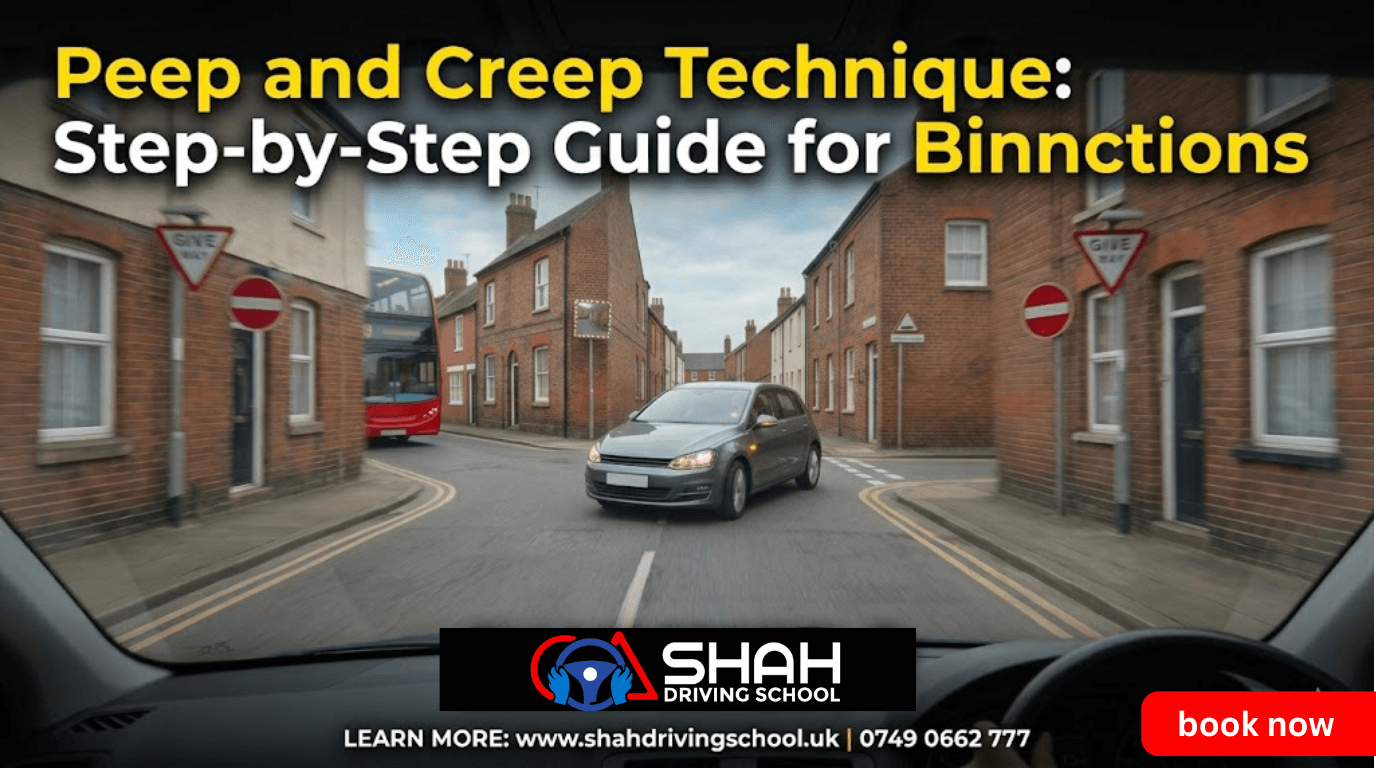
The Peep and Creep Technique is one of the most important skills you will ever learn as a new driver in the UK — and it could genuinely save your life. Whether you are approaching a closed, blind junction on a narrow residential street in Bolton or navigating a tight exit near Atherton town centre, this technique gives you the control and observation strategy you need to emerge safely and confidently. It is also a core competency that DVSA examiners look for during your practical driving test: get it wrong and you risk a serious fault; get it spot on and you demonstrate exactly the kind of hazard awareness and vehicle control that earns a pass.
At Shah Driving School, our instructors teach the Peep and Creep Technique from the very first junction lesson, because we know that confidence at blind junctions is what separates nervous learners from safe, competent drivers. In this guide, we walk you through every single step — from clutch control for beginners in a manual car to the brake-and-idle method in an automatic — so you can practise effectively and arrive at your Bolton driving test ready to shine.
The Peep and Creep Technique is a two-part method used at closed (blind) junctions — junctions where your view of oncoming traffic is restricted by walls, fences, parked vehicles, hedges, or buildings right up to the give-way line.
Together, these two actions let you safely “steal” a view of the road without committing to pulling out. Think of it as the driving equivalent of peeking around a corner before you walk into a room — only the stakes are considerably higher.
The DVSA’s marking sheet assesses your observation at junctions as a key competency. Specifically, examiners watch to see whether you:
Failing to use the Peep and Creep Technique at a blind junction — for example, stopping dead at the line and waiting without moving forward to gain a view — is a common reason learners pick up driving fault marks in Bolton and across Greater Manchester. Even worse, simply pulling out without a proper view can result in a serious or dangerous fault, ending the test immediately.
For authoritative guidance on junction priorities in the UK, always refer to The Highway Code Rules 170–183 and the DVSA’s official guide to the driving test.
Clutch control for beginners is the foundation of this technique in a manual vehicle. If you are learning in a manual car with Shah Driving School, your instructor will spend dedicated time helping you find and maintain the biting point — the sweet spot where the clutch plates begin to engage and the car becomes ready to move without stalling.
Here is the full step-by-step process:
As you approach the give-way line, select first gear early and begin slowing smoothly. Aim to arrive at the line travelling at no more than 3–5 mph, or even slower if the junction is extremely tight.
Press the clutch pedal fully down and apply gentle pressure to the footbrake. This is your “ready position” — the car is stationary, in gear, and fully under your control.
Slowly raise the clutch pedal until you feel (and often hear) a slight dip in engine tone and a gentle vibration through the pedal. This is the biting point. The car is now engaged and will move the instant you release the footbrake — but only just.
Instructor’s tip from Shah Driving School: Practise finding the biting point on flat ground before you tackle junctions. It becomes instinctive very quickly, and that instinct is what makes the Peep and Creep Technique feel smooth and natural.
Holding the clutch at the biting point, gently ease off the footbrake. The car will begin to roll forward at a very slow, walking pace — sometimes even slower. This is the creep phase. Move forward in small increments of 30–60 cm at a time, then reapply the footbrake.
As the nose of the car emerges past the obstruction, begin turning your head decisively left and right to gather information about oncoming traffic. Look for:
If the road is clear in both directions and you are confident there is a safe gap, bring the clutch up smoothly and accelerate gently to join the road. And if there is any doubt, bring the footbrake back on, hold your position, and wait for a clear opportunity.
If you are ready to get this technique sorted in a real car, our manual driving lessons in Bolton are the perfect place to start.
Automatic vehicles do not have a clutch pedal, which changes the technique slightly but does not make it any easier — in fact, it requires a different kind of discipline.
In an automatic car, the idling speed (the speed the engine naturally maintains when in Drive with no accelerator input) will gently push the car forward. This is the “creep function” built into most automatic transmissions, and it becomes your primary tool.
The key risk in an automatic is applying too much brake release and letting the car surge forward more than intended. Practise modulating the brake pedal lightly — think of it as using 10% brake pressure rather than 0%.
Our female automatic driving instructors in Bolton are trained to help learners master this exact level of brake sensitivity in automatic vehicles, in a patient and supportive environment.
The observation element of the Peep and Creep Technique is just as critical as the vehicle control. Many learners focus entirely on the clutch or the brake and forget to actually look effectively. Here is how to maximise your view from a tight junction:
If parked vehicles are restricting your view, peer through the gaps between them before you even begin to move. Sometimes you can pick up early movement — the glint of a windscreen or the flash of headlights — before you have moved an inch.
Shop windows, glass bus shelters, and the sides of vans can act as impromptu mirrors. A reflection in a car window might show you an approaching cyclist or van before your direct line of sight does. Always scan for reflections as you inch forward.
Do not rely on peripheral vision alone. Make an obvious, deliberate left-right-left head turn so that your DVSA examiner can clearly see you are taking effective observations. In Bolton driving test centres, examiners are specifically watching the movement of your head — a timid glance is not enough.
One of the most common errors on the driving test is rushing the observation phase. You are allowed to take as long as you need at a closed junction. There is no pressure to pull out quickly — a safe, measured pause is far better than an uncertain lurch into traffic.
If you are taking your driving test at the Bolton Driving Test Centre on Spa Road, you will almost certainly encounter blind junctions during your route. Here are some local scenarios where the Peep and Creep Technique is particularly relevant:
Knowing these local conditions is part of why training with a local Bolton driving school — one that knows the test routes — makes such a difference to your result.
For further guidance on specific hazards and junction types, the Safe Driving for Life website is an excellent UK government resource.
Cause: Raising the clutch too quickly or letting the engine RPM drop too low. Fix: Give the engine a tiny amount of extra revs (around 1,500 RPM) before finding the biting point. This creates a larger margin for error and prevents the engine from dying as the clutch engages.
Cause: Releasing the footbrake too quickly while at the biting point, or using the accelerator unnecessarily. Fix: Keep your right foot on the brake until you are 100% certain you are emerging. Use the clutch alone to control your speed at the junction — do not touch the accelerator until you are actually turning into the road.
Cause: Stopping at the give-way line when the line itself is set well back from the actual hazard. Fix: Use the creep technique to roll forward past the line until you genuinely can see. The give-way line is the legal minimum stopping point, not necessarily the safest observation point. You are permitted to move forward beyond it to gain a view, provided you do so slowly and with caution.
Cause: Anxiety and over-focus on clutch/brake control. Fix: Build observation into your mental routine. As soon as the car begins to creep, say to yourself: “Creep… look left… look right… look left again.” Turning it into a verbal checklist in your head makes it automatic very quickly.
Here are ten authoritative UK resources to support your learning alongside your lessons with Shah Driving School:
Q: Do I have to stop at a give-way line if my view is already clear? A: If you have a full, clear view of the road in both directions and it is safe to proceed, you do not need to stop. The Peep and Creep Technique is specifically for blind or restricted junctions. At an open junction with a clear view, slow right down, observe, and if safe, proceed.
Q: Will I fail my test if I stall during the Peep and Creep Technique? A: A single stall is usually recorded as a driving fault (minor), not a serious fault — provided you restart calmly, safely, and without panic. However, multiple stalls at junctions can accumulate into a more serious concern. Practising clutch control for beginners in low-traffic areas before test day is highly recommended.
Q: Is the technique different in wet or icy conditions? A: Yes. In wet or icy conditions, reduce your creep speed even further. The risk of sliding forward unexpectedly into a junction is real, and your stopping distance on the biting point or brake will be longer. Leave extra time for observations and additional space when emerging.
Mastering the Peep and Creep Technique is far easier when you have a patient, experienced instructor in the seat beside you — someone who knows the Bolton test routes, understands the specific hazards on local streets, and can give you real-time feedback as you practise.
At Shah Driving School, we offer fully tailored manual driving lessons in Bolton and specialist support from our female automatic driving instructors in Bolton — whatever works best for you, we have got it sorted.
📞 Book your lesson today: 07490 662 777
Whether you are a complete beginner tackling blind junctions for the first time or a learner polishing the finer points before your test, Shah Driving School is here to help you drive safely, confidently, and successfully — right here in Bolton and across Greater Manchester.
Shah Driving School — Serving Bolton, Atherton, Farnworth, Westhoughton, and surrounding areas. Approved DVSA Driving Instructors. www.shahdrivingschool.uk
WhatsApp us