
If you’re preparing for your practical driving test, understanding the show me tell me questions UK driving test format is one of the smartest things you can do. These questions form an official part of your test, and getting them wrong can cost you a fault mark before you’ve even pulled out of the test centre car park.
Yet many learner drivers overlook them entirely. They spend hours on manoeuvres and motorway awareness, only to be caught off guard by a question about windscreen washer fluid levels. That doesn’t have to be you.
This guide covers everything you need to know clearly and honestly.
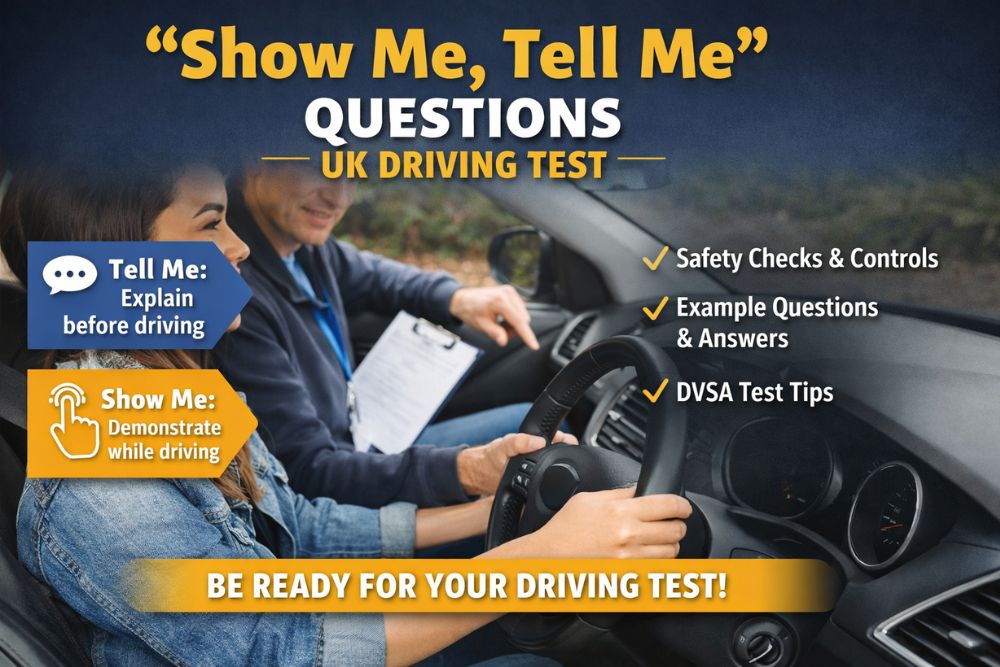
The show me tell me questions are a set of vehicle safety checks included in the UK practical driving test. They were introduced by the Driver and Vehicle Standards Agency (DVSA) to ensure new drivers understand basic vehicle maintenance and safety before they’re given a full licence.
The questions are split into two types. A “tell me” question asks you to explain how you would carry out a vehicle safety check. A “show me” question asks you to physically demonstrate it while driving or with the car stationary. Both types test whether you understand your vehicle well enough to keep it and others safe on the road.
These questions aren’t just a box-ticking exercise. The DVSA designed them to reflect real-world driving responsibilities. A driver who can’t locate their vehicle’s brake fluid reservoir, for example, may not notice a dangerous drop in brake performance until it’s too late.
Getting a “tell me” question wrong at the start of your test results in one driving fault. Getting a “show me” question wrong which happens during the drive itself also results in one driving fault. Neither will fail you outright on its own, but every fault adds up. And you only have 15 minor faults to spare.
Therefore, taking the time to learn these answers properly is absolutely worth it.
Read More: Roundabout Driving Test Tips UK: How to Handle Roundabouts Confidently
Your examiner will ask the “tell me” question before you set off. You’ll be sitting in the car, engine off, and your examiner will select one question from the DVSA’s official list.
For example, you might be asked: “Tell me how you’d check that the brakes are working before starting a journey.”
The correct answer here is that you’d check the brakes aren’t spongy or slack by testing them as you set off and that the vehicle doesn’t pull to one side when braking.
You’re expected to give a clear, accurate verbal explanation. You don’t need to use technical jargon, but your answer must show genuine understanding.
The “show me” question comes during your drive. Your examiner will ask you to physically demonstrate something related to vehicle safety. For example, they might say: “When it’s safe to do so, can you show me how you’d operate the rear windscreen demister?”
You’ll need to carry out the action when it’s safe without losing control of the vehicle or compromising your driving. That last part matters enormously. If you start fumbling with controls and your observation slips, you could pick up additional faults.
The DVSA publishes an official list of questions that examiners can choose from. Knowing them all means no question should come as a surprise on test day.
Brakes How would you check that the brakes are working before starting a journey? Brakes should not feel spongy or slack. Test them as you move off and confirm the vehicle pulls up straight.
Power-assisted steering How would you check that the power-assisted steering is working before starting a journey? Gentle pressure on the steering wheel as you move off should confirm it’s operating. Any sudden increase in effort suggests a fault.
Engine oil Tell me how you’d check the engine has sufficient oil. Switch off the engine, locate the dipstick, remove and wipe it, reinsert fully, then withdraw and check the level falls between the minimum and maximum markers.
Engine coolant Tell me how you’d check the engine has sufficient coolant. With the engine cold, check the level in the header tank against the minimum and maximum markings.
Windscreen washer fluid Tell me how you’d check there’s sufficient fluid for the windscreen washer system. Identify the reservoir and check the fluid level, topping it up if necessary.
Tyres Tell me how you’d check the tyres to ensure they have sufficient tread depth and are in good condition. The legal minimum in the UK is 1.6mm of tread depth across the central three-quarters of the tyre and around the entire circumference. Check for cuts, bulges, or excessive wear.
Headlights and tail lights Tell me how you’d check the headlights and tail lights are working. You’d either use a reflective surface or ask someone to confirm the lights work when you switch them on. Confirm both dipped and full beam function.
Direction indicators Tell me how you’d check the direction indicators are working. Operate each indicator in turn and walk around the vehicle to confirm they flash correctly.
Brake lights Tell me how you’d check the brake lights are working. Use a reflective surface or ask someone to stand behind the vehicle while you press the brake pedal.
Horn Tell me how you’d check the horn is working. Simply press it and confirm it sounds — but ensure you’re in a suitable location, as this should not be done in a built-up area unless necessary.
Demisters Tell me how you’d use the rear and front demisters to demist the windows effectively. Describe switching on the rear demister and, for the front, using the climate control or heater fan combined with the air conditioning if fitted.
Wash and wipe When it’s safe to do so, can you show me how you’d wash and wipe the windscreen? Operate the washer and wiper stalk to clean the windscreen without losing control of the vehicle.
Rear window demister Show me how you’d switch on the rear windscreen demister. Locate and activate the rear demister switch, typically found on the dashboard or centre console.
Horn Show me how you’d sound the horn. Press the horn pad on the centre of the steering wheel, ideally when stationary and safe to do so.
Heated rear windscreen Show me how you’d use the rear windscreen demister. Same as above — locate and activate the relevant control.
Hazard lights Show me how you’d switch on the hazard warning lights. Press the hazard light button usually a red triangle symbol and confirm they flash.
Dipped headlights Show me how you’d switch from dipped headlights to full beam. Demonstrate using the appropriate stalk or switch, typically by pulling the indicator stalk towards you.
Rear fog lights Show me how you’d switch on the rear fog light(s). Locate and activate the rear fog light switch, then confirm the relevant dashboard warning light illuminates.
Demist the front windscreen Show me how you’d demist the front windscreen. Use the climate control, heater, and/or air conditioning to direct warm air at the windscreen.
Many learner drivers focus purely on the manoeuvres and road rules but neglect vehicle safety knowledge entirely. That’s understandable reversing around a corner feels more daunting than describing where the coolant reservoir is. However, both matter to your examiner.
Another common mistake is not practising the “show me” questions in the actual car they’ll use for their test. Controls vary between vehicles. If you’ve studied the theory on a completely different car, you may struggle to locate the hazard light switch quickly and calmly when your examiner is watching.
In addition, some learners panic and go blank. The best way to prevent this is to practise saying the answers out loud, not just reading them silently.
Start by downloading the official DVSA list of show me tell me questions and answers, which is freely available on GOV.UK. Familiarise yourself with each question, then practise your answers in the car you’ll use for your test.
Ask your driving instructor to go through the questions during a lesson. Many instructors will also quiz you at the start or end of a session, which helps build confidence.
Moreover, understanding why each check matters will help you remember the answers more naturally. When you know that low tyre tread causes longer braking distances and increases the risk of aquaplaning, you’re less likely to forget the 1.6mm legal minimum.
Also Read: Best Time to Practise Driving in Bolton – Avoiding Busy Roads and School Runs
How many show me tell me questions are in the driving test? You’ll be asked one “tell me” question before you drive and one “show me” question during the drive two questions in total per test.
What happens if I get the show me tell me question wrong? You’ll receive one driving fault for each incorrect answer. A single wrong answer will not fail your test on its own.
Are the show me tell me questions the same every time? No. The examiner selects questions from the DVSA’s official list, so you should learn all of them, not just a few.
Can I ask for the question to be repeated? Yes. If you didn’t hear or understand the question clearly, you can politely ask your examiner to repeat it.
Is vehicle safety knowledge tested anywhere else in the driving test? The theory test includes hazard perception and multiple-choice questions covering vehicle safety, so this knowledge matters throughout your entire driving journey.
The show me tell me questions UK driving test format is straightforward once you know what to expect. Two questions, a small but real fault consequence, and a wealth of official guidance to prepare from.
The DVSA has made the full list publicly available, so there’s truly no excuse not to learn them all. Your driving instructor can help, and practising in your actual test vehicle will build the confidence you need on the day.
Take vehicle safety seriously not just to pass your test, but because these checks protect you, your passengers, and every other road user you’ll encounter throughout your driving life.
Good luck on your test. You’ve got this.
What is the difference between a show me and a tell me question?
A “tell me” question asks you to verbally explain a safety check, while a “show me” question requires you to physically demonstrate it during the drive.
How many faults do you get for a wrong show me tell me answer?
You receive one driving fault for each incorrect or incomplete answer one per question, maximum two faults total.
Where can I find the official list of show me tell me questions?
The full list is published on GOV.UK by the DVSA and is free to access at any time.
Do show me tell me questions change regularly?
The DVSA occasionally updates the question list, so always check GOV.UK for the most current version before your test.
Can I use my own car for the show me questions? Yes, and it’s actually advisable. Knowing exactly where the controls are in your own vehicle makes the “show me” element much easier to complete calmly and confidently.
WhatsApp us