
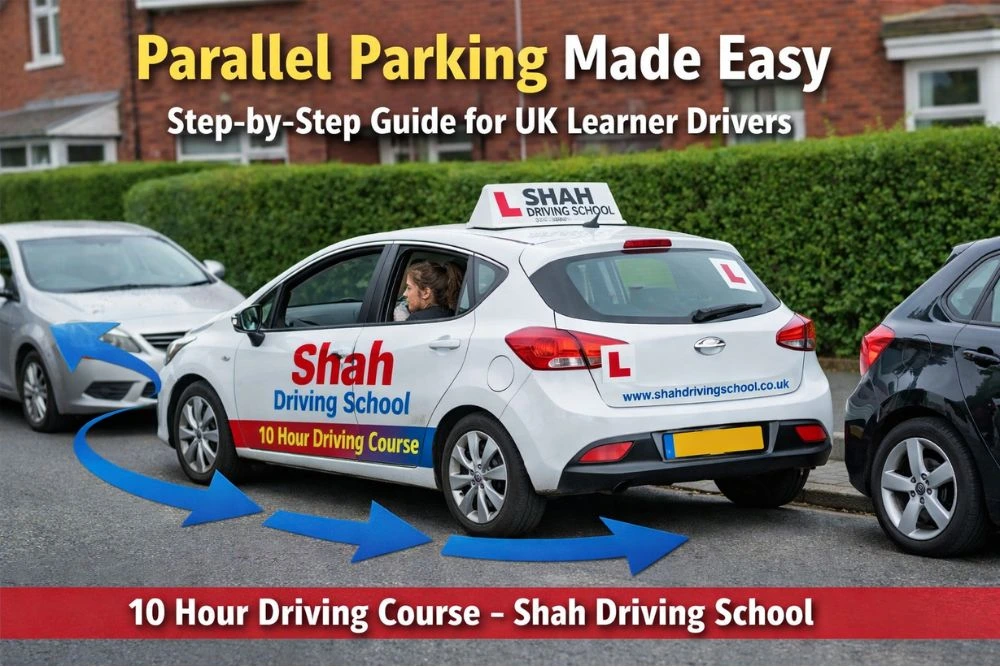
Parallel parking is one of the most nerve-wracking manoeuvres for UK learner drivers, yet it is also one of the most practical skills you will ever learn behind the wheel. Whether you are preparing for your driving test or simply want to feel more confident on real roads, mastering this technique will genuinely change the way you approach parking in busy towns and cities across the UK.
The good news is that parallel parking is not as complicated as it first appears. With the right guidance, a clear sequence of steps, and a little practice, most learner drivers can get to grips with it far sooner than they expect. This guide walks you through everything you need to know, from choosing the right gap to pulling away cleanly at the end.
Parallel parking means positioning your vehicle in a space along the side of the road, parallel to the kerb, between two other parked cars. It requires a combination of steering control, observation, and spatial awareness.
In the UK driving test, you may be asked to complete a parallel park as one of your assessed manoeuvres. According to GOV.UK, examiners assess whether you can carry out the manoeuvre safely, under control, and with reasonable accuracy. Failing to manage it can contribute to a serious or dangerous fault, so understanding the process properly matters.
Beyond the test itself, parallel parking is a genuine everyday skill. Many UK town centres, residential streets, and city roads rely almost entirely on parallel parking spaces. The sooner you become comfortable with it, the more independent and capable a driver you will feel.
A common question among learner drivers is how large a gap needs to be before it is usable. As a general guide, you need a space that is roughly one and a half times the length of your own vehicle. So if your car is around four metres long, you ideally need a gap of at least six metres.
This is not a rigid rule, however. More experienced drivers can manage tighter spaces, but as a learner, giving yourself plenty of room reduces pressure and helps build confidence.
It is also worth noting that parking too close to junctions, pedestrian crossings, or bus stops is illegal and dangerous. The Highway Code sets out clear rules about where you must not park, and these apply regardless of how good the space looks.
Aslo Read: First Time on a Motorway After Passing Your Test: A Beginner’s Safety Guide
Before you attempt the manoeuvre, assess the gap carefully. Drive slowly past it and use your judgment. Is it long enough? Are there any hazards nearby such as dropped kerbs, fire hydrant markings, or yellow lines? Always check road signs for parking restrictions before committing.
Once you have identified a safe space, signal left and pull up alongside the car in front of the gap. Position your vehicle parallel to that car, roughly half a metre away from it, and align your rear bumpers so they are approximately level with each other.
This positioning is crucial. If you are too far forward or too far back at this stage, the rest of the manoeuvre becomes noticeably harder.
Before you start reversing, carry out a full observation routine. Check your mirrors, look over your right shoulder, look over your left shoulder, and be aware of pedestrians, cyclists, and other road users. Continue checking throughout the entire manoeuvre.
The DVSA emphasises that observation and awareness are just as important as the physical steering during a manoeuvre. Examiners are watching where you look, not just where your car goes.
Engage reverse gear and begin moving back very slowly. Control your speed using clutch control or gentle brake pressure. At this stage, keep your steering straight and let the car roll back gradually.
Slow speed gives you time to think, adjust, and respond to anything happening around you. Rushing this step is one of the most common mistakes learner drivers make.
When the rear of your car reaches roughly the middle of the space behind you, begin steering towards the kerb. In most cases, this means turning the wheel briskly to the left. The exact amount of lock you need will depend on your car and the size of the space.
As a guide, when you can see the rear car in your left door mirror and your car begins to angle into the space, you are on the right track.
Once your car is at an angle of roughly 45 degrees into the space, steer firmly to the right. This counter-steer brings the front of your vehicle in towards the kerb while straightening your body along the line of the road.
Watch your front right corner carefully at this point. You do not want it to swing out too wide and clip the car in front.
As your car straightens and sits parallel with the kerb, bring your steering back to the centre position. Your aim is to end up roughly 20–30 centimetres from the kerb, which is considered the acceptable distance in the UK driving test.
If you need to adjust, do not panic. Small forward and backward corrections are perfectly acceptable as long as they are done safely and with observation.
Once you are safely in position, apply the handbrake, select neutral, and cancel your signal if it has not done so automatically. Do a final check in your mirrors and over your shoulder before you exit the vehicle, especially for cyclists coming up on your left side.
Read More: Learning to Drive as a Non-Native English Speaker in the UK: Tips & What to Expect
Many learner drivers struggle not because the manoeuvre is impossible, but because of a handful of repeated errors. Understanding these mistakes in advance can save you a lot of frustration.
Moving too quickly is perhaps the single biggest issue. Speed removes your ability to make small corrections, and corrections are often what separates a smooth park from a chaotic one.
Poor observation is another frequent problem. Looking only at the kerb or the gap, rather than checking all around the vehicle continuously, can catch examiners’ attention immediately. It can also create genuinely dangerous situations on busy UK streets.
Starting the reverse from the wrong position is also common. If your car is not correctly aligned alongside the front car before you begin, the angles simply do not work in your favour. Always take the time to get that initial position right.
The UK driving test includes a selection of manoeuvres, and parallel parking is one of those you might be asked to perform. According to GOV.UK, your examiner will ask you to carry out one manoeuvre during the test, chosen from a set list that includes parallel parking, pulling up on the right, and bay parking.
You will not be penalised for making minor adjustments as long as you carry them out safely and with proper observation. The examiner is assessing control, accuracy, and awareness, not perfection on the first attempt.
It is worth practising the manoeuvre in a quiet area first, then gradually moving to busier roads as your confidence builds. Many learner drivers find that parallel parking clicks quite quickly once they understand the sequence and stop trying to rush it.
Yes, it does, and this is something learner drivers do not always consider. A longer car requires a bigger space and earlier steering inputs. A car with a shorter wheelbase is generally more forgiving and easier to manoeuvre.
Power steering also makes a significant difference. Most modern UK cars have power-assisted steering, which means turning the wheel requires much less physical effort. If you are practising in an older vehicle without power steering, you may find the process more physically demanding.
Rear parking sensors or a reversing camera, if your car has them, can be helpful aids. However, the DVSA expects you to be able to complete the manoeuvre using your mirrors and physical observation, so do not rely on technology alone during your test.
Practice in an empty car park first using cones or objects to simulate parked cars. This removes the pressure of real traffic and lets you focus purely on the sequence of steps.
Ask your driving instructor to narrate the first few attempts. Hearing the logic explained in real time, while you are actually carrying out the manoeuvre, tends to accelerate learning far more effectively than reading alone.
Use reference points on your own car. Many experienced drivers use specific visual markers, such as where the rear car appears in the door mirror, as reliable cues for when to steer. Ask your instructor to help you identify the reference points that work for your specific vehicle.
Record your attempts if possible. Even a short video from a safe position can help you see what is happening with your angles and positioning in a way that is hard to judge from inside the car.
How many attempts can you take during a parallel park on a UK driving test?
There is no set limit on the number of attempts. However, each time you adjust, your examiner will be watching for safe observation. Multiple corrections are acceptable if done properly, but they may accumulate minor faults.
What happens if I mount the kerb during a parallel park?
Mounting the kerb during a manoeuvre is likely to result in a serious fault, which means an automatic test failure. Always move slowly enough that you can stop before the kerb if needed.
Is parallel parking harder in a manual or automatic car?
Many learners find it slightly easier in an automatic because they can focus entirely on steering rather than also managing clutch control. However, both are entirely manageable with practice.
Can I fail my test just for the parallel park?
Yes, you can, if you commit a serious or dangerous fault during the manoeuvre. However, minor faults on their own will not automatically result in a fail.
Parallel parking made easy is not just a phrase it genuinely is achievable for any learner driver who takes the time to understand the process and practise it properly. The steps are logical, the technique is learnable, and the confidence that comes from getting it right stays with you throughout your driving life.
Focus on your starting position, take your time with the reverse, steer in the right direction at the right moment, and keep your observations going throughout. Do those things consistently and parallel parking will become second nature far sooner than you might expect.
The roads of UK towns and cities are full of parallel parking opportunities. Once this manoeuvre feels comfortable, you will find that those tight urban spaces no longer feel daunting they just feel like somewhere to park.
Also Read: Read More: The Bolton Driving Test Routes Explained
What is the easiest way to parallel park for beginners?
Start slowly, get your positioning right alongside the front car, and follow the steering sequence step by step. Practising in an empty space first removes pressure and helps build muscle memory quickly.
How close to the kerb should I park in the UK?
Aim for roughly 20 to 30 centimetres from the kerb. The Highway Code advises parking close enough to avoid obstructing traffic without damaging your tyres on the kerb edge.
Do I need to signal when parallel parking in the UK?
Yes. You should signal left to indicate you are pulling over before you begin the manoeuvre, and cancel it once you are safely in the space.
How long does it take to learn parallel parking?
Most learner drivers begin to feel comfortable with parallel parking after several focused practice sessions. Consistency and patience matter more than the number of hours spent.
Is parallel parking on every UK driving test?
Not necessarily. Examiners select one manoeuvre from a set list, and parallel parking may or may not be chosen. However, you must be prepared for it as it could be included on your test day.
“`html id=”faqjsonld07″
“`
WhatsApp us