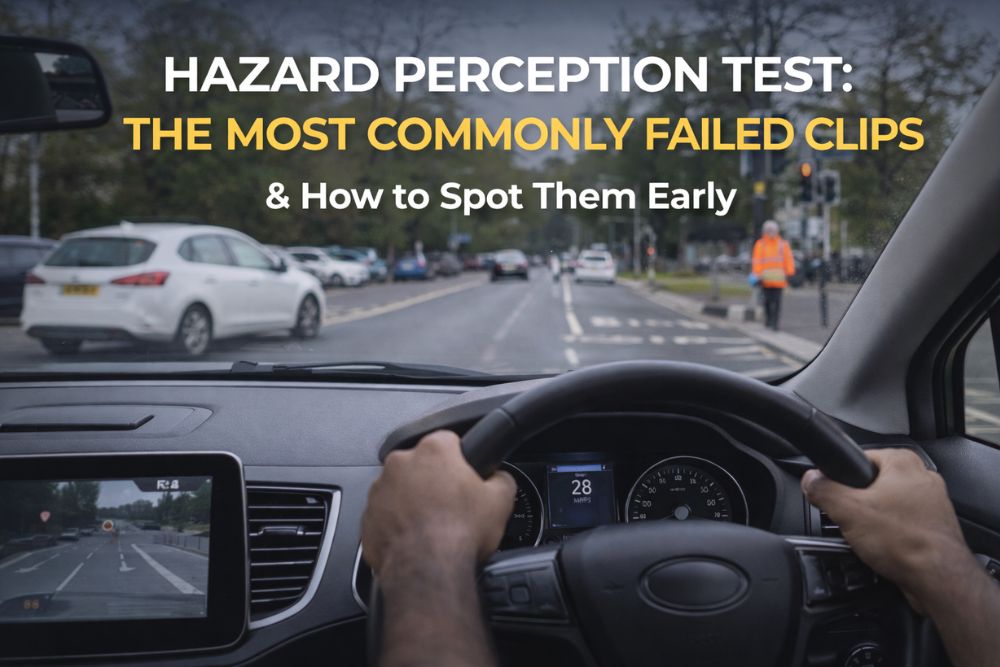
The most commonly failed hazard perception clips catch thousands of learner drivers off guard every year not because they are impossibly difficult, but because most candidates simply do not know what to look for. The hazard perception test is a critical part of the UK driving theory test, and failing it can be frustrating, especially when you feel well prepared. Understanding exactly which clips trip people up most, and why, gives you a real advantage before you sit in that test centre.
What Is the Hazard Perception Test?
The hazard perception test is the second part of the DVSA theory test in Great Britain. It consists of 14 video clips filmed from a driver’s point of view. Each clip contains at least one developing hazard. One of the clips contains two developing hazards. Candidates must click as soon as they spot a hazard developing.
A developing hazard is defined as something that causes you, as the driver, to take action such as changing speed or direction. The earlier you click after the hazard starts to develop, the higher your score. You can score between 0 and 5 for each hazard, and the pass mark is 44 out of 75.
According to the Driver and Vehicle Standards Agency (DVSA), a significant proportion of candidates fail the hazard perception element each year. The reasons are consistent and preventable.
Why Do So Many People Fail Hazard Perception?
Most candidates underestimate this part of the test. They focus the majority of their revision on the multiple-choice section and assume hazard perception is simply a case of clicking whenever something moves. That approach fails.
The test rewards anticipation, not reaction. You must click when a hazard is beginning to develop, not after it has fully formed. Clicking too late scores you nothing. Clicking in a random pattern known as “cheating” by clicking repeatedly also results in a zero score for that clip.
Here are the core reasons candidates struggle:
- They click too late, after the hazard has already developed fully.
- They miss slow-developing hazards that build up gradually over several seconds.
- They panic in busy, cluttered scenes and lose focus on the real threat.
- They click randomly out of uncertainty, triggering the cheat detection system.
- They overlook secondary hazards in the one clip that contains two.
Also Read: Learning to Drive as a Non-Native English Speaker in the UK: Tips & What to Expect
The Most Commonly Failed Hazard Perception Clips
1. The Pedestrian Stepping Off the Pavement
This is arguably the most failed scenario in the entire test. A pedestrian stands near the kerb, often partially obscured perhaps between parked cars or at a junction. Candidates tend to wait until the person actually steps into the road before clicking.
However, the correct response is to click the moment you see the pedestrian near the kerb showing intent to cross. Looking left and right, leaning slightly forward, or moving towards the road edge are all signs the hazard is developing. You must click at that early stage to score maximum points.
2. The Vehicle Pulling Out of a Junction or Side Road
This is another clip that regularly catches candidates out. A car, van, or lorry is visible at a T-junction or side road ahead. The hazard begins the moment the vehicle starts to creep forward not when it actually pulls out into your path.
Many candidates wait for a clear, obvious movement before clicking. By then, the highest-scoring window has already passed. Look for the front wheels beginning to roll, or the bonnet of the vehicle easing forward slightly. That is your cue.
3. The Cyclist or Motorcyclist Changing Position
Cyclists and motorcyclists are disproportionately represented in failed clips. They are smaller, faster, and less predictable than cars. Common scenarios include a cyclist moving towards the centre of the road to pass a parked vehicle, or a motorcyclist accelerating out from behind a queue of traffic.
The hazard starts developing when you first notice the rider’s change in trajectory. Candidates who focus only on the road ahead and miss peripheral movement in these clips consistently underperform.
4. The Child or Animal Running Into the Road
These clips involve a child chasing a ball or an animal darting into the road from a driveway, garden, or pathway. The challenge here is that the movement is sudden and brief. However, the DVSA designs these clips so that there are pre-hazard cues a ball rolling into the road, a child visible on the pavement, or an animal near an open gate.
Spotting and clicking on these anticipatory cues is what earns high marks. Clicking only once the child or animal is in the road earns low marks or nothing at all.
5. The Slow-Moving Vehicle on a Rural Road
Rural road clips are frequently underestimated. A tractor, horse and rider, or slow lorry is visible ahead. The hazard develops as the gap closes and overtaking becomes impossible or dangerous. Many candidates fail to click early enough, waiting until they are almost upon the vehicle.
The developing hazard begins when you realise the vehicle ahead is significantly slower than you, and it is not safe to overtake immediately. Click when you first register this situation not when you are forced to brake.
6. The Pedestrian Walking on a Dark or Wet Road at Night
Night-time and wet weather clips are more challenging because visibility is reduced in the clip itself. A pedestrian may be walking along the side of a road, sometimes in dark clothing, sometimes facing away from the camera. The hazard develops as you approach and the risk of a collision grows.
Candidates often fail because they are waiting for the pedestrian to do something. In these clips, your approach alone is the hazard. Click when the pedestrian becomes a genuine concern for your driving path.
7. The Double Developing Hazard Clip
One clip in every test contains two developing hazards. This is the one that surprises the most people. Candidates who click on the first hazard and then relax often miss the second entirely, scoring zero on it.
Common combinations include a vehicle pulling out of a junction while a pedestrian waits to cross further ahead, or a cyclist swerving while a car doors opens on the left. Keep scanning even after you have clicked once in any clip.
Read More: Top 5 Reasons Why Learner Drivers in Bolton Prefer a Female Driving Instructor
How to Spot Developing Hazards More Effectively
Scan the Whole Scene, Not Just the Centre
Train your eyes to scan the entire frame left verges, parked vehicles, pavements, junctions, and distant bends. Hazards rarely announce themselves in the middle of the screen.
Look for Pre-Hazard Cues
Every developing hazard in the test has cues that appear before the danger fully forms. Look for:
- Movement near the edges of the road
- Vehicles edging forward at junctions
- Pedestrians near the kerb or looking into traffic
- Children, animals, or cyclists near the road
- Brake lights on vehicles ahead
- Road signs indicating junctions, schools, or pedestrian crossings ahead
Use the “What If” Mindset
As you watch each clip, constantly ask: “What if that person steps out? What if that car pulls forward? What if that cyclist changes direction?” This proactive thinking is exactly what the test is measuring, and it mirrors genuine defensive driving.
Time Your Clicks Carefully
Do not click in bursts or repeatedly on a single hazard. One firm, well-timed click per hazard is the correct approach. Clicking five or more times rapidly in a short period triggers the DVSA’s cheat detection and zeroes out your score for that clip.
People Also Ask: Common Hazard Perception Questions Answered
What counts as a developing hazard? A developing hazard is any situation that requires you to take action as a driver such as slowing down, steering, or stopping. It is the early stage of a risk, not the risk itself.
Can you click more than once on a hazard? Yes, but be careful. Clicking multiple times in a short window triggers cheat detection. Click once when you first identify the hazard developing, and once more only if the situation worsens slightly.
How long is the hazard perception test? There is no fixed time limit per clip. The clips play in real time, typically lasting between 60 and 90 seconds each. The full section takes approximately 20 to 25 minutes.
What is the pass mark for hazard perception? The pass mark is 44 out of a possible 75. You must pass both the multiple-choice section and the hazard perception section in the same sitting to receive your theory test certificate.
Do you fail automatically for clicking randomly? Yes. The DVSA’s system detects irregular clicking patterns. If you click without reason in rapid succession, you receive a score of zero for that clip.
Practical Tips to Pass Hazard Perception First Time
Preparation makes a significant difference. Here are approaches that genuinely work:
Use official DVSA practice materials. The DVSA publishes an official hazard perception practice app. The clips are filmed in the same format as the real test, and using them builds genuine familiarity.
Watch real dashcam footage. Viewing real driving footage from YouTube channels or dashcam compilations trains your eyes to spot hazards in authentic conditions not just in test scenarios.
Study the Highway Code. Understanding right of way rules, road markings, and driver responsibilities gives you context for why certain situations are classed as hazards.
Practise on a variety of clip types. Do not just repeat the clips you find easy. Deliberately focus on night driving, rural road, and multi-hazard clips, as these are where most candidates drop marks.
Review your scores by clip, not overall. When practising, identify exactly which clip types score you lowest and target those specifically.
What Has Changed in the Hazard Perception Test Recently?
The DVSA updated the hazard perception test in 2024 to introduce computer-generated imagery (CGI) clips alongside traditional filmed footage. This change was confirmed on the official GOV.UK website. The CGI clips feature animated environments that are designed to present hazards more consistently and without issues related to weather, lighting, or camera quality.
The scoring system remains the same. The pass mark has not changed. However, the visual style of some clips is now different from older practice materials, which is worth being aware of when choosing revision resources. Always ensure your practice clips are up to date.
Conclusion
Understanding the most commonly failed hazard perception clips gives you a real edge going into your theory test. The key is not speed of reaction it is anticipation. Train yourself to spot the early signs of a developing hazard, scan the full scene rather than the centre alone, and never click randomly out of panic.
The hazard perception test is designed to assess whether you think like a safe driver. If you approach your revision with that mindset, you will not only pass the test you will build skills that genuinely protect you on the road.
Frequently Asked Questions
- How many clips are in the hazard perception test? There are 14 clips in total, one of which contains two developing hazards, giving 15 scoreable hazards overall.
- What score do you get for clicking at the right time? Each hazard is scored from 0 to 5. A score of 5 means you clicked at the earliest possible point as the hazard began developing.
- Can I pause or replay clips during the test? No. Clips play once in real time and cannot be paused or rewound. You cannot go back to a previous clip.
- How is the cheat detection triggered? Clicking more than a certain number of times within a short window of time in a single clip triggers the DVSA’s automated cheat detection, resulting in a zero score for that clip.
- Are the practice clips online the same as the real test? Official DVSA practice materials closely replicate the real test format. Third-party materials vary in quality, so always verify they are based on current DVSA standards.
“`html
“`
Preparing for your driving test? Learn with experienced instructors at Shah Driving School and build the hazard awareness skills needed to pass your test confidently.
Read More: Automatic vs Manual Driving Licence in the UK: Which One Is Right for You in 2026?