
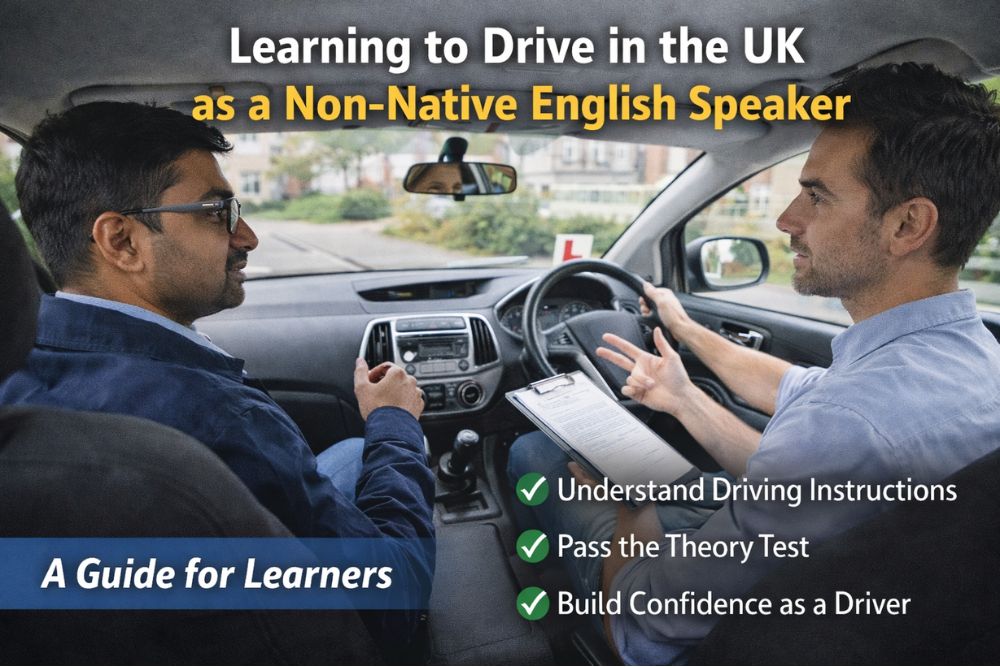
Learning to drive as a non-native English speaker in the UK can feel overwhelming at first but thousands of people do it successfully every year.
Whether you have recently moved from South Asia, Eastern Europe, the Middle East, or anywhere else in the world, the UK driving system is fully open to you. You just need the right information, the right preparation, and a little patience.
This guide walks you through every step of the process from eligibility and theory tests to practical driving lessons and the final test. It also addresses the language challenges you may face and gives you practical tips to overcome them.
Before you book a lesson, it is important to understand who is eligible to drive in the UK. The Driver and Vehicle Licensing Agency (DVLA) sets the rules on this.
You must be at least 17 years old to drive a car in the UK. You must also hold a valid driving licence either a UK provisional licence or a licence from your home country if it qualifies under the UK’s exchange agreements.
You are eligible to learn to drive in the UK if you are:
If you already hold a driving licence from a non-EU country, you may be able to exchange it for a UK licence without retaking the full test. You can check the full list of approved countries on the GOV.UK website.
The UK driving test is split into two separate parts. You must pass both before you can legally drive on your own.
The theory test is a computer-based exam taken at an approved DVSA (Driver and Vehicle Standards Agency) test centre. It has two sections:
The test is available in English by default. However, as a non-native English speaker, you need to pay close attention to how questions are worded. They often use formal UK English phrasing that can be tricky even for fluent speakers.
Here are some practical tips to help you prepare:
Unfortunately, the DVSA does not currently offer the theory test in languages other than English or Welsh. This means language preparation is essential.
The practical test lasts about 40 minutes and involves driving on real roads with a DVSA examiner. The examiner will give you instructions during the test.
As a non-native English speaker, this is where many people feel most anxious. The examiner speaks clearly, but if you miss an instruction, it can affect your performance. Therefore, knowing what commands to expect is very helpful.
Read More: The Bolton Driving Test Routes Explained
Examiners use standard phrases during the test. Familiarise yourself with these:
Practise these phrases with your instructor before the test. Ask them to simulate a full mock test using the exact same language the examiner will use.
Finding the right instructor makes an enormous difference. Look for an instructor who is patient, experienced with learners from different backgrounds, and communicates clearly.
Many non-native English speakers in the UK choose driving instructors who speak their native language. This can be a great help in the early stages, as it removes the language barrier and allows you to focus on learning to drive rather than translating instructions.
However, there is an important consideration. Your practical driving test will be in English. So while bilingual lessons can help you learn faster initially, you should switch to English-only instructions at least a few weeks before your test to get comfortable with the language.
Tips for choosing your instructor:
The UK drives on the left side of the road. If you are from a country where driving is on the right such as India, Pakistan, most of Europe, the USA, or the UAE this will require an adjustment period. It feels unusual at first, but most people adapt within a few lessons.
It is strongly recommended that every learner reads the full Highway Code, which is freely available on GOV.UK. As a non-native English speaker, take notes on any terms or phrases you do not fully understand.
No. As of 2025, the DVSA only offers the theory test in English and Welsh. There is no option for other languages. This means you must develop enough English reading ability to understand the questions and answer options clearly. The good news is that the language used in the test is not highly complex it is practical and direct.
No. The DVSA does not allow interpreters to accompany you during either the theory test or the practical driving test. The examiner gives instructions directly to you, and you must respond accordingly. This makes it essential to practise understanding and responding to driving instructions in English before your test day.
On average, most learners take around 45 hours of professional lessons combined with additional private practice before passing the practical test. The total time from starting lessons to getting your full licence varies many people take between three to twelve months depending on how often they practise.
Yes, it can definitely help. Experienced drivers often need fewer lessons than complete beginners. However, you still need to learn UK-specific rules, left-hand driving, and the UK’s particular road culture. Do not assume that driving experience from another country means you are ready to take the UK test without lessons the style and standards are quite different.
It depends on where you are from and your residency status. If you are visiting the UK, you can usually drive on a valid foreign licence for up to 12 months. However, if you become a resident, the rules vary. Some nationalities can exchange their licence directly without testing; others must go through the full UK test process. Check the GOV.UK website for your specific country’s rules.
It is important to budget carefully before you begin. Here is a realistic breakdown of the costs involved as of 2025:
All fees listed above are set by the DVLA and DVSA and are available on the GOV.UK website. Always book your tests directly through the official GOV.UK portal to avoid being overcharged by third-party booking sites.
Test anxiety is completely normal. However, for non-native English speakers, there is an added layer of stress what if you do not understand an instruction? What if you mishear the examiner?
Here is something reassuring: you are allowed to ask the examiner to repeat an instruction once. The examiner will say it again clearly. This is perfectly acceptable and will not count against you. So if you miss something, simply say, ‘Could you repeat that, please?’ and the examiner will oblige.
Other strategies to reduce test anxiety include:
Once you pass your practical test, you will receive a pass certificate on the day. Your full UK driving licence will arrive by post from the DVLA within a few weeks.
As a new driver, you should also be aware of the two-year probationary period. If you accumulate six or more penalty points within two years of passing your test, your licence will be revoked and you will need to reapply for a provisional licence and pass both tests again.
In addition, you will need car insurance before you can drive alone. As a new driver, insurance can be expensive. Therefore, it is worth comparing quotes across multiple providers using comparison websites such as Compare the Market or MoneySuperMarket.
Also Read: Top 5 Reasons Why Learner Drivers in Bolton Prefer a Female Driving Instructor
Learning to drive as a non-native English speaker in the UK is entirely achievable. The process is well-structured, the resources are widely available, and the driving community in the UK is genuinely diverse.
The key is preparation. Understand the language used in the theory test. Familiarise yourself with the examiner’s instructions. Find a patient and clear instructor. And most importantly, give yourself enough time to learn properly rather than rushing the process.
Driving in the UK opens up genuine freedom the ability to travel independently, commute more easily, and explore the country at your own pace. That freedom is absolutely worth working towards.
Good luck with your lessons. Take it one step at a time, stay consistent, and you will get there.
Also Read: First Time on a Motorway After Passing Your Test: A Beginner’s Safety Guide
Yes, you can still apply without one, though you will need to provide other valid identification. The DVLA application on GOV.UK lists the accepted identity documents.
The hazard perception test is video-based with no reading required, so language is less of a barrier here. Practise using free online mock tests to build confidence.
There is no limit on the number of attempts. You can rebook your theory or practical test after each failure, though you must wait at least three working days to rebook the practical test.
Yes. All paid driving instructors must be an Approved Driving Instructor (ADI) registered with the DVSA. You can verify any instructor’s status for free on the GOV.UK website.
Yes, but you must be accompanied by a qualified driver who is at least 21 years old and has held a full UK licence for at least three years. You must also display L-plates (red letter L on white background) on the vehicle.
“`html
“`
WhatsApp us