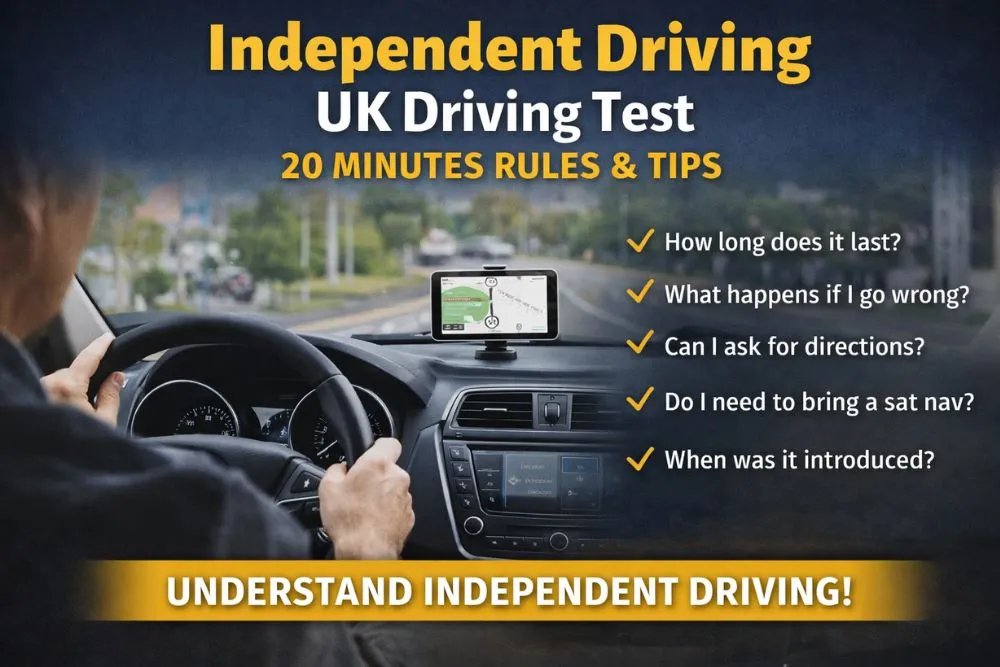

If you’re preparing for your practical test, understanding the independent driving test UK section is one of the most important steps you can take. Introduced by the Driver and Vehicle Standards Agency (DVSA) in 2010 and significantly updated in December 2017, independent driving now makes up around 20 minutes of your practical driving test that’s roughly half of the entire assessment.
Many learners feel nervous about this part. However, once you understand exactly what examiners are looking for, it becomes far less daunting. This guide breaks down everything you need to know, clearly and practically.
Independent driving is a section of the UK practical driving test where you drive without turn-by-turn instructions from the examiner. Instead, you follow either a sat nav or a series of traffic signs on your own.
The purpose is straightforward. The DVSA wants to assess whether you can make real-world driving decisions independently, just as you would after passing your test. It mirrors everyday driving situations rather than simply following an instructor’s prompts.
It does not test whether you know the route. If you go the wrong way, the examiner will not mark you down for it unless you commit a driving fault in the process.
The independent driving section lasts approximately 20 minutes. This forms a significant portion of the test, which runs for around 40 minutes in total.
Before December 2017, this section ran for only 10 minutes. The DVSA extended it to give examiners a more realistic picture of a candidate’s natural driving ability.
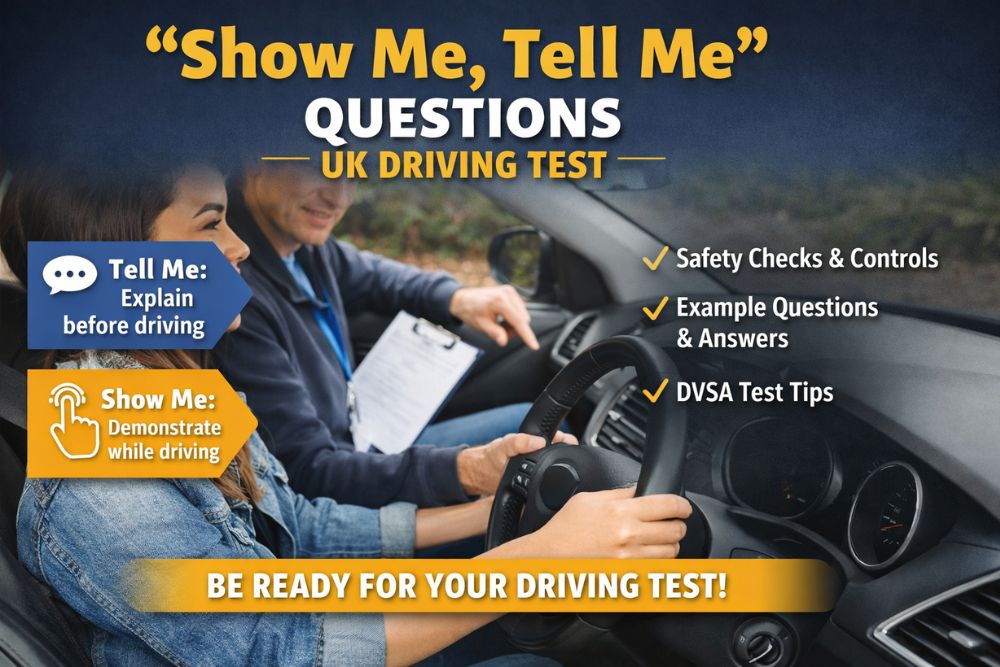
Read More: Understanding the “Show Me, Tell Me” Questions in the UK Driving Test
Since December 2017, the majority of practical driving tests use a portable sat nav for the independent driving section. The DVSA confirmed that around four in five tests now use this method.
The examiner will set up the sat nav and place it on the dashboard. You simply follow the directions it gives you, just as you would when driving to an unfamiliar destination.
The DVSA uses a TomTom sat nav during the independent driving section. The device provides both voice instructions and on-screen directions.
You are not expected to memorise any route. If the sat nav loses signal or gives unclear instructions, the examiner will step in and provide directions. There is no penalty for this whatsoever.
Yes, absolutely. If you miss an instruction from the sat nav, you can ask the examiner to clarify. This will not affect your result. The examiner is there to support you with route information they are not assessing your memory.
In some test areas, or in roughly one in five tests, the examiner will ask you to follow road signs to a given destination rather than using a sat nav.
For example, they might say: “I’d like you to follow the signs for the town centre.” You then drive to that destination using the signs available on the road.
This approach is particularly common in areas with reliable, well-signed routes. It tests your ability to scan the road environment and respond to directional information in real time.
During the independent driving section, the examiner observes your overall driving behaviour. They are not solely focused on whether you follow the route correctly.
They look at how you handle junctions, roundabouts, and lane changes. They also assess your use of mirrors, speed management, and how safely you respond to other road users.
In short, they want to see confident, safe, and lawful driving. Minor navigation errors will not cause you to fail.
A driving fault (previously called a minor fault) is recorded when you make a small error that does not pose immediate danger. You are allowed up to 15 driving faults before failing the test.
A serious or dangerous fault such as pulling out without checking your mirrors, or cutting up another vehicle will result in an immediate test failure. These can occur during any section, including independent driving.
Also Read: The Best Quiet Spots in Atherton and Bolton to Practice Your Driving Manoeuvres
Understanding where candidates go wrong helps you avoid the same pitfalls.
Missing a turn and panicking is one of the most common issues. If you miss a turning, stay calm. Do not brake suddenly or make an unsafe manoeuvre. Simply continue driving safely the sat nav or examiner will redirect you.
Speeding up to follow signs is another frequent error. Some learners accelerate to keep up with directions. Always maintain a safe, legal speed regardless of what the signs are showing you.
Forgetting routine observations can also happen. Under pressure, some candidates neglect their mirror checks or fail to signal properly. Your normal driving habits must continue throughout this section.
The best way to prepare is to practise driving without constant guidance from your instructor. Ask them to give you a destination and let you find your own way there.
Also, get comfortable using a sat nav. Many learners have limited experience with them, particularly in reading the screen while maintaining road awareness. Practise this skill in low-pressure conditions first.
In addition, spend time driving on a variety of roads including town centres, dual carriageways, and residential areas. The more varied your experience, the more confident you’ll feel when the examiner sets the sat nav.
No. Independent driving is one section within the wider test. You will still complete Show Me Tell Me questions, a reversing manoeuvre, and general driving before or after this section.
If you make a mistake during independent driving, it does not carry over to the rest of the test. Each part is assessed on its own merits.
Once the independent driving section ends, the examiner will resume giving you directions as normal. You will complete the remainder of the test under their direct guidance.
At the end of the test, they will drive back to the test centre and invite you inside for your result. They will explain any faults clearly, regardless of whether you pass or fail.
Can you fail the driving test just for the independent driving section? Yes, if you commit a serious or dangerous fault during this section, you will fail the test. However, taking a wrong turn alone will not cause a failure.
Do all test centres use a sat nav for independent driving? The vast majority do. The DVSA confirmed that around 80% of tests use a sat nav. A small number of test routes rely on traffic sign navigation instead.
What if you can’t see the sat nav screen clearly? Tell the examiner before the test begins. They can adjust the position of the device. If you have a visual impairment affecting screen use, speak to your test centre in advance to arrange appropriate adjustments.
Is independent driving the hardest part of the test? This varies by candidate. However, many learners find it manageable once they stop worrying about the route and focus on their driving behaviour instead.
Read More: The 2026 DVSA Rule Change: What Bolton Learners Need to Know Now
The independent driving section is a fair and realistic assessment of how you’ll perform as a newly qualified driver. It is not a trick or a trap. The DVSA designed it to reflect real driving conditions, and with the right preparation, most candidates handle it confidently.
Focus on your driving fundamentals, stay calm if you miss a direction, and trust your training. If you drive safely and lawfully, the route really does not matter.
It lasts approximately 20 minutes, making it around half of the total practical test duration.
No. Taking a wrong turn does not result in a fault, as long as you do not make an unsafe driving error while doing so.
Yes. You can ask for clarification on directions at any point, and this will not affect your test result.
No. The examiner provides a DVSA-approved sat nav. You do not need to supply any equipment.
It was introduced in October 2010 and extended from 10 to 20 minutes in December 2017 by the DVSA.
WhatsApp us