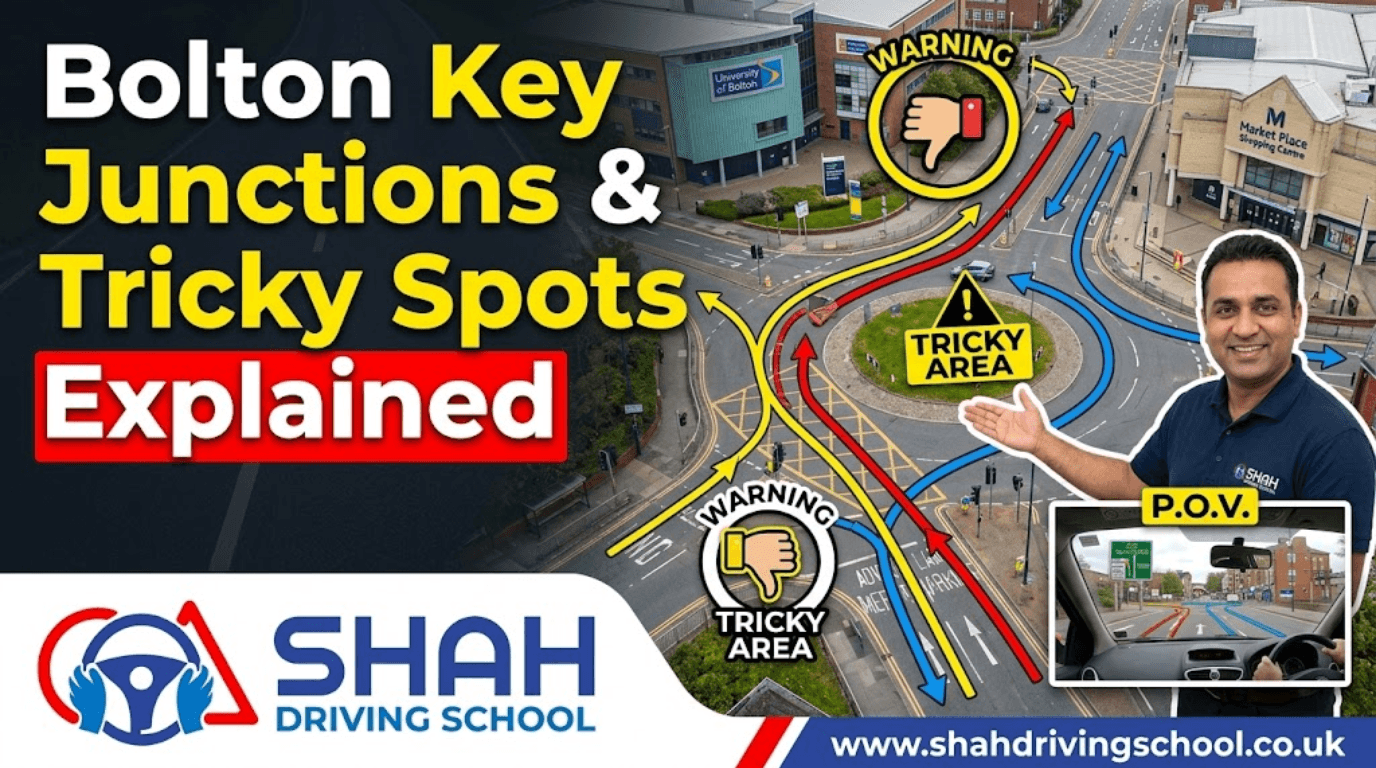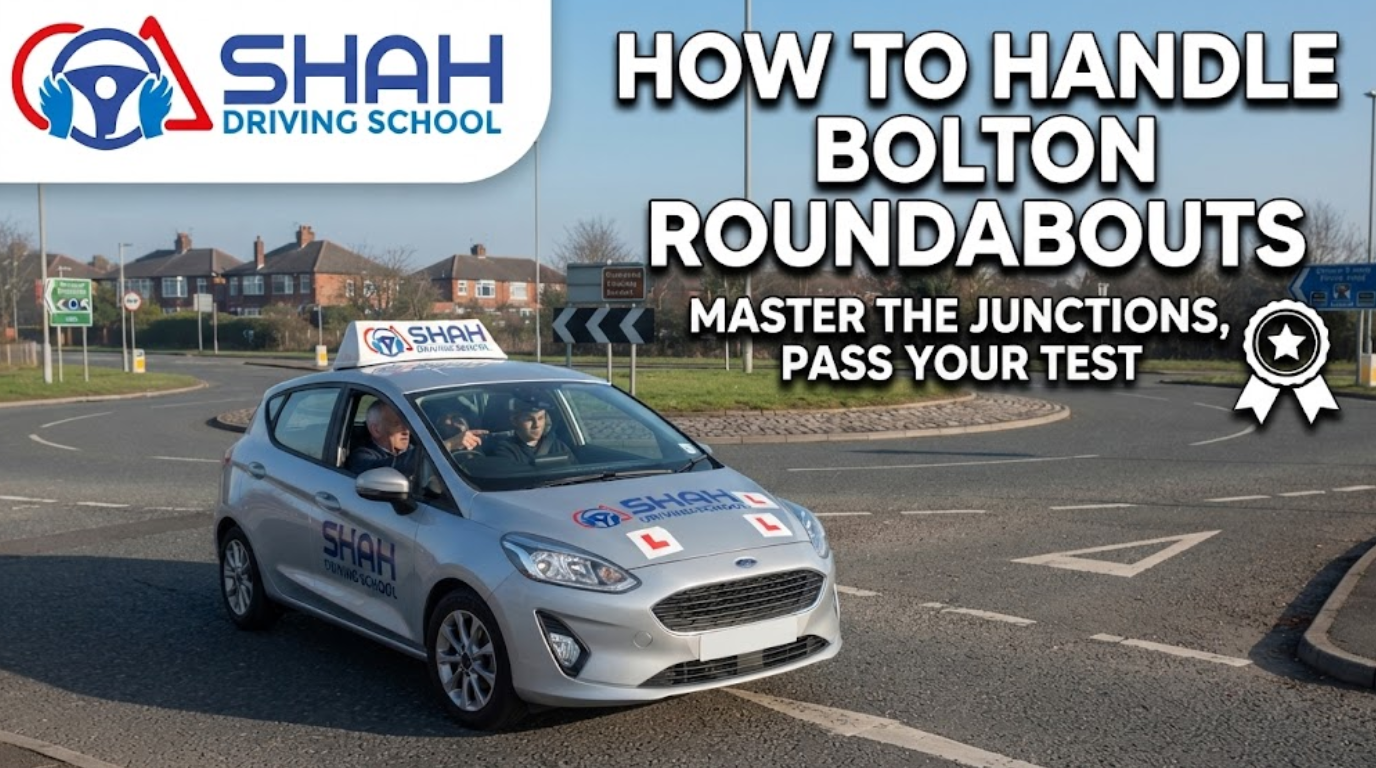
Knowing how to handle Bolton roundabouts is one of the most critical skills any learner driver in the area needs to master before sitting their practical driving test. Roundabouts are responsible for a significant proportion of test failures at both Weston Street (Bolton) and Atherton Gibfield Park test centres — not because they are impossible, but because most learners simply have not been taught to approach them with a clear, repeatable system.
This guide gives you that system — built around the specific roundabouts you will actually encounter on your test routes, with the exact techniques Bolton driving instructors use to prepare learners for first-time passes.
Whether you are taking driving lessons in Bolton for the first time or preparing for a re-sit after a roundabout-related failure, this is the most locally specific, technically complete resource available.
Why Roundabouts Cause So Many Test Failures in Bolton and Atherton
The DVSA publishes national data on the most common practical test failure reasons each year. Observation at junctions — which includes roundabout errors — consistently sits at the top of that list. In Bolton and Atherton specifically, the roundabout network is varied and demanding enough that underprepared candidates encounter familiar roads and still make costly errors.
The reasons are consistent and specific:
- Wrong lane selected on approach before reaching the give way line
- Lane drift mid-roundabout, crossing white lane boundary lines
- Missing the exit signal — failing to indicate left before leaving
- Left mirror and blind spot not checked before exiting
- Hesitating at a safe gap — waiting unnecessarily and recording a hesitation fault
- Cutting across lanes on exit rather than following road markings cleanly
Every single one of these faults is entirely preventable with the right preparation on the right local roads.
The Highway Code Framework — Your Starting Point
Before focusing on Bolton’s specific roundabouts, every learner must have the Highway Code rules completely internalised.
Highway Code rules 184 to 190 govern roundabout behaviour in full. The core rule is non-negotiable:
Give way to traffic already on the roundabout, approaching from your right.
This single rule eliminates the most dangerous roundabout errors. You do not yield to vehicles approaching from other entries — only to those already circulating on the roundabout to your right.
Beyond the priority rule, Highway Code rules establish:
- Signal left when taking the first exit; no signal approaching for a straight-ahead exit; signal right when going around more than halfway
- Signal left after passing the exit before your intended one — not at your own exit, but after the one before it
- Use the most appropriate lane throughout and give way to cyclists on your left when exiting
These rules are not guidelines. Examiners at Weston Street and Atherton assess compliance with all of them throughout every test.
The Complete Roundabout System — Step by Step
Shah Driving School and experienced driving instructors across Bolton use a systematic approach to roundabout navigation that applies to every roundabout regardless of size, complexity, or traffic volume.
Step 1 — Read the Road Signs from 100 Metres Back
Begin processing direction signs and road markings from at least 100 metres before the give way line. Identify your exit number or destination name. Never arrive at a roundabout without knowing which exit you are taking.
If you are not certain of the exit, slow down gradually and allow more time. A legal, controlled late decision is far safer than a hurried lane change.
Step 2 — Select Your Lane Early
Lane selection must be completed before you reach the give way line — not during the final approach. The standard lane selection rules:
Left lane: First exit; straight ahead (typically second exit) where road markings confirm; any exit in the left half of the roundabout.
Right lane: Any exit requiring you to travel more than halfway around; third exit or beyond at a standard four-exit roundabout.
Critical rule: Road markings always override the standard guidance. At many Bolton roundabouts — particularly the Middlebrook system and the Chequerbent approach — specific lane markings differ from the standard allocation. Read and follow painted arrows and text.
Step 3 — Set Your Signal Correctly Before the Give Way Line
- First exit (left): Signal left on approach. Maintain throughout.
- Straight ahead: No signal on approach.
- Third exit or beyond (right): Signal right on approach. Maintain until passing the exit before yours, then signal left.
This sequence is one of the most commonly failed elements among Bolton learners. It must be drilled until it is automatic — not consciously constructed during the approach.
Step 4 — Observe Before Emerging
At the give way line, look right. Is there any vehicle approaching on the roundabout? If yes — give way. If the roundabout is clear, emerge smoothly at an appropriate speed for your lane and intended exit.
Check right again as you edge forward if your initial sightline was restricted. Never assume a roundabout is clear from a stationary position back from the line.
Step 5 — Navigate by Road Markings, Not by Other Vehicles
Once on the roundabout, follow the lane markings — not the car in front. At spiral roundabouts particularly, following another vehicle rather than the markings is the primary cause of mid-roundabout lane crossings that generate serious faults.
Trust the painted road surface. It is specifically designed to guide you from your entry lane to your exit without any lane changes, provided you entered correctly.
Step 6 — Signal Left, Check Mirrors and Blind Spot, Then Exit
As you pass the exit before your own, signal left. Check your interior mirror, then your left exterior mirror, then your left blind spot. Only then move toward your exit lane.
The left blind spot check is the most frequently missed element in Bolton test failures. Cyclists and motorcyclists remain in the left lane throughout roundabouts. Missing this check when one is present constitutes a serious fault.
Bolton and Atherton’s Most Important Roundabouts — What You Need to Know
Our driving test preparation courses specifically address every significant roundabout on the Weston Street and Atherton Gibfield Park test route networks. Here are the ones that demand the most specific preparation.
The Chequerbent Roundabout — A6/A579 Junction, Westhoughton
The Chequerbent Roundabout is the most notorious junction in the entire Bolton and Atherton test area — and the one that catches the most underprepared candidates from both test centres.
Sitting at the junction of the A6 and A579, with motorway connections from junction 6 of the M61, Chequerbent combines:
Multiple simultaneous vehicle streams arriving from three distinct road types at varying speeds. The skill of reading speed differentials between arriving vehicles and judging safe gaps accordingly must be developed through specific, repeated practice at this junction — not theoretical understanding.
Queue traffic on the A6 Bolton approach during peak hours. Manual learners face continuous slow-speed clutch management at a slight incline. Automatic learners face continuous brake-and-creep observation. Both groups benefit enormously from having driven this approach in multiple traffic conditions before test day.
Complex exit configurations — the exits toward Bolton, Leigh, Westhoughton, and the M61 diverge in quick succession. Lane selection from 100 metres back — reading the approach signage early — is the only reliable solution.
For learners taking automatic driving lessons specifically, Chequerbent’s queue approach is one of the strongest arguments for the automatic vehicle choice. Without clutch management consuming cognitive bandwidth in slow-moving queue conditions, all attention goes to gap observation and roundabout assessment.
The Middlebrook and Macron Roundabout System — Horwich, BL6
The Middlebrook retail park area near Horwich hosts one of the most complex roundabout systems in the Bolton area — multiple roundabouts in close proximity, each with several exits, high retail traffic volumes, and approach lane configurations that differ from the standard allocation.
The specific challenges here:
Exit proximity — consecutive exits appear in quick succession, requiring precise exit signal timing and swift mirror and blind spot checks.
Retail pedestrian traffic — significant pedestrian crossing activity on the approach and exit roads demands continuous observation beyond the roundabout itself.
Approach lane marking complexity — the Macron/Middlebrook roundabout approach lanes are specifically marked and must be read from the correct distance to allow confident, clean lane selection.
Learners on test routes from Weston Street heading northwest encounter this system regularly. Those who have driven every exit configuration in lessons consistently outperform those encountering it for the first time under examination pressure.
The Atherleigh Way Roundabout System — A579, Atherton
For learners sitting their test at Atherton Gibfield Park, the A579 Atherleigh Way roundabout system is the most significant preparation priority.
The A579 connects Leigh to the west with Atherton town centre to the east, passing through several roundabout junctions that demand:
- Lane discipline at 40mph approach speeds — arriving at roundabouts from a faster road character requires earlier lane selection and more deliberate speed reduction than urban roundabout approaches
- HGV interaction — the A579 carries commercial traffic. Understanding the wider swept path of large vehicles at roundabouts, and maintaining safe position relative to them, is specifically covered in test preparation sessions at Atherton
- Multiple exit configurations — the Atherleigh Way system includes roundabouts with more than four exits. Learners who have driven every combination perform significantly better under examination conditions
Bolton Town Centre Gyratory — Trinity Street Area
The gyratory road system around Trinity Street in Bolton town centre presents learners with a specific set of challenges that standard roundabout training does not automatically address:
Bus lanes — operational hours bus lane restrictions exist on several Trinity Street approach and exit roads. Entering a bus lane during restricted hours is recorded as a serious fault. Knowing the operational hours and lane boundary positions is essential knowledge for any learner on a Weston Street test route heading toward the town centre.
Multi-lane priority decisions — the gyratory’s multi-lane configuration demands early lane selection, consistent lane-holding through the system, and exit positioning that follows markings precisely.
Pedestrian crossing density — the town centre approaches carry heavy pedestrian traffic. Continuous observation beyond the immediate traffic picture is essential throughout.
Spiral Roundabout Markings — The Feature Most Learners Don’t Understand
Several Bolton and Atherton roundabouts incorporate spiral marking systems — continuous lane boundary lines on the roundabout surface designed to guide you from entry to exit without requiring any lane change.
Most learners either:
- Ignore the markings and follow the vehicle ahead — which often leads to a lane change when the vehicle ahead takes a different exit
- Misread the markings and brake mid-roundabout to re-read them — which creates a hazard for following traffic
The correct approach is straightforward: select the correct approach lane for your exit, enter the roundabout, and follow the painted lane boundary on the roundabout surface from entry to exit. If you entered correctly and follow the markings, you will arrive at your exit without crossing any white lines.
Shah Driving School and other experienced Bolton instructors practise spiral roundabouts at quieter times first — with explicit commentary on the marking system — before introducing normal traffic volumes.
Specific Pre-Test Preparation Recommendations
For learners approaching their test date at either Weston Street Bolton or Atherton Gibfield Park:
Drive every significant roundabout on your test route network at least five times in lessons before your test date — from every significant approach direction, at varying traffic levels. Five repetitions build familiarity. Fifteen build instinct.
Complete a full mock test on real test routes before your actual examination. The mock test reveals which specific roundabout elements are still generating faults — giving you targeted practice time before the real test.
Know your exit before you move. The single most effective habit to develop is making the exit decision before the 100-metre board rather than at the give way line. Everything else — lane selection, signal, speed — follows from knowing where you are going with time to prepare.
Our intensive driving courses in Bolton include specific roundabout preparation sessions on the actual test route roundabouts — including the Chequerbent, Middlebrook, and Atherleigh Way systems — with at least one full mock test before your examination day.
For the complete official DVSA guidance on what examiners assess throughout your practical test, see the DVSA’s official driving test guidelines.
Frequently Asked Questions: How to Handle Bolton Roundabouts
1. What is the most common roundabout fault at Weston Street Bolton test centre?
The most frequently recorded roundabout fault at Weston Street is incorrect lane selection on approach — choosing the wrong lane for the intended exit before reaching the give way line. The second most common is failing to check the left mirror and blind spot before exiting, particularly relevant where cyclists are present. Both are directly addressed in structured lesson programmes on real test route roundabouts.
2. Do I have to signal at every roundabout on my Bolton driving test?
Not always. For a straight-ahead exit, you do not signal on approach. You signal left only after passing the exit before your intended one, while still on the roundabout. For a first exit, signal left on approach. For a third exit or beyond, signal right on approach, then switch to left after passing the preceding exit. Incorrect signalling — including signalling too early for a straight-ahead exit — is a recorded minor fault.
3. Is the Chequerbent Roundabout always on the Atherton or Bolton driving test?
No specific route is predetermined or guaranteed. However, the Chequerbent junction area and approach roads appear on test routes from both Weston Street and Atherton Gibfield Park with enough regularity that every learner from the western Bolton and Westhoughton area should be fully prepared for it regardless of whether it appears on their specific route. Underprepared candidates who encounter it unexpectedly are at significant risk of a serious fault.
4. What are spiral roundabout markings and do I need to understand them for my test?
Spiral roundabout markings are continuous lane boundary lines on the roundabout surface that guide you from your entry lane to your exit without requiring a lane change. Several Bolton and Atherton area roundabouts incorporate them. Understanding how to follow them — entering the correct lane and trusting the markings throughout — is important test preparation. Learners who follow other vehicles rather than the markings frequently drift lanes and record serious faults.
5. Can I fail my Bolton driving test for hesitating at a roundabout?
Yes — if your hesitation involves waiting at the give way line when a clearly safe gap was available, an examiner can record this as a hesitation serious fault. The key word is “clearly safe” — examiners do not expect candidates to pull out into insufficient gaps. What they assess is whether you emerge promptly when a genuinely safe gap exists. Developing accurate gap judgement through repeated practice on real Bolton test route roundabouts — including the A579 and A6 corridor approaches — is the most effective preparation for this specific assessment point.
All Highway Code references and DVSA test standards are accurate as of June 2026. For official government guidance on learning to drive in the UK, visit GOV.UK — Learning to Drive.