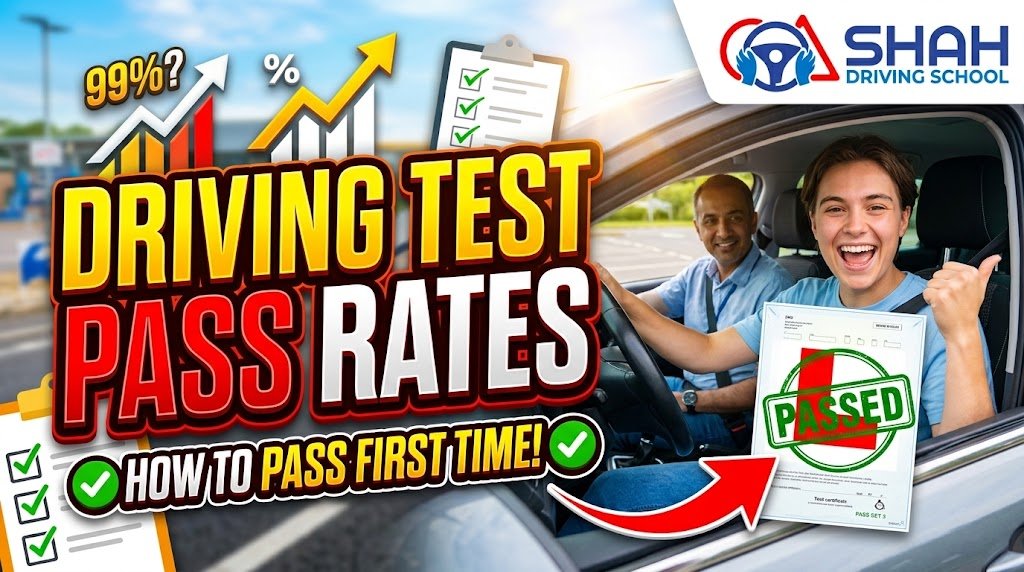
When booking a practical exam, almost every learner searches for official driving test pass rates to gauge what challenge lies ahead. Driving test statistics can feel daunting, particularly when national headlines highlight long test waiting lists and strict examiner criteria.
However, raw numbers only tell half the story. A pass rate is not a lottery ticket or a predetermined roll of the dice; it is a statistical reflection of candidate preparation, local road networks, and adherence to The Official Highway Code.
At [INTERNAL LINK: https://shahdrivingschool.uk/ | Shah Driving School], we train learners across Bolton, Atherton, Leigh, Westhoughton, Horwich, and Wigan to perform well above statistical averages. In this comprehensive guide, we dissect the latest official DVSA driving test statistics on GOV.UK, break down local test centre results across Greater Manchester, and reveal the exact driving faults you must avoid to secure your full pink driving licence on your very first attempt.
Understanding UK Driving Test Pass Rates: National vs Regional Trends
Across Great Britain, the national average practical driving test pass rate typically hovers right around 48% to 50%. That means roughly one in every two driving tests conducted by the Driver and Vehicle Standards Agency (DVSA) results in a pass.
Yet, when you zoom into regional and local data, wide variations emerge. Historically, remote Scottish highland centres can register pass rates as high as 70% to 80% due to single-track roads and low traffic density. Conversely, congested inner-city London and central Birmingham test centres frequently struggle to cross 35% to 40%.
Greater Manchester presents a fascinating middle ground. Its unique mix of historic industrial layouts, busy ring roads, modern motorway links, and pedestrianised urban hubs means that pass rates vary significantly even between test centres located just a few miles apart.
Bolton Driving Test Pass Rates: Why Weston Street Defies the Odds
The Bolton driving test centre, situated on Weston Street (BL3 2AW), is one of the most popular test locations in the North West. Interestingly, Bolton regularly records some of the strongest figures in the entire Greater Manchester conurbation.
Bolton Average Pass Rate: Consistently between 54.0% and 56.7%.
Comparison to National Average: Bolton performs roughly 4% to 7% above the UK median.
Why Does Bolton Score So High?
Many learners wonder why Bolton outpaces neighbouring urban hubs like Cheetham Hill, Bury, or Rochdale. The answer lies in the diversity of Bolton’s road infrastructure:
Balanced Route Variety: Bolton test routes provide a clean distribution of urban driving, quiet suburban residential streets (such as Great Lever, Daubhill, and Deane), and dual carriageways.
Predictable Arterial Links: Routes frequently incorporate St Peter’s Way (A666) and Manchester Road. While fast-moving, these roads feature clear overhead signage and well-established lane structures compared to chaotic inner-city gyratories.
Structured Local Tuition: Dedicated training through structured | manual driving lessons in Bolton equips learners to navigate Bolton’s steeper hill starts (around Astley Bridge and Chorley Old Road) and multi-lane roundabouts with composure.
Atherton Driving Test Pass Rates: Navigating Gibfield Park
Located roughly four miles south of Bolton, the Atherton test centre on Gibfield Park Avenue (M46 0SU) serves candidates from Atherton, Leigh, Westhoughton, Hindley, and Wigan.
Atherton Average Pass Rate: Typically ranges between 44.0% and 49.9%.
Comparison to National Average: Atherton tracks slightly below or right on par with the Great Britain average of 50.0%.
The Key Challenges at Atherton Test Centre
The slight dip in Atherton’s pass rates compared to Bolton is directly tied to specific local hazards:
Industrial Park Exits: Gibfield Park Avenue itself sees substantial commercial traffic, HGVs, and delivery vans. Moving off from the test centre requires immediate precision and continuous 360-degree observation.
Mini-Roundabout Sequences: Atherton and neighbouring Leigh feature dense clusters of double mini-roundabouts. Failing to assess right-of-way correctly or hesitating excessively at these tight junctions accounts for a significant percentage of driving faults.
Rural-to-Urban Transitions: Routes often transition rapidly from 50 mph rural connecting roads into tight 20 mph or 30 mph residential zones, catching out candidates who fail to adjust their speed proactively.
Comparing Driving Test Pass Rates Across Greater Manchester
To put your local test centre into perspective, examine how official DVSA data compares across neighbouring test centres in Greater Manchester and Lancashire:
| Driving Test Centre | Typical Overall Pass Rate | Driving Environment | Relative Challenge Level |
| Bolton (Weston Street) | 54.6% – 56.7% | Mixed suburban, residential, dual carriageway (A666) | Moderate / Balanced |
| Atherton (Gibfield Park) | 44.3% – 49.9% | Commercial estates, country lanes, mini-roundabouts | Moderate / Technical |
| Bury (Manchester) | 38.2% – 38.5% | Dense urban, tram line intersections, complex gyratories | High |
| Cheetham Hill (Manchester) | 40.6% – 46.3% | Heavy inner-city traffic, high pedestrian activity, narrow streets | Very High |
| Rochdale (Manchester) | 35.8% – 38.1% | Steep topography, tram crossings, complex ring-road systems | Very High |
| Chorley (Lancashire) | 57.3% | Open bypasses, rural routes, modern town roundabouts | Favourable |
| Great Britain (National) | 48.7% – 50.0% | Countrywide statistical baseline | Baseline Benchmark |
(Data derived from consolidated DVSA testing and operational statistics.)
As the data illustrates, choosing Bolton or Atherton places you in a far more favourable testing environment than tackling inner-city centres like Rochdale or Bury. However, your personal preparation remains the decisive factor.
Manual vs Automatic Driving Test Pass Rates: Breaking Down the Data
One of the most persistent debates among learners is whether to test in a manual or an automatic car. You might expect automatic pass rates to be significantly higher because there is no clutch pedal to master and stalling is virtually impossible.
The published DVSA figures reveal the opposite:
UK Manual Driving Test Pass Rate: Approximately 50% to 51%
UK Automatic Driving Test Pass Rate: Approximately 42% to 44% (and in some urban centres, under 38%)
Why Are Automatic Pass Rates Statistically Lower?
This statistical paradox is not caused by the car itself; it stems from candidate habits and preparation timelines:
Underestimating the Test: Because modern automatic cars are mechanically effortless to drive, many learners rush to book their practical test before developing mature observational skills, road sense, and hazard anticipation.
Cognitive Distraction: While you do not have to change gears, you are evaluated against the exact same DVSA criteria for lane positioning, speed compliance, roundabout lane discipline, and independent navigation.
Over-reliance on Vehicle Aids: Automatic drivers sometimes become complacent with pedal creep or hill-hold assist, forgetting to apply the handbrake when paused for extended periods or failing to perform physical shoulder blind-spot checks.
When delivered with proper professional rigour, taking automatic driving lessons in Bolton allows you to channel 100% of your cognitive focus into hazard perception and road positioning, easily surpassing the national average.
Why Driving Test Pass Rates Dip: The Top 5 DVSA Faults
According to official DVSA fault logs, over 80% of test failures across the UK stem from the same ten recurring errors. In Bolton and Atherton, examiners repeatedly record serious faults in these top five areas:
1. Inadequate Observation at Junctions
This is the single most common reason candidates fail their driving test nationwide.
The Fault: Emerging onto a major road (such as joining Wigan Road or pulling out onto Manchester Road) without looking both ways thoroughly, or forcing an approaching vehicle to brake or change direction.
The Fix: Treat every give-way line with deliberate care. Check right, left, and right again. Never let creeping peer pressure make you pull out into an insufficient gap.
2. Incorrect Mirror Use When Changing Direction
Checking mirrors is not a tick-box ritual; it must inform your driving actions.
The Fault: Moving left toward the kerb to park without checking the passenger door mirror for cyclists, or changing lanes on the St Peter’s Way dual carriageway without checking the side mirror and blind spot.
The Fix: Always execute the Mirror-Signal-Manoeuvre (MSM) routine in strict chronological sequence. Check interior and door mirrors before you indicate, never while you are already steering.
3. Lack of Steering and Lane Control
The Fault: Cutting corners when turning right into side streets, drifting across lane dividers on multi-lane roundabouts, or swinging wide when turning left out of junctions.
The Fix: Look further ahead down the road. Your hands naturally guide the steering wheel where your eyes are focused. Follow spiral roundabout arrows precisely and stay centered in your marked lane.
4. Poor Positioning at Junctions and Roundabouts
The Fault: Sitting in a left-turn-only lane at a roundabout when your route requires going straight ahead, or failing to position to the left of the centre line when turning right.
The Fix: Read overhead gantry signs and road surface markings well before reaching the junction. If you realise you are in the incorrect lane, do not cut across traffic. Continue safely in your designated lane; examiners will not fail you for taking the wrong exit, provided you do so safely and legally.
5. Inappropriate Speed and Response to Traffic Signs
The Fault: Driving at 30 mph through newly implemented 20 mph residential zones around Bolton schools, or driving dangerously slow (crawling at 25 mph on a 50 mph bypass) when road and weather conditions are clear, demonstrating unnecessary hesitation.
The Fix: Regularly scan for speed limit repeaters and circular signage. Match your speed progressively to the limit and prevailing traffic flow without rushing.
How to Beat Average Driving Test Pass Rates on Your First Attempt
You do not have to be a victim of statistics. Thousands of learners pass their test in Bolton and Atherton every year by adopting a methodical, evidence-based training process:
1. Complete Realistic Mock Tests
Driving with your instructor under full test conditions—without advice, radio, or casual conversation—is the single best inoculation against test-day nerves. Mock tests expose hidden weaknesses under authentic pressure, allowing you to rectify them before an examiner ever steps into the car.
2. Clock Up Adequate Tuition Hours
The DVSA recommends an average of 45 hours of professional tuition supplemented by roughly 22 hours of private practice. Attempting to sit a practical test after only 15 or 20 hours is the leading reason why first-time pass rates suffer. Quality instruction builds muscle memory that holds steady even under intense examination pressure.
3. Consider an Intensive Training Course
If long gaps between weekly lessons cause you to forget key reference points, our structured intensive driving crash courses condense the learning journey into focused, continuous days. Learning daily cements vehicle control and route familiarity rapidly.
Frequently Asked Questions (FAQs)
What is the current driving test pass rate in Bolton?
The overall practical driving test pass rate at the Bolton test centre on Weston Street is approximately 54% to 56.7%. This places Bolton comfortably above the Great Britain national median of 50.0%, making it one of the highest-performing test centres in Greater Manchester.
Why is the pass rate at Atherton slightly lower than Bolton?
Atherton’s pass rate averages between 44% and 49%. This is primarily due to its testing environment, which features immediate exits onto commercial industrial estates, complex sequences of double mini-roundabouts in Leigh, and rapid transitions between country bypasses and narrow residential roads.
Do driving examiners have a secret quota for how many people they pass?
No. This is an enduring myth. DVSA driving examiners do not have pass or fail quotas. If every single candidate on a given day drives safely, follows the Highway Code, and incurs no serious or dangerous faults (and no more than 15 driving faults), every candidate will pass.
Does taking your test in an automatic car make passing easier?
Mechanically, automatic cars are simpler because they eliminate gear shifts and clutch control. However, national DVSA statistics show that automatic pass rates (around 42%–44%) are actually lower than manual pass rates (around 50%). Passing requires identical observational standards, hazard perception, and road safety discipline regardless of gearbox type.
Turn the Statistics in Your Favour with Shah Driving School
Ultimately, driving test pass rates represent historical averages—they do not define what you are capable of achieving. With the right instruction, clear reference points, and deep familiarity with local Greater Manchester test routes, you can approach your practical test with complete calm and walk away with your full licence.
At Shah Driving School, our team of fully qualified, DVSA-approved male and female driving instructors provides patient, results-driven coaching tailored to your individual learning pace.
Ready to secure your pass certificate?
Call or WhatsApp: 0749 0662 777
Visit online: shahdrivingschool
Book your manual, automatic, or intensive driving lessons in Bolton, Atherton, Leigh, Westhoughton, Horwich, or Wigan today!