
Roundabout lane discipline in Bolton is the single most common source of driving test faults at Weston Street and Atherton test centres — and the area where even well-prepared learners most frequently let themselves down on test day. Shah Driving School’s instructors have prepared hundreds of Bolton learners for the specific roundabout challenges on local test routes, and this guide gives you the complete technical framework — lane selection, spiral markings, signalling sequences, observation habits, and examiner assessment points — that consistently produces clean, confident roundabout driving under examination conditions.
This is the technique guide that complements our local Bolton roundabout location guide — covering not just which roundabouts are challenging, but exactly how to handle every roundabout scenario you will encounter on your Bolton driving test.
The DVSA publishes annual data on driving test fault categories — and observation at junctions, which includes roundabout errors, consistently ranks as the number one cause of serious faults at test centres across the UK. At Bolton’s Weston Street test centre, roundabout-related faults account for a disproportionate share of test failures — not because the roundabouts are uniquely difficult, but because most learners simply have not received specific, systematic instruction on lane discipline technique.
The specific roundabout faults that Shah Driving School’s instructors most consistently see recorded at Weston Street and Atherton include:
Every single one of these faults is preventable with the right technical understanding and sufficient practice on real Bolton roundabouts. This guide addresses each one directly.
🔗 GOV.UK — Driving Test Faults: What Counts as Serious or Dangerous
Before lane discipline, signalling, and spiral markings can be meaningfully discussed, one foundational rule must be completely instinctive: give way to traffic already on the roundabout, approaching from your right.
This rule is established in Rule 185 of the Highway Code and applies to every roundabout in the UK regardless of size, marking pattern, or traffic volume.
🔗 Highway Code — Rules 184–190: Roundabouts
In practice, this means:
This sounds straightforward. Under examination pressure, with vehicles approaching from multiple directions simultaneously, it requires the automatic, unthinking application that only comes from systematic practice on real Bolton roundabouts.
Correct lane selection on the roundabout approach is determined by your intended exit — and it must be made early enough that you are not changing lanes in the final metres before the give way line.
The standard rule for lane selection at a two-lane approach is:
Left lane — for exits in the left half of the roundabout (first exit, second exit if the roundabout is oriented so that exit is broadly ahead-left)
Right lane — for exits in the right half of the roundabout (exits requiring you to go around more than half of the roundabout — typically the third exit onwards or any exit that requires passing more than two exits)
Straight ahead — for exits directly ahead (typically the second exit at a standard four-exit roundabout), use the left lane unless road markings specifically direct otherwise
However — and this is critical — road markings always override the standard rule. Many Bolton roundabouts have specific approach lane markings that differ from the standard allocation. Reading and following the painted arrows and text in your approach lanes is always the primary reference. The standard rule is the fallback only where markings are absent or unclear.
Approach lane markings in Bolton typically include:
Shah Driving School’s Bolton instructors specifically train learners to read these markings from at least 100 metres back — not at the final approach. Reading late creates rushed, uncertain lane changes that generate serious faults.
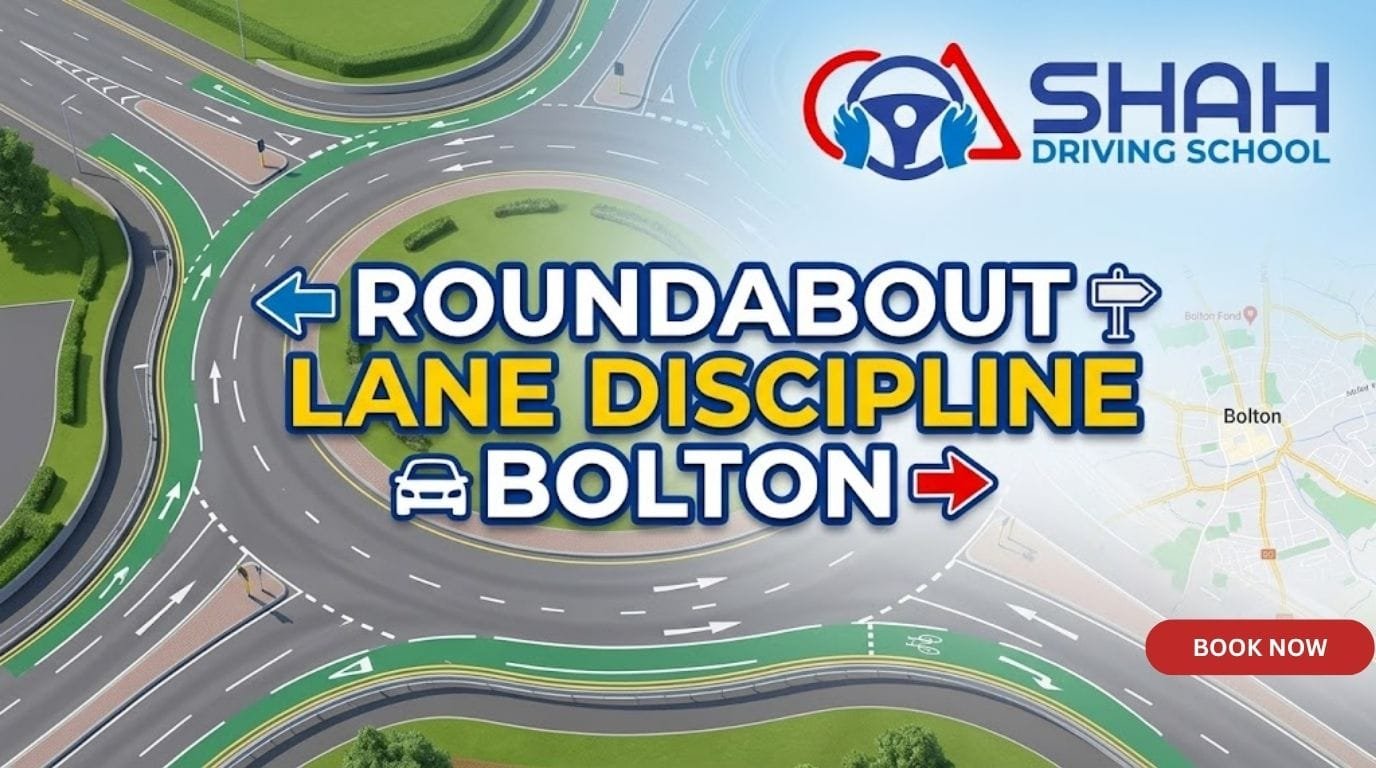
Spiral roundabouts are a specific type of multi-lane roundabout design introduced to reduce lane-changing conflicts on the roundabout itself. Bolton’s busier roundabouts — including sections of the Middlebrook approach system and the town centre gyratories — incorporate spiral marking elements.
The key characteristic of a spiral roundabout is that the lane markings on the roundabout itself guide you from your entry lane to your exit point — without requiring a lane change mid-roundabout. If you select the correct approach lane and follow the road markings on the roundabout surface, you will arrive at your exit without needing to cross any lane lines.
This design eliminates the most common mid-roundabout fault — lane drift — for drivers who understand and trust the markings. The problem is that many learners do not understand spiral markings and either:
Shah Driving School’s approach to spiral roundabout preparation is specific: we drive the relevant Bolton roundabouts in lessons at low traffic times with explicit commentary on the marking system, then revisit at normal traffic volumes once the system is understood. By your test, the markings are familiar and trusted — not a source of mid-roundabout confusion.
Incorrect or missing signals at roundabouts are one of the most consistently recorded minor faults in Bolton driving tests — and one of the most easily corrected with specific instruction.
Here is the complete, technically correct signalling sequence for every roundabout scenario:
The most frequently missed signal in Bolton driving test conditions is the exit signal — signalling left to indicate you are about to exit. The timing rule is:
Signal left as you pass the exit immediately before the one you intend to take.
Not when you can see your exit. Not when you have passed it. As you pass the one before it. That timing gives other road users clear, early indication of your intention and gives you the observation time needed to check your mirror and blind spot before moving toward the exit.
Under test pressure, many learners signal either too late — as they are already turning off — or not at all. Shah Driving School’s instructors drill the signal timing specifically on every significant Bolton roundabout until it becomes completely instinctive.
Correct signalling and lane discipline are necessary but not sufficient. Complete roundabout technique requires systematic observation at every stage.
Understanding the general technique is the foundation. Applying it on Bolton’s specific test roundabouts — with their individual layouts, approach marking variations, and traffic characteristics — is what your actual test requires.
The roundabout approaches around Bradford Road and the Great Lever area generate the most consistent lane discipline faults at Weston Street. The road markings are clear — but candidates who have not practised reading them in advance frequently miss the left-turn-only lane designation on certain approaches, generating a serious lane discipline fault within the first minutes of their test.
Shah Driving School preparation: We drive every Bradford Road approach in lessons, with specific instruction on the lane markings at each one, before any learner sits their Weston Street test.
The Trinity Street area incorporates a gyratory system rather than a traditional roundabout — but the lane discipline principles are identical. The bus lane restrictions add an additional observation requirement: candidates must actively identify bus lane operational hours and avoid them accordingly.
Shah Driving School preparation: Bus lane awareness on Trinity Street approaches is a specific lesson element — including the operational hours, the lane boundary markings, and the approach to the stop line that avoids last-minute lane changes.
As covered in our Bolton roundabout location guide, the Middlebrook system near Horwich generates lane confusion through multiple exit proximity. The approach markings are the key — but they require reading from a sufficient distance to make the lane selection before traffic pressure builds.
Shah Driving School preparation: We approach every Middlebrook exit configuration in lessons at reduced-traffic times before introducing the full traffic-volume approach. By test time, every exit feels routine.
Chequerbent’s dual carriageway approach from the A6 creates the specific challenge of arriving at a multi-exit roundabout from a higher speed. Speed reduction, lane selection from the dual carriageway approach, and the give way judgment all need to happen in a compressed time frame.
Shah Driving School preparation: We specifically practise the A6 dual carriageway approach to Chequerbent, including speed reduction timing, approach lane discipline, and the give way observation sequence — all before any learner encounters it under examination conditions.
Why it happens: Late reading of road markings, following the car ahead rather than the signs, or uncertainty about which exit number corresponds to the intended destination.
The fix: Begin reading roundabout approach signs and road markings from 100 metres back. Identify your intended exit before you reach the roundabout, not at it. Know whether your exit is left-half or right-half of the roundabout before you approach — so the marking simply confirms your pre-planned lane rather than directing a last-second change.
Why it happens: Looking at other vehicles rather than road markings, insufficient steering control at the roundabout’s curvature, or anxiety about other vehicles causing involuntary steering adjustment.
The fix: Trust the road markings and steer by them, not by the position of adjacent vehicles. On spiral roundabouts, following the painted lane boundary from entry to exit naturally prevents drift. On standard roundabouts, maintaining your position within the marked lane requires deliberately keeping the lane boundary in your peripheral vision throughout.
Why it happens: Cognitive overload — too many simultaneous demands reducing signal timing to an afterthought.
The fix: Build a mental cue. As you pass each exit on the roundabout, actively count it and check whether it is the exit before yours. When you pass the one before your exit, signal left immediately — not as a considered decision, but as an automatic response to the cue.
Why it happens: Focus on the exit itself rather than the observation sequence required before moving toward it.
The fix: Make the pre-exit check sequence a fixed habit: signal — mirror — blind spot — move. In that order. Every time. The habit must be built in lessons on real roundabouts until it is as automatic as the signal itself.
Shah Driving School’s roundabout lane discipline training in Bolton follows a specific progression that builds genuine competency rather than surface familiarity:
Stage 1 — Technical instruction before driving
Your instructor explains the lane selection, signalling, and observation sequences fully before you drive any roundabout. You understand the system before you execute it.
Stage 2 — Quiet approach roundabouts
Your first roundabout practice sessions use smaller, lower-traffic roundabouts in Bolton’s residential and suburban network — where the consequences of hesitation or lane uncertainty are minimal and correction is straightforward.
Stage 3 — Familiar multi-lane roundabouts
Once your technique is solid on smaller roundabouts, your instructor introduces the multi-lane junctions on Bolton test routes — driving each one multiple times with specific commentary on the marking system, the signal timing, and the observation sequence at each individual roundabout.
Stage 4 — Mock test conditions
In your final preparation phase, all roundabouts are driven in mock test format — no instruction, just your instructor observing and recording faults. The debrief identifies any remaining specific issues before your actual test.
For learners who want to fast-track this progression, our intensive driving courses in Bolton complete all four stages in daily consecutive sessions — reaching roundabout test-standard in days rather than weeks.
For a full breakdown of our intensive preparation approach, read our guide on how to pass fast with Shah Driving School.
🔗 GOV.UK — Book Your Official DVSA Practical Driving Test
Based on Shah Driving School’s experience preparing candidates for Weston Street, the most common roundabout fault is incorrect lane selection on approach — followed closely by missing the left mirror and blind spot check before exiting. Both are directly addressed in our structured Bolton roundabout preparation programme.
Spiral markings are continuous lane boundary lines on the roundabout surface designed to guide you from your entry lane to your intended exit without requiring a lane change mid-roundabout. Select the correct approach lane for your exit, then follow the painted lane boundaries on the roundabout surface. If you stay within your marked lane throughout, you will arrive at your exit correctly positioned. Shah Driving School covers every Bolton roundabout with spiral elements in dedicated lessons.
No — not on approach. For a straight-ahead exit, you do not signal on approach. You signal left after passing the exit before your intended one, while still on the roundabout. This is one of the most commonly misunderstood roundabout signalling rules — many learners either signal left on approach (incorrect) or fail to signal at all before their exit (also a fault). The correct sequence is: no signal approaching — signal left after passing the preceding exit.
Taking a wrong exit due to genuine direction uncertainty is not automatically a test failure — provided you take the wrong exit safely, with correct signalling, lane discipline, and observation throughout. An examiner assesses how you drive, not which route you take. The fault occurs only if you attempt to correct the error with an unsafe manoeuvre — cutting across lanes, reversing, or making an emergency change of direction. If you miss your exit, take the next safe one and continue. Your examiner will redirect you.
Most Weston Street test routes include between four and eight roundabout encounters — ranging from mini-roundabouts in residential areas through to multi-lane junctions on the A666 and Bradford Road corridors. Shah Driving School’s preparation programme ensures you have driven every significant roundabout type on the Bolton test route network before your actual examination day.
Roundabout lane discipline in Bolton is not an innate talent — it is a learned system. Understand the lane selection rules, learn the signalling sequence, follow the road markings, and practise the observation habit until it is automatic — and roundabouts stop being a source of anxiety and become a source of confidence.
Shah Driving School’s Bolton instructors deliver exactly this progression — on real Bolton roundabouts, in real traffic, with specific instruction on every significant junction your examiner might choose. Our 15-hour automatic intensive course includes every major Bolton test route roundabout as mandatory preparation.
📞 Call or WhatsApp: 0749 0662 777
🌐 Book online: www.shahdrivingschool.uk
Ready to master roundabout lane discipline in Bolton and pass your driving test first time? Call Shah Driving School today — and let’s get every roundabout on your test route feeling completely routine.
All Highway Code references accurate as of June 2026. Shah Driving School is a DVSA-registered driving school serving Bolton, Great Lever, Halliwell, Deane, Farnworth, Westhoughton, Horwich, and the wider Greater Manchester area. All instructors hold current ADI certification.
WhatsApp us